8 Steps To Limit Risk in Your Toy Testing Procedures

Categories
Blogs

8 Steps To Limit Risk in Your Toy Testing Procedures

Production competitiveness has become so high in countries like China that suppliers often find ways to cut corners in order to save costs, often putting the quality and safety of your toys, and their extremely vulnerable user base, in jeopardy. When it comes to upholding product safety and compliance, no other consumer goods product is more highly regulated than toys. However, despite stringent requirements and mandatory safety toy testing around the world, unsafe children’s products continue to reach the market today.

As recent as 2017, many importers of the popular ‘fidget spinners’ were found to be selling products in the US that contained alarmingly high levels of mercury and lead leading to mass product recalls and damaged brand reputations.

Non-compliance in the toy industry present a myriad of dangers for brands that can lead to heavy financial losses, unnecessary recalls, and a damaged reputation. It’s reasons like these that quality managers constantly live in fear of quality issues with toys, but it doesn’t have to be this way with strict compliance regulations and proper toy testing procedures.

Improving Your Existing Toy Quality Assurance Processes
Toy quality assurance and toy testing As a quality manager who is responsible for producing toys you know that where quality is concerned the stakes are sky-high. You need to know that toys adhere to the demands of every test they might face when being exported globally to markets with different demands. At API, our quality inspectors and laboratories follow a comprehensive set of 8 toy quality testing steps (built through decades of experience) that helps quality managers effectively manage quality right from the outset. This article will take a brief look at the global toy testing standards themselves, and the step by step procedures API follows to help minimise the risk of quality issues sneaking through and danger of recalls happening, as well as protecting your supply chain and ensuring customer safety and satisfaction.

API’s 8 Step Toy Quality Assurance Process

Click here to watch our comprehensive toy testing process video

1. Preventing Mechanical Risks In The Design Stage

Product Design Specification (PDS) serves as the guideline for understanding the various problems identified early on in the design stage. Possibilities need to be investigated and filtered through various criteria laid out in the PDS to be set forth as practical, viable solutions that require further evaluation.

Through comprehensive design evaluation and hazard assessments, API help you identify potentially dangerous design features and mechanical risks from the outset, helping you save on costly redesign and engineering resources related to product modification, and more serious quality and safety issues later down the line. Furthermore, the evaluation also helps to identify all of the necessary tests that you would need to submit your product to.

2. Preventing Toxic Risks With Raw Materials Testing

Raw material toy testing to ensure toy quality Raw material quality control is paramount in helping to prevent product failure and ensuring a consistent level of quality that you and your customers expect. Making sure that players in your supply chain are continuously subjected to testing of raw materials being used in your toy production, or when they decide to switch suppliers, verifies that the materials are at the level of quality you’re paying for and that no toxic elements such as lead and cadmium finding their way into your finished product. Complying with chemical restrictions in raw materials laid out by the EU and US chemical content regulations such as REACH, EN71 and CPSIA starts with chemical testing. API’s laboratories help to identify toxic elements that can aid you in defining a list of approved materials to be used in the toy production process early on, ensuring your products comply with the limits set for safe use now and into the future.

3. Evaluating Toy Safety Before Mass-Production Through Prototype Testing

The practical solutions and tests identified in the design evaluation stage are embodied in the form of a prototype. The aesthetics, functionality, mechanical aspects, as well as the potential manufacturing issues are all considered, and these aspects need to be thoroughly tested. API’s technical experts are part of technical committees that discuss and write standards for toys, and can ensure you are up to date on the latest developments and discussions on regulation before new regulations are officially published. API’s Hong Kong Laboratory is accredited by HOKLAS to perform laboratory testing for the European, American and Australasian markets. The three main areas of testing are:

1) ‘Mechanical and Physical Properties’

  • Drop Test
  • Compression Test
  • Torque Test
  • Tension Test
  • Flexure Test
  • Bite Test

2) ‘Flammability’

  • Conducted on  toys to examine their flammability characteristics

3) ‘Restricted Substances – Chemical Testing’

  • Lead content test
  • Cadmium content test
  • Phthalate content test
  • Other applicable chemical tests

Prototype testing helps to identify the shortcomings of initial toy design and how they will hold up in real use case scenarios.
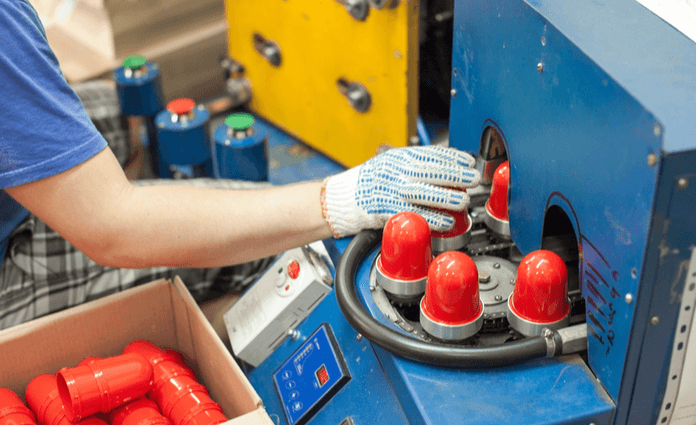
Toy testing at a factory

Evaluate your Factory

Perform a quality management audit with specific points related to toys, such as ensuring that sharp tool equipment and a broken needle policy has been used and properly calibrated. It is also important to ensure that your factory has also established traceability system for identification and tracking materials through production. Through this testing process, API helps you to further refine the product design and remove any obstacles that may detract from the original concept by making it safer for use, and ultimately, preventing the need for costly recalls well before the products hit the production line. On top of this testing process, API are also entitled to issue certificates of conformity as a ‘Notified Body’.

4. Ensuring Compliance Through All Inclusive Compliance Software

Whether your brand is directly or indirectly affected by Directive 2009/48/EC, it is of vital importance to ensure the collection and gathering of all the necessary technical documentation needed from your manufacturer to demonstrate the conformity of the product to the applicable requirements of the TSD.

It is up to your product manufacturer to draw up this technical documentation, or request it from relevant parties, and keep it and the EC declaration of conformity for a period of 10 years after the toy has been placed on the market. It is up to you as the importer to ensure that the manufacturer fulfills this duty, that the toy bears the required conformity marking, and is accompanied by the required technical documents. These documents must be made available to national surveillance authorities upon request for the same period of time to demonstrate conformity of the toy. Technical documentation to be drawn up and collected must be presented in one of the official languages in the EU and shall include: 1. Description of the design and manufacture 2. List of components and materials 3. Safety data sheets 4. Safety assessments 5. Conformity assessment procedure 6. EC declaration of conformity 7. Addresses of manufacture and storage 8. Documents submitted to a Notified Body 9. Test reports 10. Conformity of series production details 11. EC-type examination details 12. Conformity of series production details Today, many manufacturers, importers and retailers are still operating on outdated systems like collecting multiple spreadsheets and files, leading to unreliable data and outdated documentation, which creates an almost insurmountable task of trying to accurately trace and maintain the information for each product reference. API’s Technical Compliance File (TCF) solution is a one process procedure that consists of 5 steps to ensure total product compliance: 1. Expert intervention to define the scope of compliance 2. Document collection 3. Document review 4. TCF report issuance 5. Record keeping and database integration (all available online 24/7)
A solution like this promises increased visibility and transparency into your supply chain that will prove invaluable to optimizing your current quality systems, allowing you the time to mitigate any potential quality risks as and when they become apparent.

5. Monitoring Production Consistency With DUPRO/Inline Inspection

The production line is inspected when at least 25% of the order has been completed. The DUPRO verifies that initial discrepancies found out during an Initial Production Check (IPC) have been rectified.

Each stage of the assembly process will be analysed and samples of the goods in progress will be collected and checked. This means that any impending problem can be identified on-site and addressed at the very stage where it is occurring. By checking unfinished products during production and assessing if AQL standards are being met, API assures that corrective actions can be taken in order to assure the quality of your toys moving forward.

6. Checking and Classifying Non-Conformities Right Before Shipping

API conduct both Final Random Inspections and Loading Check inspections to ensure your products conform and that they are being shipped in a safe and secure manner.

Final Random Inspection

A FRI (Final Random Inspection) is basically an acceptance sampling inspection performed prior to shipment. The Sampling is derived from the inspection level requested in accordance with MIL-STD-105E (ISO2859-1). API is also certified HKIAS which endorses third-party inspection based on an in-house procedure. The sampled goods are then checked piece by piece and the non-conformities found, if any, will be classified into three categories (critical, major and minor). The selection of an AQL (Acceptable Quality Level) per type of non-conformities will determine the acceptance or rejection of the goods.

Sample Collection For Lab Testing

Products randomly picked from mass production for pre-shipment testing which can occur in DuPro or FRI. The test checks the alignment of product quality from mass production and pre-production.

Pre-shipment Testing

The aim of pre-shipment testing is to verify the consistency of the production quality with a focus on critical aspects of the toys, without having to perform the full test again. API provides tailor-made testing solutions based on client requirements to ensure quality is maintained at this stage of the process. Loading check inspections to ensure toy quality
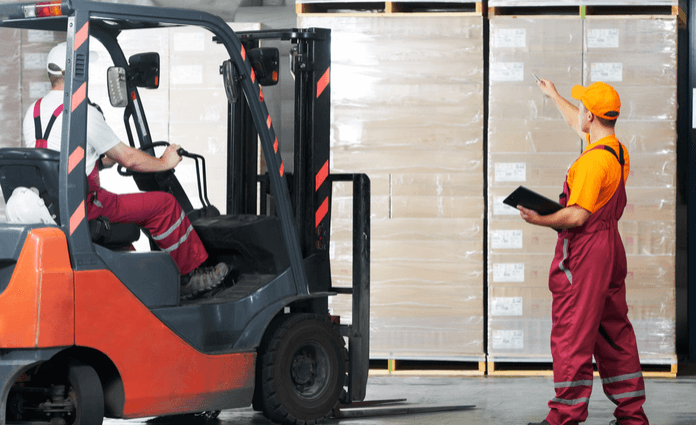
Loading Check Inspections

The loading check serves as a way to control container quantity and to adequately manage stuffing arrangement. API performs inspections of packed goods as they are being loaded into the shipping container to ensure the correct products are loaded, in a secure and safe manner.

7. Taking Quality Assurance Full Cycle With Reorders and Random Sampling

Sample collection for testing during the reorder process is a concept of a highly effective continuous quality improvement monitoring program, helping you determine the frequency of testing per supplier performance. This policy sends a clear message to suppliers that you’re watching their product quality closely, and that any unauthorized product/material change is strictly prohibited, and at the same time encourages them to improve.

8. Business Intelligence Tools

In order to the determine the frequency of sampling per factory, you’ll need a comprehensive vendor scorecard. API have developed its own platform for you that records quality data of each factory’s test and defect levels during inspection.

It also provides you with a comprehensive data analysis on factory performance across your own suppliers and across others in our database that you may not currently be working with. The database record does not simply include just the pass or failure of the product test/ inspection, but also a record and classification of each defect. Through this database we’re able to point out top defects recorded per factory and compare your own suppliers against others in the industry.


Categories
Blogs

5 Global Sourcing Challenges for Hardlines in 2018

Procurement used to manage vendors and negotiate costs. In today’s global sourcing landscape, it’s about so much more; it’s about effectively managing risk, ensuring sustainability, all to the ends of creating a strategic competitive advantage for your brand.

The key to this progression?

Technology.

Technology has been a lead disruptor in many industries. It has enabled a more visible supply chains calling for more effective ways of managing areas of risk and sustainability.

Advancement in this industry comes with its own unique set of challenges, ones that can only be met with innovative strategies, preparation and the adoption of technology to enhance your capabilities.   

As we move into 2018, we move into a new year with new possibilities and new heights to be achieved. But before then, what does the state of retail look like today?

The Current State Of Retail

Over the last couple of years we have seen the shift towards omnichannel retailing, where there is a demand for product to get to the end-user faster than ever before.

Amazon has been leading the charge in this area with their online purchasing systems and same day delivery options. This increase in pace has lead to an increase in pressure on retail supply chains, and that is of course not without its own challenges.

The state of retail research report states that the top three experienced retail supply chain challenges for 2017 are: handling promotions, better collaboration with suppliers and availability without increasing stockholding.

This can be achieved through the automation of your demand forecasting and accurate centralised data tracking will be key as you look to overcoming this year’s challenges.

Successfully addressing your current challenges, lays the foundation for a competitive position in the marketplace with systems already in place to handle the challenges that the new year has to offer.

The future of global sourcing holds as many opportunities as it does new, more complex challenges, a few of which we will take a look at it below.

What global sourcing and procurement challenges can your hardlines retail supply chain expect to face in the future?

Risk management for global sourcing

I list but five of the predicted challenges to arise over the next 10 years:

  • Risk – Over the next 10 years we will see a shift in the way that risk is approached. Currently the risk management approach taken by most quality and procurement professionals has to do mainly with product and regulation compliance. It is predicted that a more holistic approach to handling risk will be adopted.This is predicted to be accomplished through defining new metrics and data points for a fuller, more defined picture, enabling the ability to plan and address risk in a way that has not successfully been accomplished before.  
  • Sustainability – The cost of sustainable supply chains has always been a primary factor for not adopting sustainable approaches to business. The future sees that the role of procurement will move beyond that, and look to creating and sustaining social value. This point cannot go without mention that within the next 10 years we will see the largest sector of our workforce being filled with millenials, who care about sustainable and economic growth. It is predicted that there will be less exploitation of resources with a stronger use and reuse cyclical economy.
  • Collaboration – Collaborative outsourcing will be key to managing the array of everyday supply chain complexities. This will be based on mutual interest and trust leading to a mutually beneficial outcome. In 10 years time, the complexities you are currently experiencing will need to increase as you endeavour to manage multiple vendors at one time. If you are collaborating and building successful relationships with your suppliers, then this will be an easier transition for you.
  • Transparency – Much of the supply chain has nothing to do with the end-user of your product, but with the dawn of social media your role as a quality or procurement professional may need to. The era of social media has brought about transparency like no other, increasing the spotlight on retail brands and their supply chain operations. You will need to ensure that your entire supply chain adopts a “social” mindset which will create a business model that has the brands image at the fore.
  • Information – We are in the age of big data, the success of your supply chain relies on it. You will need to embrace big data through advanced data mining and analysis. We are increasingly finding ourselves in a world driven by data, and this will only increase over time with more access to real-time data tracking and updates. The key is to begin planning for this. Start asking yourself what your data capacity currently is, look at your own data and begin mapping how you will embrace the coming of a bigger data age.  

So, how will these challenges impact you?

So while you are still in the process of building systems to deal with your 2017 challenges as you move into a busy 2018 season, the quality systems you put in place today will form the foundation, the very building blocks of how you are to manage the above mentioned challenges as we journey towards to the future.

Think of it as a road map allowing you to effectively plan for the future.  

The above global sourcing challenges increase your level of supply chain transparency, a holistic approach to managing your risk, but each one of these challenges requires technology to optimise the current and predicted supply chain pace.

The adoption of new technology will mean that more data will be available for analysis, allowing a lot more insight, visibility and transparency into your operations. The more data you have the more effectively you can produce products of the highest quality, and the better you can identify risk early on.

Key Takeaways

After delving into some of the top challenges that retailers came up against in 2017 and as you seek to efficiently plan for 2018, the key will be to improve your current operating systems through clever, more advanced technologies and strategic planning.

So let’s look at some ways that you can begin this process;

  • Automate your forecasting processes – There are technologies and systems that you can adopt to ease this process for your brand. You can use the well reviewed SAS demand forecasting software to help you solve your forecasting troubles; “the combined power of automation, analytics and workflow, you can generate the most unbiased and accurate large-scale demand forecasts.” Resistance to this will only set you back, as your competitors will be doing everything to embrace growth. In adopting technology to automate your forecasting process you will be saving yourself time, a resource that can be used elsewhere.Data tracking for better global sourcing.jpg
  • Data tracking – For store stock levels, online stocks, current distribution centre stocks, predicted future stock levels in distribution centres, finished goods in transit, inventory being shipped from freight forwarders etc. Accuracy in this regard is key and technology can provide that, and do away with human controlled data entries.
  •  
  • Supplier collaboration – Fostering a culture of supplier collaboration will have long term benefits for your brand. While we have all sorts of technology that can be used to aid communication with your supplier, it is often the tried and tested face to face experience that truly allows for an effective and mutually beneficial relationship that is collaborative in nature.

Adopting new technologies and strategies, while you may be resistant at first, will only be if benefit to the optimisation of your supply chain operations, resulting in bottom line benefits for your brand.  

Facing supply chain challenges head on is not easy, but it will require your leadership to embrace the challenge that lies ahead and grasp the opportunity for learning, in order to create a well run and competitive supply chain for your brand.

Let us know in the comments section if you are currently facing these challenges and what you have done to address them?

Categories
Blogs

Humans, Robots & Supply Chain Automation

The rise of things like Blockchain, IoT (internet of things), cryptocurrencies and robots and automation have all been defining disruptors for the retail supply chain over the last few years.

How are supply chains across the globe currently being impacted by the rise of these disruptors?

Are human jobs at risk?

How can your business adapt to utilise these new technologies? 

Answers to all of these questions and more as we take a look into the ‘Four Industrial Revolution’ of modern-day commerce.

The State Of Automation And Its Role In The Retail Supply Chain

The Fourth Industrial Revolution and the emergence of big data, automation, robots and AI have created disruption in the supply chain for many retailers today.

While many retailers have been slow to adapt to the age of digitisation, they have adopted advanced software that has been able to provide them with operational efficiencies and increased data visibility. What I mean by this is that many retail brands have slowly shifted from the age-old manual entry excel spreadsheets to software that can provide accurate, real-time data that is visible to all of their supply chain stakeholders.

So this is where the majority of SME’s (Small, Medium Enterprises) find themselves. 

But…

A rapidly changing, technologically driven retail landscape means that each day an increasing number of robots and AI are integrating themselves into the global retail supply chain operations.

What Supply Chain Operations Are Integrating Robotics?

In understanding what supply chain operations global supply chains are currently integrating with robotics, you can start to imagine how you could begin to digitize your supply chain operations. So let’s dive in;

Warehousing Management – The introduction of robots and wearable technology has been introduced into warehouse management activities allowing for greater efficiencies, minimizing the likelihood of human error.

So what does this look like? 

Amazon is a prime example of automating some of their warehouse activities. They adopted the Kiva system which cost $775 million to put in place. This Kiva system is made of robots that place and stack products all over the warehouse, creating system efficiencies for Amazon as well as reducing overhead expenses. Warehouse management and the retail supply chain

Whilst this is a ghastly amount and likely very unaffordable if you are an SME (Small, Medium Enterprises), there are entry-level robots that are cheaper and can be used to create this kind of efficiency for your operations. The cheaper Baxter robot has an approximated lifespan of about three years and, costs approximately $25,000 is able to work over 2000 hours straight in a plastic factory.

This, as you know, is not a possibility within the human workforce as it is in violation with the social compliance standards as laid out by the SA8000. The level of production efficiencies that can be achieved through automated process are definitely worth your time in research.      

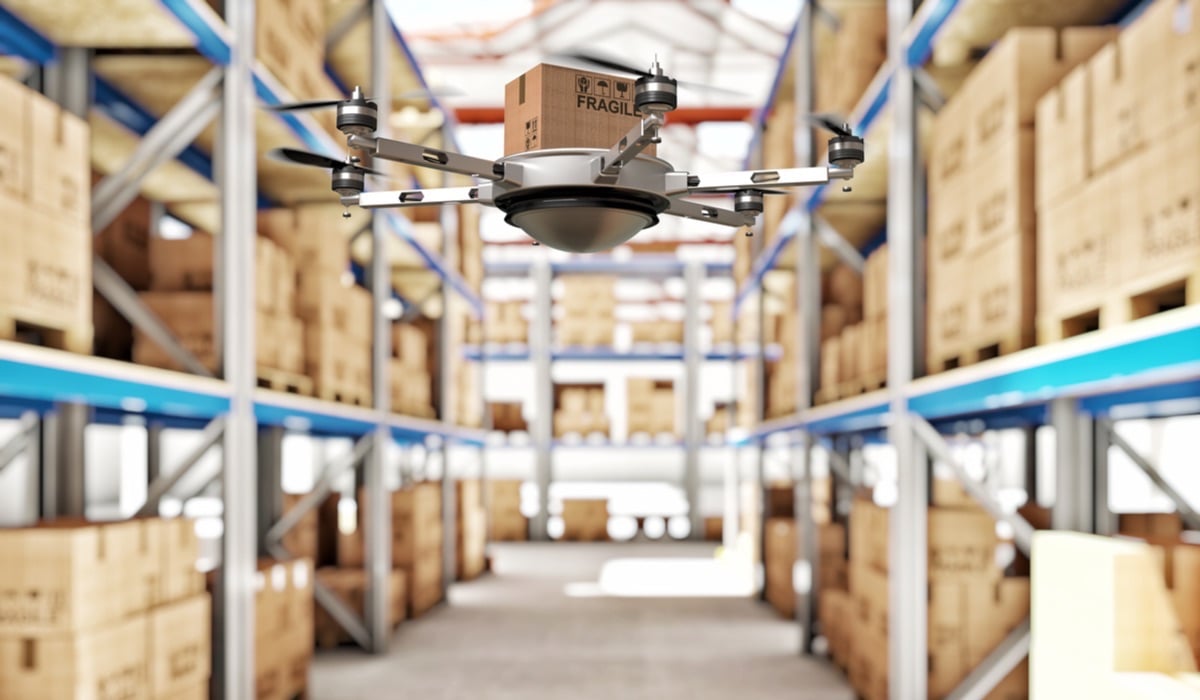
Inventory Management – In June 2016, Walmart began testing the use of drones for better inventory management. Walmart said that it could take up to a month for its inventory to be checked manually, but takes only 24 hours with the use of a drone. The drone flies around the warehouse, scans every items’ barcode, allows for real time data insight and is also able to quickly locate any misplaced items. This not only makes for an efficient inventory management system, but also a well managed warehouse.

The automation of the simpler routine warehouse and inventory systems such as stacking/moving stock around and labeling boxes as per specifications should free up your labour force to spend more time and resources into optimizing your supply chain and its operations for further enhancements and innovation. Robotics and automation should be seen as collaborative for more enhanced and optimised operating systems.   

 These are only two of the examples of where automated robots and technological advancements are currently being applied to supply chain activities, but they are certainly not the only areas that are being technologically transformed. 

Last year the world saw Amazon make the very first drone delivery, an exciting technological advancement in the area of delivery and transportation. This, however also indicates the rapid pace at which retail is moving and transforming.

In order for you to keep up with the likes of a global retailer like Amazon or Walmart, you will need to begin planning for the digitisation of your supply chain. 

So the big question then…

Are Robots And Automation Taking Human Jobs Away?

The number one question much of the retail labour force is asking “Will robots be taking away our human jobs?”

There is absolutely no doubt that with the rise of automated robots and AI that there will be a reduction in the number of labour needed in your retail supply chain;

The production line – Robots can work through the night, doing away with overtime, overworked and underpaid working conditions that often result in social compliance violations.

Automated robots improve the efficiency of the production line, they are able to produce products at a much faster rate than is ever achieved automation and bots in the retail supply chainthrough human labour.

Warehouse and inventory management – Stock can be moved around and stacked up accordingly, inventory can be managed through the flight of a drone with real-time data updates and the ability to trace misplaced inventory. This all helps to create an optimised warehouse and provides near perfect insight into inventory enabling, better stock control and demand forecasting.  

While at this point you may think that I have painted the picture of a robotic, automated retail supply chain, this is not true.

Human labour is still very much needed.

Let me tell you why.

1. Production and supply chain automation is expensive. The initial start up costs may be too much for many smaller retail brands.

2. Robots will need maintenance and calibration – This may require additional training for your current labour force, but this should also be seen as an opportunity in the market for the employment of a higher skilled labour force.

Humans are necessary for the running of your supply chain. “No matter how well encoded your robots are, technology is not advanced enough for the appropriation of human judgment.”  

According to Brandon White of Kenco, “The best solution to introducing AI innovation into the supply chain is a “hybrid” of humans and AI technology working alongside one another.” Adopt an optimistic perspective – robots and automation should enhance productivity and efficiency.

How?

Collaboration. Collaboration with machinery is absolutely necessary to create an efficient technologically advanced supply chain.  

Key Takeaways

So, while robots and AI certainly have a place in the supply chain, humans are still essential for every aspect of the supply chain. However, the current jobs of your existing labour force will have to change to accomodate the age of technology and the efficiencies that it presents.

You will essentially need a higher skilled workforce to work in collaboration with the automation technology that you seek to adopt. You will need people who can calibrate and code higher tech machinery, and you will also need more leadership and HR roles.

You may or may not be feeling the pressure to adopt AI automation into your supply chain, but the reality is, it’s on the horizon. Your customer demands more of you and more of your supply chain. The question is, what are you doing to meet their demands? As we move into the future, your comfort zone may need to be left behind.

Let us know in the comments section how automation, robotics or AI have affected your supply chain. 

avoid unnecessary supply chain complexities with our guide to preventive quality management

Categories
Blogs

Case Study: CQI (Continuous Quality Improvement) Strategy

A CQI strategy should be adopted to provide you with a road map toward improvement of your supply chain activities. It should be designed in such a way that takes your retail brand through the process of data collection, data analysis and a continuous cycle of monitoring of activities for efficiency.In this blog post, we take a look at one of our very own retailers that experienced various supply chain complications, and what we did to help them implement an effective CQI plan that would ultimately reduce their expenses and optimise their quality systems.

A continuous quality improvement Case Study

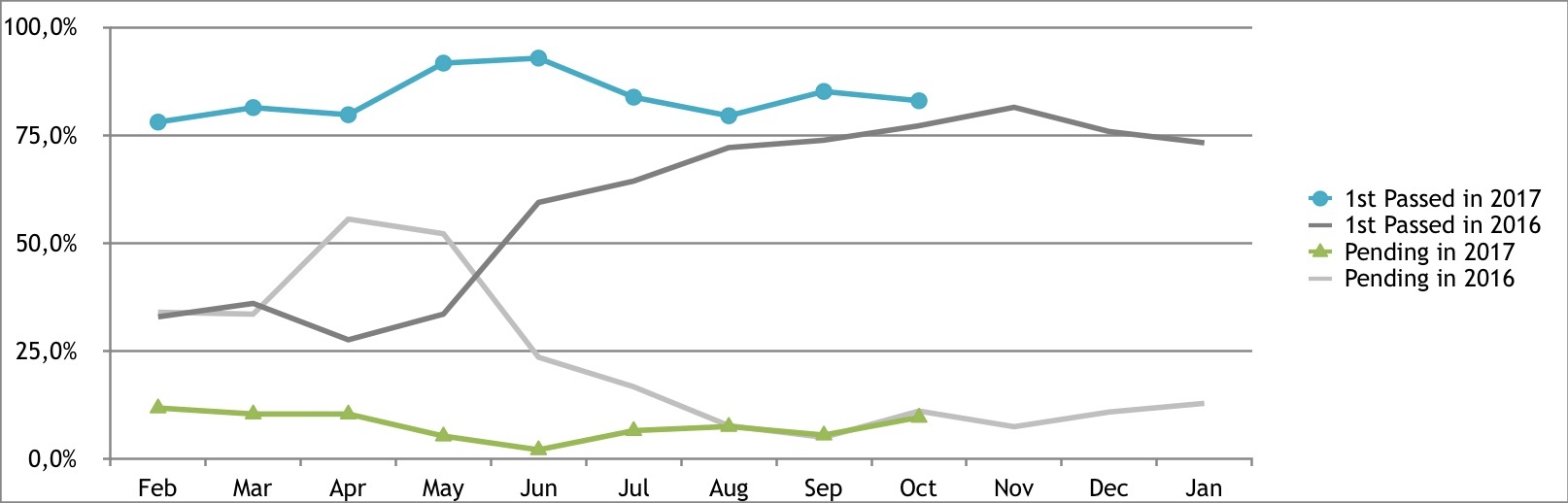
A well known European sourcing company kept finding that 60% or more of their inspection reports failed or were declared pending. As a quality director you will know that a high pending rating slows down your decision making process and directly affects productivity rates. It was at this point the retailer decided to review the problem in a lot more detail; through the services of a third-party quality provider – API.

So, what was API’s approach?

  • We needed to quantify the difficulties that they experienced. We went and recorded all of their product defects and fail or pending reasons for their products. Our inspectors capture all available data which is then entered directly into API’s data capture system. This process allows for data analysis to be done across all inspections or per category/ supplier.CQI

What was the problem?

One of the top reasons for pending products was a discrepancy in information that was found on the shipping mark compared to that of the product specifications.

But, why were these problems experienced?

The retailer had three different coding systems, which made it difficult for the supplier and they often mixed these numbers up.

API was able to find this problem through various stages of data collection and analysis.  API then presented their finding to the management team where it was discussed how to deal with these different coding systems, and what kinds of things should be present on the shipping mark in order to minimise their current supplier confusion.

What solution was implemented?

API was able to identify an opportunity for improvement within the rules and guidelines of the retailer, and the documents were modified to help minimise their suppliers’ confusion. An opportunity was also identified to update the supplier manual to be inclusive of these new modifications, which then needed to be re-distributed to all of the existing suppliers.

As a part of the continuous quality improvement plan it was strongly suggested to consistently monitor the company’s passing, fail and pending rates in order to effectively evaluate levels of improvement as a direct result of the implementation of the plan suggested by API.

What were the results of implementing this CQI plan?

The retailer experienced great success by implementing this solution. They experienced a passing rate that remained mostly over 80% even during peak season. 


CQI graph

After the improvement suggestions were implemented it helped this retailer to significantly reduce their pending and failure rates. In a situation like this, it’s important to note that even though the problem was not directly related to manufacturing, it still required both the quality and merchandising team to implement the changes as suggested by API.


Key Takeaways

Implementing a a continuous quality improvement strategy for your retail brand is essential for production, quality and management effectiveness – without it you will be firefighting problems all along the way. As a part of your strategy you need to be answering these five questions – if you aren’t go back and make sure that you do:

How did your CQI strategy improve;

       1.  Your organisational effectiveness?
       2. Your level of customer satisfaction?
       3. Your levels of compliance?
       4. Your organisational culture?
       5. Your organisation’s documentation?

If you cannot answer those questions definitively you may need to reevaluate your strategy to be more inclusive of addressing them.

Let us know in the comments section below about how you have gone about improving your own quality systems

Ready to begin tackling preventive quality management?

check out our preventive quality management guide to get you started

Categories
Blogs

Put In Place A CQI Strategy For The Festive Season

The festive season is fast approaching and retail stores the world over are seeing an influx of people coming through their doors to purchase essential and luxury items. This time of the year is a very busy (and lucrative) time for most retail businesses, but it also presents an increase in supply chain pressure and demand that can lead to unsatisfied customers if quality becomes an issue.

Quality should most certainly not be a seasonal prerequisite for your brand.

It’s of vital importance that you have a continuous quality improvement (CQI) strategy in place to ensure you have a road map for success to ensure that you deliver, even more so when your supply chain pressure is on.

In this blog post, we look at why you need an improvement strategy, and we will also touch on the seven quality management principles and how they serve as the path to better quality for you, all year round!

Why You Need A CQI Plan For Your Retail Brand;

A CQI plan is meant to form a road map to improving your production activities, which will positively impact your production outputs. It should be designed to take your retail brand through the process of monitoring, data collection and analysis as a part of your daily activities.  

So what Tools Are Commonly Used for improved quality processes?

These tools are not used in isolation of one another, and a lot of the time the tool you choose to select will be situation specific, so you may use a combination of the below mentioned tools;

  • Check Lists – This will need to be prepared ahead of time, and you should look at creating a template and update it regularly. It should be used to collect and analyse all kinds of data relating to your production procedures and operating systems.
  • Brainstorming – This enables a creative environment where ideas are shared in a large group. The key here is to ensure there is no judgment as this will hinder the creative process. The point is to uncover any hindrances to your production process, aCQI strategy and the quality management principles nd this tool should be inclusive of all levels of employees for creative and productive inputs.


  • Benchmarking – Oftentimes benchmarking against industry standards such as ISO 9001 is used in order to compare how your quality systems are lining up accordingly. You need not only benchmark against an industry standard, but if you wanted to you may also benchmark against your competitors.  
  • Root-Cause Analysis –  This is a continuous improvement strategy that is often adopted to get to the root cause of a problem and seeks to permanently eliminate that problem from ever recurring again. There are a number of techniques that can be used as a part of your RCA strategy, and it will be up to your unique situation as to what tool you select.

These tools are only a few of what’s in the arsenal of techniques that can be used to implement a sound improvement plan. You need not only select one tool, you can mix and match to ensure that you find what works best for you.

The 7 quality management principles integral to your CQI plan;

If you are successfully adopting a quality management system, which I shall be bold enough to say that you should be, then you will know that an improvement approach is integrated into each principle of the most popularly used Quality Management System – ISO 9001. So let’s dive into what these principles are;

QMP 1 – Customer focus; How well are you meeting and exceeding your customer’s expectations? Your brand will need to work towards sustained confidence from your customer base

QMP 2 –  Leadership; The creation of unity and purpose with the engagement of employees at all levels will be crucial to how well you are able to align your strategy, quality policies, and production processes to achieve quality objectives.

QMP 3 – Engagement of people; By involving all people at all levels of your organisation you will create opportunities to effectively and efficiently achieve your quality and production objectives.

A CQI strategy for Improved product quality

QMP 4 – Process approach; A consistent approach to your organisation’s interconnected systems and operations produces a set of production results; in understanding how your production results are achieved you are then able to optimise your systems accordingly, ultimately improving your production performance.

QMP 5 – Improvement; Continuous improvement is essential for your organisation to maintain exceptional levels of performance. An improvement focus and strategy allows you to react to changes more efficiently.

QMP 6 – Evidence-based decision making; Decision-making should always be based on evidence and data analysis, this approach is more likely to produce your desired results and outcomes.  

QMP 7 – Relationship management; Successful production of your household goods can often come down to the way in which you manage your relationship with your supplier. Let it be open, communicative and collaborative. This approach has had more success when it comes to that increase in retail supply chain pressures.

These principles are the underpinning guidelines of the ISO quality management systems. When applied correctly they are able to take you towards that continuous performance improvement approach for your entire supply chain.  

The Benefits of Adopting A CQI for your Retail Brand

There are a number of benefits of adopting a continuous quality improvement strategy for your retail brand, ones that should not be ignored if you are to remain a competitor in the retail marketplace.

  • Reducing the number of quality errors – It will help you analyse available data, identify any areas for improvement, or any already existing production problems which will in turn reduce the number of quality errors that arise in your supply chain.
  • You increase your supply chain adaptability – It will ensure that when problems are identified your supply chain knows and understands the changes it needs to make in order to optimise for supply chain efficiencies.
  • Increased productivity – It will enable you to identify existing or potential problem areas within your supply chain, and once identified, you will be able to implement the solution which will increase your productivity outputs.

Key Takeaways

As the festive season has arrived and retail pressures are beginning to surmount to what seems like you will never get through it, rest on knowing that everything you have implemented up until now will work in your favour.

Your own continuous quality improvement strategy should include;

  • A variety of tools and techniques; such as brainstorming and checklists
  • You will also need to intimately understand the 7 quality management principles if you are to implement a successful strategy
  • If you are questioning why, don’t; there are production and quality benefits as well as those much needed bottom line benefits.

If you have not implemented a continuous quality improvement strategy before enlist the above knowledge in order to implement the appropriate quality management steps needed to ensure that only quality products reach your consumer; product defects and recalls are every retailers nightmare, with over 2000 children’s toys declared unsafe in the EU in 2016, but a successful strategy will make sure that Santa pays you a visit too.

What continuous quality improvement strategies have you implemented in the past that have proved full proof especially as we enter into the festive season?

WOULD YOUR COMPANY STAND TO BENEFIT FROM

OPTIMISED QA SYSTEMS?

SIMPLY CLICK BELOW FOR MORE ON DOING JUST THAT!

Categories
Blogs

Why Every Company Should Use Environmental Auditing

Manufacturing in the 21st Century has brought about some ugly truths about the way in which many retail brands produced their products, from the amount of CO2 emissions released to the way in which manufacturers dispose of waste. Today, environmental auditing is not a mandatory practice for retail brands, so is it even necessary? 

At API, we believe that ethical brands are the most perfectly positioned to meet the increasing demands of consciously aware consumers today.

Your brand’s social and environmental standings plays a bigger part in the heart’s of consumers the world over than ever before. We have created a visual guide that takes you through:

  • What an environmental audit is
  • Why you should adopt an EMS
  • Complying with ISO 14001
  • Types and scope of environmental audits
  • Essential pre-audit/post audit activities 
  • Key benefits for your brand 

 See why an environmental quality audit is essential for your brand below:

environmental auditing

So Why does your brand need an environmental audit?

  • It ensures legislative compliance
  • It reduces your environmental impact.
  • It reduces your water and energy usage
  • It has positive implications for your brands image and your bottom line

An audit such as this will have long term benefits for your retail brand as well as ensuring a competitive place in the market.

 Click below for more on how you can get started with your audit today! 

Categories
Blogs

2 Root Cause Analysis Techniques To Improve Quality

As a Root Cause Analysis (RCA) is a continuous improvement strategy used to identify the drivers of a problem, it serves the purpose of eliminating that problem from ever recurring again! But, how is this achieved? There are a number of RCA strategies that technical auditors can adopt to identify and eliminate the problem. In this blog post, I seek to take you through a tried and tested technique that many organisations adopt. So let’s dive in; Getting to the ‘root’ of the problem It is important to note that a root cause analysis should not be a once off thing that you implement in the odd major defective production case. You should have a Risk Assessment/Risk Management strategy that integrates RCA to exactly how you will diagnose non-conformities in your production process and handle your resolution process. 2 Root Cause Analysis Techniques for an improved quality audit The premise of every RCA can be defined as this;

  • Problem Recognition and Definition – You will need to acknowledge and define what your retail production problem is.
  • Identify the causes – You will need to go through the process of cause identification. The trick here is not to spend too much time brainstorming or mind mapping; this needn’t be a time-consuming aspect of the RCA.
  • Identify solutions – This step is based on your cause identification. In this step, you will need to identify the best possible solutions to addressing the problem so that it does not happen again.
  • Implement the solutions -If your products quality were compromised on the production line, you would need to begin implementing the solutions that you were able to identify in the previous step to prevent any future occurrences of this. The solution that you select needs to be one that optimizes and betters your operational processes. If the proposed solution does not accomplish this, you may need to repeat the above steps to ensure you come up with something that will.
An RCA should not be a time-consuming strategy. What it does need to do, is highlight the problems and make room for process optimisation.

So Who Conducts A Root Cause Analysis?

In a nutshell, the above is how an RCA would be performed, but who conducts them? This is a good question, especially if you are outsourcing your quality audit solutions to a certified third-party organization. Usually, your RCA is performed internally. Your factory manager can go for RCA training or a third-party organisation like API can deploy a trained quality auditor who will be able to assist you as you go through the RCA process. Can RCA’s Improve Quality Performance Results? Yes, they can improve your audit results, as your organisation is taking the onus to identify a recurring problem, analyse that problem to ultimately eliminate that problem, thus creating an improvement culture for your brand. The primary benefits of an RCA can have for your organization include this;
  • It provides a learning process to better understand the cause and effect of various solutions.
  • It provides a logical approach to solving your production problems through already existing data.
  • It can reduce your risk.
  • It will prevent recurring problems.
  • It will improve overall production performance.
  • It will leads to more robust quality management systems.
Through RCA an diagnostic you will be able to instil a continuous improvement system for your organization, where you will be able to reap the benefits of a well run production line. Let’s take a look at two popular RCA techniques and how you can go about performing them for any production problems that you may be facing.

The 8 Disciplines Problem Solving Technique

This problem-solving technique is used to identify the root causes of potential problems or nonconformities in your production process. It was developed and used primarily by the Ford Motor Company in the 1980’s for the above reasons; to identify and solve recurring production problems. This technique is not just for the automotive industry, but has proved itself useful for a diversity of industries. Many quality auditors undergo training to enable them to perform problem-solving techniques such as the 8D. The 8D technique is mainly focused on areas like safety equipment, factory procedures, factory flow, out-of-spec parts, logistics and any other concerns that may be a danger to workers. Let’s dive into how you can perform this technique; Defining the 8D Technique **Scenario – 2700 chairs were recalled last year because of fall hazards that were due to the breaking or bending of the leg. The CPSC found that structural frame of the upholstery chairs was missing a support block to the leg, which was against the original design specs. As I am sure you are aware – this is quite a problem, one I am sure your brand does not want to repeat. So let’s go into how you can adopt the 8D technique to solving a production problem such as the above; Create a team – You will need to establish a team with the appropriate the product and process knowledge. So this may be anyone who was in the factory, or even the QC manager as he may not have relayed the product specs correctly? Describe the problem – With your team you will now need to describe the problem in as much detail as possible using the who, what, where, when, why, how, and how many questions. These questions will enable your team to quantify the potential problem at hand. We know that 2700 chairs were recalled, you now will begin to uncover the reasons behind this. Implement and verify containment action – Once you have described and identified the problem you will need to contain those problems. How will your organisation prevent a massive recall like this in the future? Identify the root cause – Now you will need to identify all potential causes of the problem and question why it was not identified earlier. This process will come up with more than one cause, and each will need to be proved through some thorough brainstorming. Formulate and verify corrective actions – Based on the above findings you will need to define and implement the appropriate corrective actions.  2 Root Cause Analysis Techniques for an improved quality audit - Risk assessment for an improved quality audit Correct the problem and confirm the effects –  Based on the findings of the above steps, you will need to ensure that the cause of the problem is removed and you will then need to supervise the effects this may have on your future production process. Prevent the problem from recurring – As the 8D technique is a continuous improvement technique, you may need to revisit and amend the management systems and/or operating systems, practices, and procedures to be sure that your root cause has been removed and the problem will not recur. Congratulate the team – This is an important step as your team will have spent a lot of time reflecting and analysing each production step to the benefit of your brand. Acknowledge and recognise them for their efforts and thank them individually.
The Five “Whys” Technique

This problem solving technique is simpler in its approach and you may find that you need to adopt a more structured technique for more complex situations. In saying that, there are many organisations that adopt this technique for the above reason, as it is simpler and maybe less time consuming than others. This problem solving technique was devised in the 1930’s by Sakichi Toyoda, the founder of Toyota Motor Corporation, where it gained its popularity in the 1970’s helping to solve common production problems. This techniques is designed to ask “Why” five times. If we take an example such as this;  “We cannot assemble this product”.  Then a trained quality auditor would ask: Why? One part is too long or too short Why? The machine that cuts this part works inconsistently Why? One adjustment is loose Why? A lock nut is missing Why? The maintenance manual does not mention this lock nut In its simplest form we would have identified that the problem lies within the instruction manual – The manual can then be updated to include the problem of the lock nut.

Key Takeaways

Production problems are a struggle, but there are many ways in which these struggles can be avoided and prevent potentially costly recalls for your brand. In this post, we looked commonly used problem-solving techniques that will ensure a smoother production process for your retail brand. These root cause analysis techniques are designed to incorporate a full team approach to identifying the root-causes of any production problem you may be facing, and successfully eliminating them together to achieve greater production success.
Categories
Blogs

A Factory Quality Audit Checklist To Assess Your Suppliers

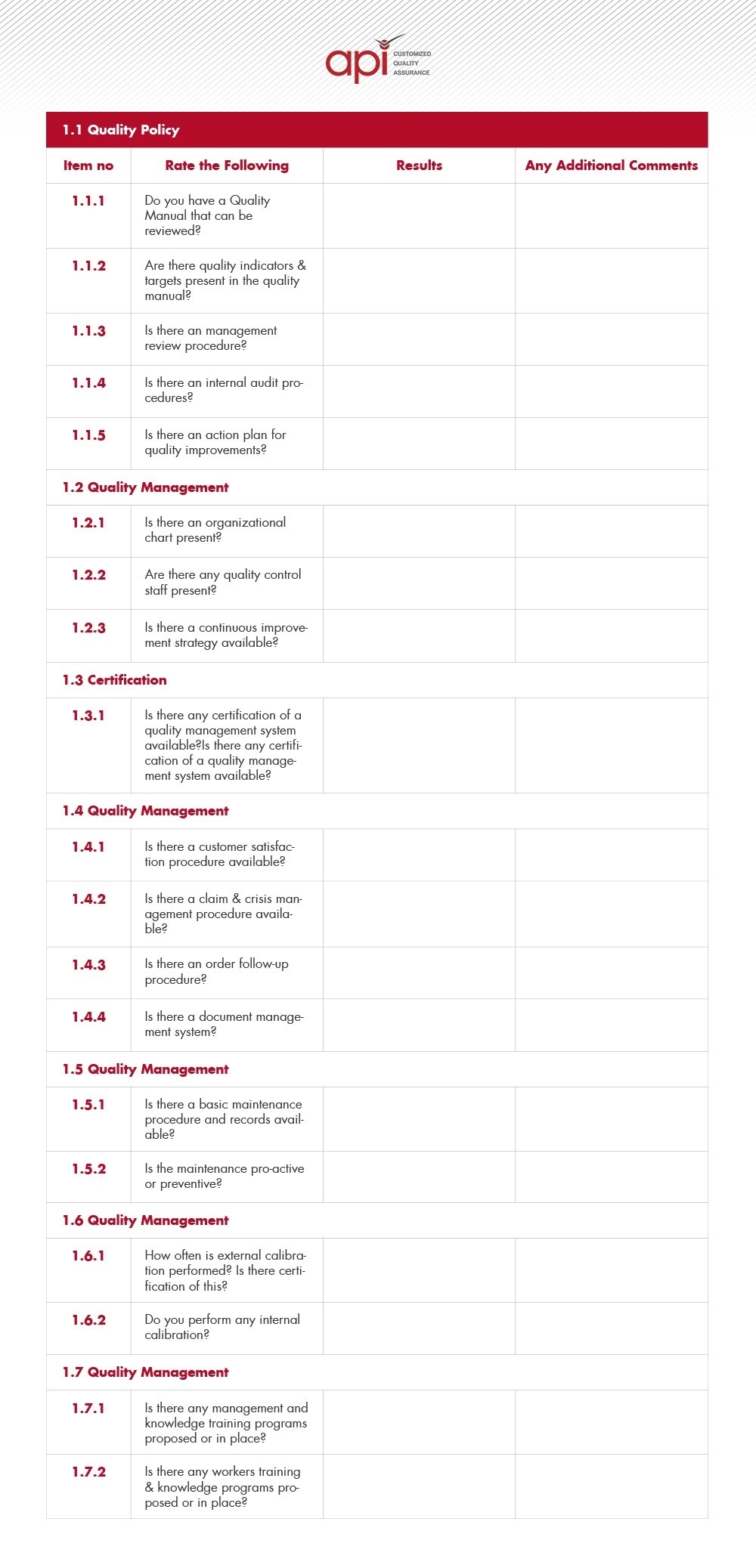
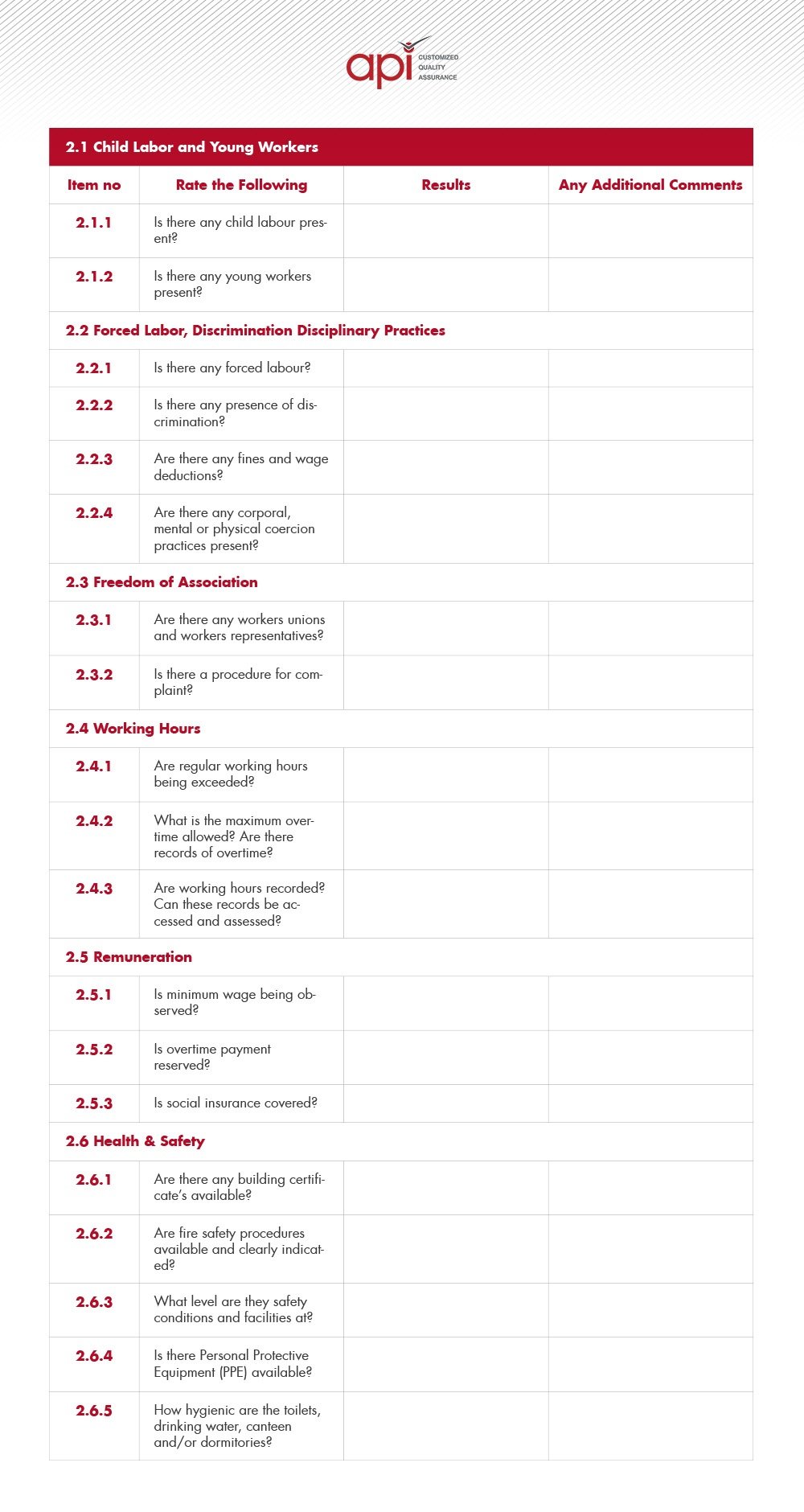
Household goods manufacturing and supply chain operations are often vulnerable to compliance and regulation violations. With the pace at which the many complex parts of a supply chain can move, it’s no wonder that retailers who trust too willingly in their suppliers can land up in hot water when things don’t go according to plan. The only way to address these challenges head on is by conducting a quality audit. Discover our factory quality audit checklist that touches on quality management, social and environmental compliance here. An audit of your supplier’s factory is conducted to ensure that your supplier and their factory’s operations are able to produce your product to your expected levels of quality, as well as ensure compliance in your product’s destination market. This is not the only reason though… Carrying out audits also help to assess the risks that may be present with a particular supplier and provide direction on how you can go about managing that risk. Ultimately, the decision to work with a particularly supplier will be up to you, but your decision will at least be based on a trusted risk assessment with a presented improvement strategy. Our checklist takes you through a what a brief assessment of your supplier’s quality systems would/should look like. We will cover 3 main sections in this checklist:
  1. Quality Assurance & Technical Questions
  2. Social / Health & Safety Questions
  3. Environmental Audit Questions

How Does A Quality Audit Grading System work?

For each checkpoint, the following guideline should be used; N/A – Checkpoint not available or not evaluated. 0 – Major non-conformity – absence of procedure or proof of big discrepancies in implementation – a corrective action will be designed for this checkpoint. 1 – Minor non-conformity –  incomplete procedure or proof of discrepancies in implementation – a corrective action will be designed for this checkpoint. 2 – Acceptable –  procedures are available and implementation is acceptable, however opportunities for improvement exist – an opportunity for improvement can be designed for this checkpoint. 3 – Good – procedure and implementation acceptable, no opportunity for improvement identified. 4 – Best Practice – factory has designed and implemented best practice of industry.

Quality Assurance & Technical Questions

a factory quality audit checklist 1WHAT TO LOOK OUT FOR:
  • Quality manual and all procedures show revision control (sign-offs & dates), history of changes
  • Product quality yield data, problems and corresponding improvement actions, status of preventive/ corrective/audit results
  • Strategic and tactical objectives, goals, action plans, etc.
  • Analysis of field failures, inspection yields, resource needs, internal audit results, corrective action status, etc.
  • Management review meetings, goal setting, performance measurement, internal audits, action plans, customer surveys
  • Employee involvement/recognition program, Lean, Six Sigma, kaizen, SPC, 5-S, cost reduction programme
  • Corrective actions, trend charts, meeting minutes, non-conformance frequency & cost analysis
  • Management review meetings and corrective actions
  • Look for use of training aids and work instructions at work stations
  • Qualification records, certification history
  • Records of testing, production quality records, audit records, interview workers to validate training records
  • Job descriptions, job skills assessment, training records, training manuals

What if my quality assurance score is below standard?

API is able to customize its QA solutions based on your specific needs and requirements. API will provide the supplier information on how they can go about improving various things within a factory. This information will be relayed back you, the retailer, where you will gain insight into your potential supplier and their factory operations to ensure compliance across the board.

SOCIAL / HEALTH & SAFETY QUESTIONS

A factory quality audit checklist 2

What to look out for:

  • Procedure for training and communication and participation
  • Emergency preparedness and response plan, monitoring and performance measurements
  • Policies and procedures, health and safety trend charts, accident rate improvement history
  • Safety committee or group meeting minutes, accident investigation reports, safety audit reports
The social audit assesses the social systems and structures that your supplier has in place and is normally based on the standards as laid out by the SA8000. As a professional third party auditing company, API is able to provide their industry expertise and long time experience to aid you in achieving your social compliance certification.

Environmental Audit Questions

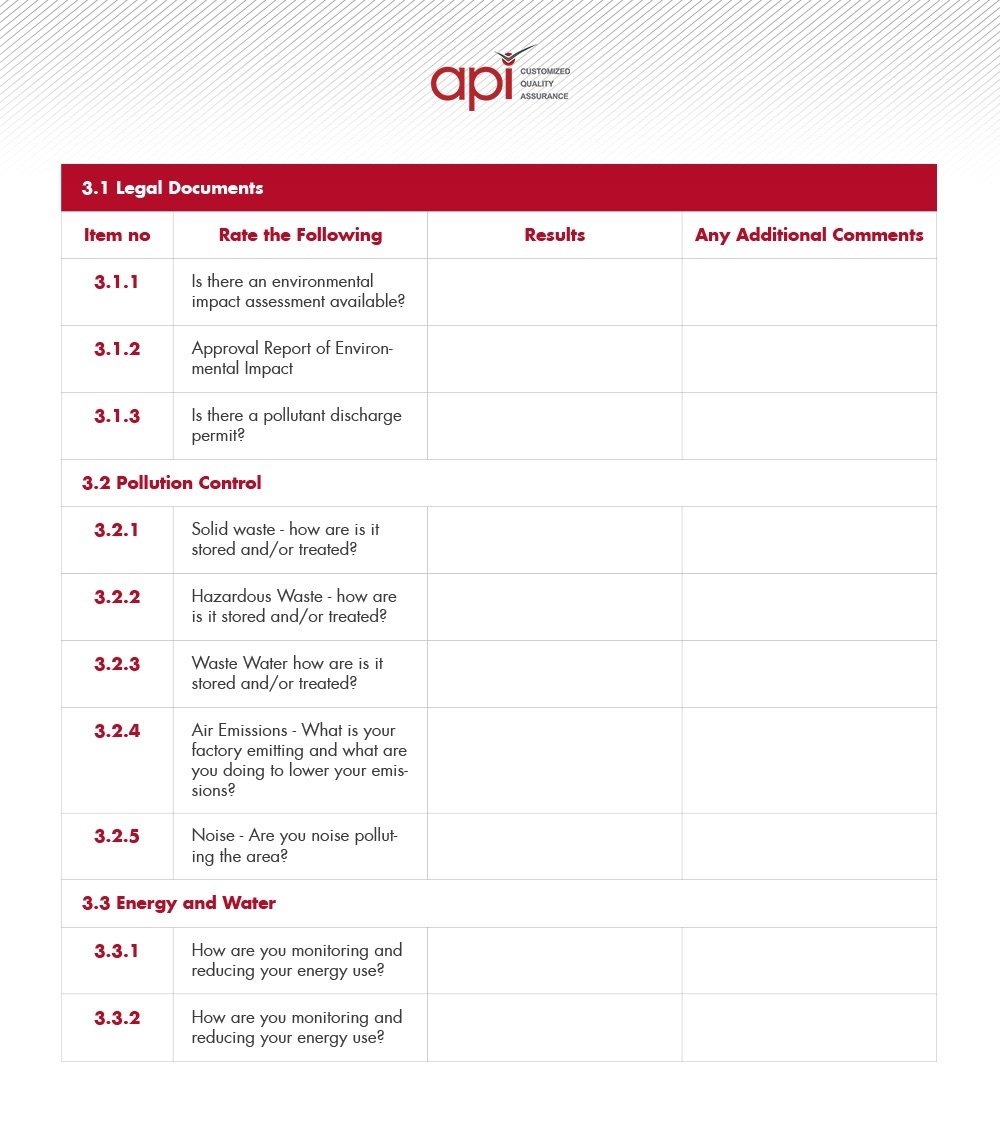
a factory quality audit checklist 3

What to look out for:

  • Environmental policy statement document
  • Records of agency/government inspection, procedures for measuring and monitoring environmentally sensitive activities
  • Record of purchases, waste stream and consumption; inventory control procedures
  • Records/use of; non-hazardous (RoHS/WEEE compliant) materials in production, biodegradable materials, returnable containers or packaging, recycling program, packaging materials made of recycled materials

Key Takeaways

A factory quality audit checklist allows you insight into your suppliers quality control processes and manufacturing capabilities, their strengths and weaknesses. This empowers you to strengthen those weaker processes where needed. A quality audit checklist will help ensure:
  • your factory’s quality systems are up to date, organized and well recorded.
  • confidence in the selection of your supplier based on checklist insights.
  • confidence in the quality of the product that is manufactured.
  • confidence that compliance standards are actively being met by your supplier.
This approach allows you to build a more collaborative relationship with your supplier, where you supplier has a more invested approach to your brand and its product. It helps to ensure top class quality systems and a mutually beneficial relationship between supplier and retailer.
Categories
Blogs

3 Types of Factory Quality Audits Your Retail Brand Needs

Many retail brands today are littered with non-compliance, human rights and environmental violations. These organisations find themselves at a loss on how to handle this kind of supply chain complexity risk. So, how can your brand prevent all of this? Factory quality audits. These quality audits aim to identify, eliminate and reduce supply chain risks for your retail brand. They also offer continuous improvement strategies to allow for constant growth, awareness and a strategic competitive position in the marketplace. In this blog post, we explore the different kinds of quality audits that third-party quality providers can offer you, so let’s dive into what each audit can provide you with and what the benefits will be for your brand.

Technical Audit

Let’s begin by defining what a technical audit of a factory is; This is the process of evaluating and assessing your factory’s technical capabilities; whether or not they have a quality manual with all its quality systems defined from organizational structure to assessing whether or not a factory has any internal audit and inspection procedures. This audit will also assess the factory’s layout and whether or not there is scheduled regular maintenance and calibration of machinery. This audit is typically based on the guidelines of ISO 9001: 2015, which is an internationally recognised standard to ensure an efficient quality management system (QMS) of your chosen factory. The latest update has meant that the standard is more performance focused, and this is done by merging a process-based approach with risk-based thinking and adopting the Plan-Do-Check-Act cycle. ISO 9001 - Techincal Quality Audit According to the guidelines as laid out by ISO 9001:2015, they are roughly categorized into eight sections; five of which are mandatory for the QMS of your factory;

  • Requirements for a quality management system
  • Management responsibility
  • Resource Management
  • Product Realization
  • Measurement, analysis, and improvement of your QMS
Clauses one to three are not requirements, but are informative about the scope of this standard references to help understand the standard better, and terms and definitions that you may need to aid in the adoption of this QMS. What are the objectives of a technical audit? The objectives of hiring a third-party auditor to assess the quality management systems of your factory would be this;
  • To assess whether there is an effective and efficient QMS of the factory.
  • To assess whether or not this factory is able to meet your production requirements.
  • This audit will assess the potential risks you may be aligning yourself with.

Social Audit

The SA8000 was established by the Social Accountability International in 1997. Over time this standard has become a reliable framework that many retail brands and organisations adopt to eliminate human rights violations from their supply chains. Looking back at the sweatshop claims against Mattel in 2011 for its use of child and forced labour, not to mention illegal amounts of overtime that were agreed to under the table, these horrific situation still need to continuously be eliminated from today’s retail supply chains. Social quality audit The SA8000 framework can measure the social performance of an organisation in eight different areas; this is rooted by the management system element that can drive continuous improvement in all areas. This standard is valued for its meticulous approach to achieving certain levels of social compliance. The 9 SA8000 social compliance requirements are:
  • Child labour – No children younger than 15 years of age may be employed by any factory, as we can tell in the case of the above factory, this was not the case.
  • Forced labour – No person may be employed by a factory if they haven’t offered to do so voluntarily.
  • Health and safety – A safe and healthy workplace environment must be provided by the factory, who should also prevent any potential health and safety incidents and work related injury or illness from occurring. You would need to ensure that there is sufficient personal protective equipment (PPE) within hard-labouring factories.
  • Freedom of association and collective bargaining – All staff have the right to form, join and organize trade unions and to bargain collectively on their behalf.
  • Discrimination – A factory is prohibited from engaging in discrimination in hiring, remuneration, access to training, promotion, termination or retirement.
  • Disciplinary practices – A factory is prohibited from engaging in or tolerating the use of corporal punishment, mental or physical coercion or verbal abuse of employees.
  • Working hours – A factory must comply with applicable laws, collective bargaining agreements and industry standards on working hours, breaks and public holidays.
  • Remuneration – The right of staff to a living wage must be respected by the factory.
  • Management systems – Compliance must be reviewed and implemented to the SA8000 standard through developed policies and procedures.
If child labour is found within your supply chain, it results in an immediate audit failure! You need to ensure that your supplier complies with the requirements of SA8000 so that you can eliminate potential areas of risk that may be present in your supply chain. Once you receive your audit report, based on the findings, your supplier will have time to rectify any mishappenings, and this will then usually result in unannounced visits to assess whether any improvements have taken place. Key Benefits of a social compliance audit for your retail brand
  • Compliance according to the SA8000 framework will prove that your brand is committed to social accountability; from treating your employees fairly to ensuring compliance with minimum wage requirements.
  • It will by nature continuously improve the efficiency of your supply chain.
  • If your organization aims to operate internationally, this standard will stand you in good stead for any international tender.
  • This standard will ensure that you are globally compliant and that you reduce and manage risks accordingly.
  • This standard will also provide brand protection for your organization.

Environmental Audit

An environmental audit will assess whether or not your factory complies with environmental regulations; this will often be based on the ISO 14001: 2015 standards which are an internationally recognised family of standards. I want to go back to the above factory that was producing toys for Mattel; in the undercover investigation it was found that hazardous chemical products were used in the production process, but factory workers were told to hide them when auditors came in. Environmental quality audit There are many concerns with regards to a situation as the above 1. The chemical usage in the toys would likely not have met international regulation. 2. Hiding violations from an auditor only aids non-compliance and illegal production processes. 3. How are these chemicals affecting factory workers? How are they stored? How are they disposed of? The environmental audit procedure seeks to uncover the above issues, with the ultimate goal of eliminating those kinds of violations and ensuring a clean and well-managed supply chain. An environmental audit such as ISO 14001:2015 will assess the following;
  • The legal requirements according to the substances that are being used which would along with risk assessment document.
  • An audit would assess whether the factory has an existing Environmental Management System (EMS) in place.
  • An audit would assess the solid and hazardous waste situation of the factory and whether or not they have an appropriate procedure in place for the disposal of waste.
  • An environmental audit would assess waste water disposal, how and where you are disposing this waste water, this is often paired with waste water testing to know what kinds of chemicals are present that could potentially be damaging to nearby water canals.
  • An audit will also assess the CO2 emissions of your supplier’s factory.
  • An audit will assess the amount of energy and water that your supplier’s factory uses.
See the checklist we created on the types of questions an auditor may ask when visiting a factory. This would be coupled with the observation skills that a professional auditor would possess. **TIP The above audits assess your factory’s current operating procedures. It must be said that it is not uncommon to find a factory that complies with everything we have mentioned up until now. The key is to understand that these audits aim to highlight any major risks, but that upon receiving your audit report you will also receive continuous improvement suggestions, to aid your factory in achieving compliance and an excellent social and environmental rating.   So you may be thinking, that’s great I know what they will assess, but what are the felt benefits of an Environmental Audit? Good question, let me tell you why you need an Environmental Audit;
  1. It ensures compliance with international regulation.
  2. It encourages better environmental performance of suppliers.
  3. It reduces environmental impact.
  4. It reduces costs through a lower environmental impact.
  5. It provides a strategic competitive advantage for your brand.
So I pose the question to you – are you ready for an environmental audit?

Conclusion

Retailers today often only consider one or two of the above quality audits, but as consumer behaviour has shifted, you may want to consider being certified according to all three international standards. This would ensure that your organization achieves a strong competitive position in the marketplace. So let’s take a quick re-look at the benefits these can have for your brand;
  1. These audits will ensure compliance to international regulation
  2. These audits will provide a continuous improvement strategy for your supplier.
  3. These audits will ensure a well organized quality management system for your supplier.
  4. These audits will reduce your costs.
  5. These audits will strategically position you in the marketplace.
The insights of the above quality audits should provide you with enough information to decide on how you should manage specific supply chain risks. These audits aim to eliminate many of the common supply chain violations found and ensure the optimisation of your quality systems.

dive into our visual guide to show you why your retail brand needs environmental auditing today!

Categories
Blogs

What Are The Common Reasons For Quality Audit Failure?

Unethical or morally gray manufacturing practices are not uncommon for many factories across the globe, most commonly situated in third world or developing countries, for their cheaper manufacturing options. The figures, from the UN’s International Labour Organisation (ILO) and the Walk Free Foundation, show 24.9 million people across the world were trapped in forced labour for 2016. These cheaper conditions translate into unregulated conditions with little to no regulation and monitoring of working conditions, most of them horrific. These situations have lead to an increase in monitoring and auditing solutions to try and regulate the some of the terrible working conditions that many retail brands have been susceptible to over the years. Despite this, there are still many that fail to meet certain international standards and regulations put forth, making it absolutely necessary to know just what you need to avoid! In this blog post, we dive into some of the most common reasons that households goods suppliers fail their quality audits and what you can do to make sure your retail brand doesn’t fall into this pool.

Technical Failures

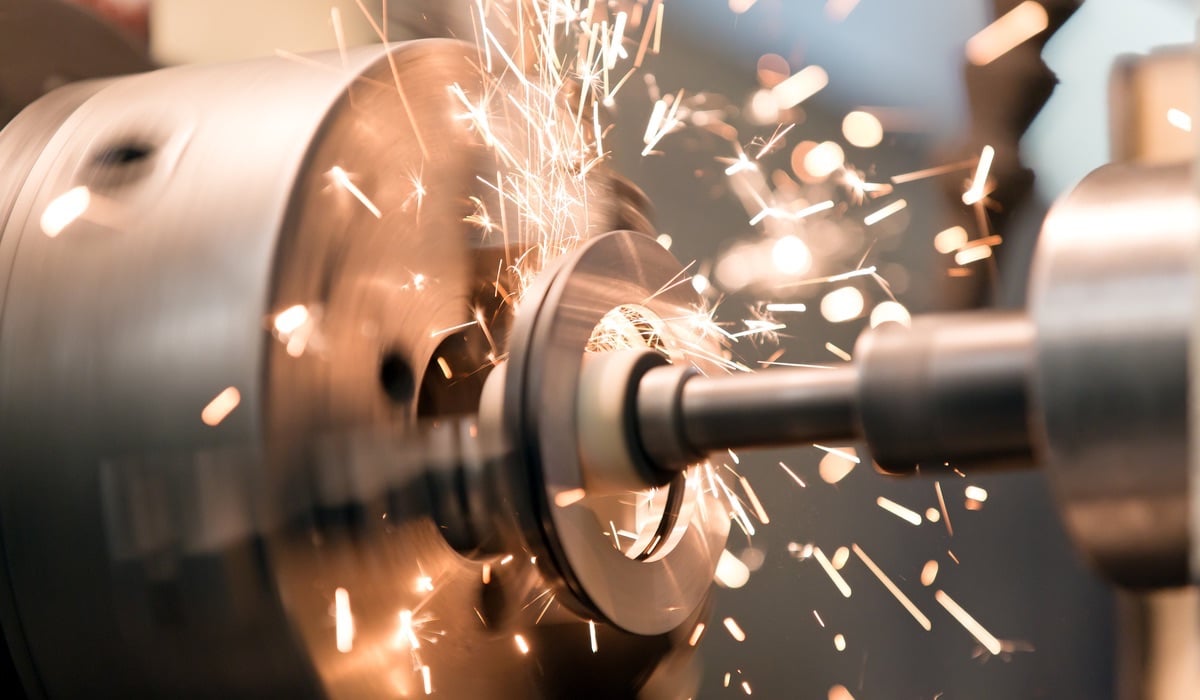
A technical audit is used to evaluate and assess a factory’s existing quality systems from policies and organizational structures, to the defined roles and responsibilities of the factory’s staff. So what are some of those common reasons a supplier may fail their technical audit? Disorganised documentation – As mentioned above, your supplier’s quality policies, records, reports and all documentation will be reviewed. Many factories often run on outdated systems like old excel spreadsheets, which opens your brand up to human error and potential risks that can be avoided. Without adequate reporting procedures or quality policies, the likelihood that your production requirements will be met, according to specification and in compliance with its destination market, will often not be the case if you choose to work with a supplier that has undefined and disorganized systems. Calibration and Upkeep of Machinery and Equipment – Many factories are dotted between third world and developing countries. There is a reason why Europe and U.S.A prefer to source abroad. It is often a lot cheaper than what they can find within their own borders, but that does not come without its own set of challenges.   Calibration of machinery in quality audit Many factories struggle with resources and finances, which means their money will often go into sourcing raw materials for the next production before putting money into the servicing of their machinery and equipment. This will mean that when an auditor comes to inspect the factory and its layout that the machinery is often out of calibration or filled with too much oil, which can contaminate your product and potentially places your brand in a risky position. Not ideal.

Social Failures

A social audit assesses the social systems and structures that your supplier has in place. Social compliance audits are always in line with the standards as laid out by SA8000; Child labour – Many social audit failures arise from being socially non-compliant with child labour causing an immediate “zero tolerance” failure. This is a serious violSocial Compliance in a quality auditation. If this is discovered during your audit process, it is recommended to rather find a different supplier. There are no grounds where this is acceptable. Hazardous working conditions – Hazardous and unsafe working conditions are not unheard of in many third world factory’s across the globe and are often the cause of factory technical audit failure. Things like faulty Personal Protective Equipment (PPE), expired fire extinguishers, no clearly marked exit signs, exits not in working order, machinery that is in need of calibration or lack of safety gear found on heavy machinery can lead to audit failure. These safety violations are easy enough for your supplier to address and solve, so bear this in mind upon receiving audit results as you will often need to factor in corrective time for your supplier. Panasonic and Sony have been caught in supply chain scandals, which have created immense amounts of bad media coverage for the global electronic brands. They have been accused of unfair labor practices in factories, vastly underpaid staff and electrical components that are said to be sourced from parts of the world known to be inclusive of child slave labour.
Environmental Failures  

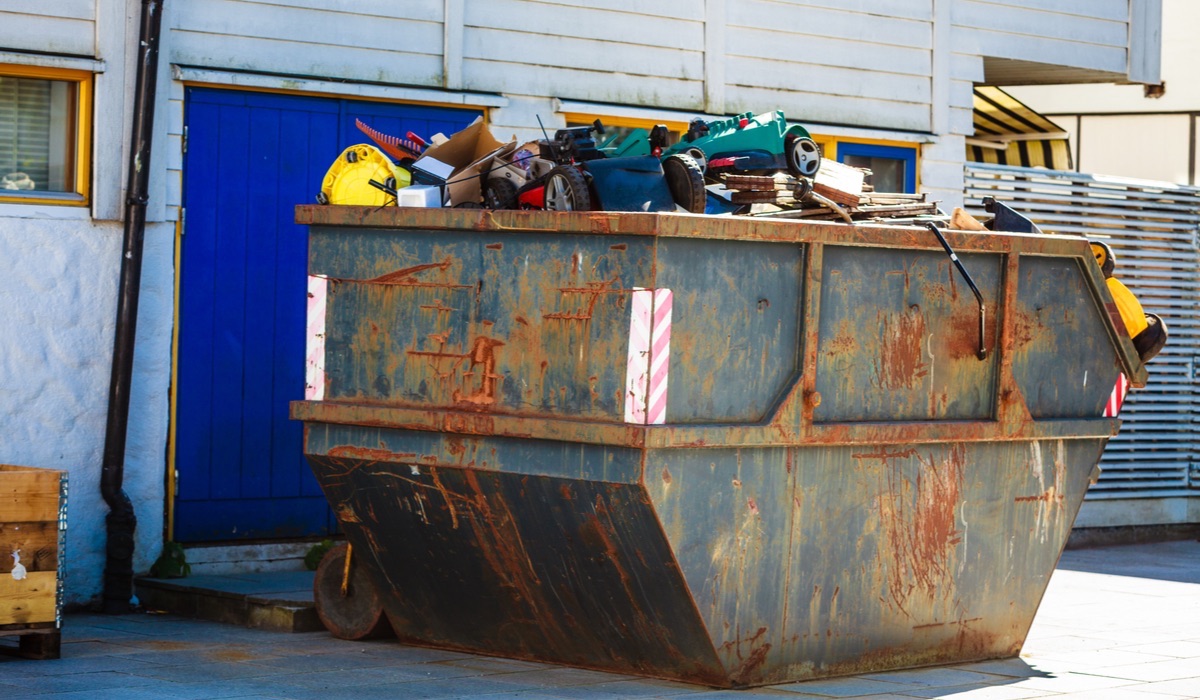
With regards to ISO 14001, while it’s not a mandatory compliance standard, it is a little more complex to navigate because of this. But as the rules of engagement in retail have shifted into the hands of the consumer, retail brands are forced to rethink the application of this standard within their supply chain. Consumers today, are interested in reducing their environmental impact on the planet and your brand should help them do just that. How you ask? By complying with the guidelines of ISO 14001:15 – In saying that what are some of the common reasons many factories fail environmental audits? Incorrect methods of waste storage or disposal – This is often a problem as many factories do not have the capability or facility to dispose of their waste correctly. If your factory disposes fumes into the atmosphere or disposes untreated water into sewerage systems, it is considered to be an environmental risk and grounds for audit failure. Often a certified third-party waste disposal company will need to come and collect your waste to ensure that is disposed of correctly; your supplier can receive certificates, stating correct disposal as well. Environmental Quality Audit Let’s take a look at how this could play out; Wal-Mart paid a criminal fine of $11 million and another $3 million to the Missouri Department of Natural Resources, for violating the Clean Water Act by illegally disposing of hazardous waste materials. This is a serious violation and a costly one at that, environmental violations are not taken lightly so bear that in mind as you proceed.  

Conclusion

Understanding the most common reasons for quality audit failure allows you insight into the kind of supplier your brand should be aligning itself with. These audits are complex (especially the social and environmental audits), and it is up to the observation skills of your chosen auditor that will determine the level of compliance that a supplier meets. The audit report that your retail brand receives will present you with a full picture of all the risks a third-party auditing company is trained to see. It will be up to you to make a final decision, bearing in mind the authoritative position consumer’s today are in, by putting your customers first and producing products in an ethical manner, you automatically put your brand first.

Let us know in the comments section if this has been helpful information for you.


Ever wondered whether environmental auditing was for you? Check out our visual guide to help you on your way!

en_USEnglish