Auteur/autrice : Administrateur
Toys go green, but are they safe?
- Auteur de l’article Par Admin
- Date de l’article février 8, 2023

The sustainability mega-trend hasn’t missed the toy market. Today’s eco-conscious consumers have put toy makers under pressure to produce products that are sustainable, but the reality is that very few toys can be recycled. Most are made from a combination of plastics, metals, and other components that most recycling companies don’t accept. To put a number to it, experts suggest that the toy industry alone is on track to produce more than one million tons of plastic waste annually from 2023. In the face of this staggering plastics problem, the sustainable toy market is growing, valued at US$19 million in 2020 and forecast to reach US$60 million by 2030.
Environmental responsibility isn’t the only driving force behind the rise of green toys. Consumers have become more aware of the health effects of toxic chemicals and materials found in products intended for children and are demanding alternatives. Technological and material innovations have also advanced the sustainability quest, but obstacles remain in sourcing and testing. Furthermore, a combination of kids being stuck at home and eco-anxiety caused by the pandemic has accelerated consumer appetite for made-to-last, planet-friendly toys.
Many of the major players in the toy industry are leading the way to reduce the environmental impact of toys. The Lego Group is on a challenging mission to make all its core products out of sustainable materials by 2030, and by 2025, all its packaging will be made from renewable or recycled materials. The brand has also introduced an initiative (Lego Replay) that invites children to donate their pre-loved Lego bricks to children in need. Mattel Inc. has expanded its Mattel Playback program, which allows consumers to send back a broad range of Mattel toys for recycling and reuse. The brand has also introduced certified carbon-neutral toys and aims to use entirely recycled, recyclable, or bio-based plastics in all its toys and packaging by 2030.
It may be recycled, but is it safe?
Consumers naturally expect safe products from the brands they trust—especially those targeting children. When implementing sustainable materials and processes, toy brands must ensure that they’re not introducing products that may be dangerous for children. Toxic chemicals in toys are of particular concern, especially those made for kids under 3 because of their mouthing and rapid metabolic rate, high surface area to body weight ratio, and rapid physical development. The product safety risks of toys made with sustainability in mind include:
- Recycled materials, such as plastic, may contain toxic chemicals due to exposure during the recycling process.
- Toys made from recycled plastic may contain toxic chemicals such as flame-retardants (PBDEs, HBCDs) or POPs (persistent organic pollutants).
- Sustainable toys may also contain toxic materials like lead paint on wooden toys.
- Different mechanical properties may introduce risks: for example, a sustainable product may be more brittle and not pass all tests.
- It’s difficult to be sure where old materials came from, and they may contain unknown chemical sources.
Most toy safety testing relates to chemicals, and any substances found to be potentially damaging to human health are immediately banned from the industry. Regulation in this area is increasing and becoming more expensive and challenging to navigate. A third-party expert can help you determine which tests are required based on your BOM and materials and work with you to streamline the testing process. This will not only enable you to stay ahead of regulations and avoid costly risks but will, most importantly, put your customers’ health and wellbeing first. It will also give you visibility over your supply chain so you can anticipate and manage risks throughout the product life cycle.
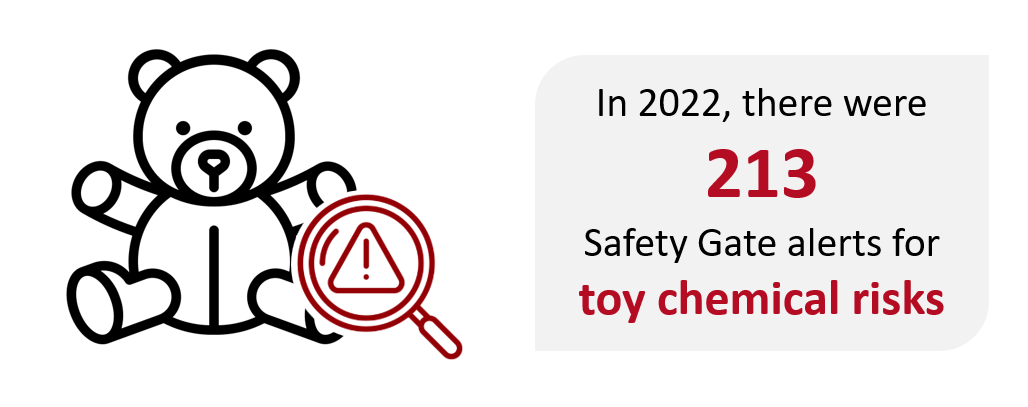
Missteps can be costly, and they do happen. In 2022, 213 toy products were recalled in Europe because of chemical risks.

By not actively managing your chemical risks, you risk a lot more: your brand reputation. After consumer trust satisfaction plummets, it can be a tall and expensive mountain to climb to win that trust back—especially for toy companies that are perceived to not care about the wellbeing of children. Mattel Inc., the largest brand in the US, recalled millions of toys in 2007 due to hazards from small, powerful magnets and lead paint. The recall costs and lawsuits have cost the brand over US$100 million, but the damage to brand reputation may cost them for many years to come.
How can toy brands align their sustainability efforts with the importance of product safety? Compliance is essential, but it’s only the starting block. Supply chain visibility, improved traceability, and scientific methods that help verify the origin of new materials and the potential presence of harmful substances can help you anticipate risks early on and focus on the areas where risks are highest, ultimately saving you time and money.
Chemical Risk Assessment is the identification and mapping of product risks based on:
- Materials
- Product group: e.g., toys for under 3 years
- Factory performance: an audit be performed within the last 12 months
- Industry insights: e.g., product recalls or newly banned substances
This risk-based approach allows you to maximize safety while managing costs.
API’s specialized solutions for sustainable toys
At API, we combine our on-the-ground experience with our scientific expertise in an end-to-end approach, allowing you to create more sustainable products that are still safe to use. Some of our specialized solutions include:
- Chemical Risk Assessment
- Traceability and increased visibility over your entire supply chain
- rPET testing, advanced testing that verifies and quantifies rPET in products to ensure your recycled polyester claims are genuine.
- Chem Scan Check™, a new testing approach that detects more than 250 chemical substances in one test.
Interested in finding out more about how our safety solutions can benefit your brand?
API’s Quality Solutions – ICPHSO 2023
- Auteur de l’article Par Admin
- Date de l’article février 6, 2023

Comment l'API profite à votre entreprise
API are the household goods and toys quality experts of the WORMS SAFETY Alliance. Established in 1994, API is trusted by some of the biggest retailers in Europe. We understand compliance comes first, but also that new challenges require a new approach. We can help you to stay ahead of the game, so you can create better products that are safe to use. We secure the safety and quality of our customers products via laboratory testing (compliance and performance), TCF (Product Technical Compliance File), audits, inspections and sustainability solutions made for this industry.
We understand that the current environment is very challenging. We can help you bring new thinking to transform increasing risks into opportunities
5 Reasons Why We Are Different

The expertise of a specialist

Return on investment oriented

Our DNA: ‘boots on the ground’

Not a one-size-fits-all provider

We make it simple
We Focus In 5 Strategic Areas

Technical expertise

Data Leverage

Innovation & Technologies

Tailor-made solutions

Sustainability, Traceability
We Put The Environment At The Heart Of What We Do
Audits environnementaux :
Sustainable Processes
- Environmental assessments
- Chemical assessments
- Verification of low impact processes
- Coaching of factories
Sustainable Products
- Life Cycle Assessments
- Product carbon footprint
- Green claims validation
- Hot-spots identification
We bring A DIFFERENT APPROACH TO SUPPORT YOUR BUSINESS GOALS
Risk Management: Optimizing Your Quality Budget
Allocate resources to the products and suppliers that need the most technical support – the higher the risk in one dimension, the higher the control and monitoring required.
Recycled Polyester Testing – Verification & Quantification
Ensure your recycled polyester claims are genuine.
Following years of research, Worms Safety Laboratories have pioneered an innovative solution to detect and quantify rPET in textiles. Increasing regulation and consumer expectations has increased the need for substantiation of claims.
Even if you know your supply chain, relying solely on someone else’s information and declarations is risky. Accurate scientific testing is the only way to verify the genuineness and amount of rPET within raw materials.
Chem Scan Check™
To support our partners in chemical risk management, we developed Chem Scan Check™ (CSC), which scans for more than 285 hazardous chemical substances in one go. Instead of waiting and paying for multiple tests on expected chemicals with a traditional testing approach, we offer our partners wider visibility, in 72 hours so they can anticipate and mitigate risk.
A chemical scan that gives you visibility on almost all hazardous substances to help prevent ‘unexpected’ non-compliance risks in only 72h.
API à la Spielwarenmesse® 2023, le salon du jouet de Nuremberg
- Auteur de l’article Par Admin
- Date de l’article 30 janvier 2023

We are pleased to announce our participation at the Spielwarenmesse® 2023 in Nuremberg on 1-5 February 2023.
Are you also joining the Spielwarenmesse® 2023 Toy Fair? Come and visit us at our booth B-76 in Hall 7 and discover API’s innovative solutions and best practices for Toys Quality Management. Book your appointment to talk to our team!
API’s Solutions for Toys: Stay Ahead Of The Game
API are the toy quality experts of the Alliance pour la sécurité des morsures. Established in 1994, API is trusted by some of the biggest retailers in Europe. We understand compliance comes first, but also that new challenges require a new approach. We can help you to stay ahead of the game, so you can create better products that are safe to use. We secure the safety and quality of our customers products via laboratory testing (compliance and performance), TCF (Product Technical Compliance File), audits, inspections et solutions de durabilité made for this industry.
API’s Toy Quality Solutions – Spielwarenmesse
- Auteur de l’article Par Admin
- Date de l’article janvier 10, 2023
STAY AHEAD OF THE GAME

Comment l'API profite à votre entreprise
API are the toy quality experts of the WORMS SAFETY Alliance. Established in 1994, API is trusted by some of the biggest retailers in Europe. We understand compliance comes first, but also that new challenges require a new approach. We can help you to stay ahead of the game, so you can create better products that are safe to use. We secure the safety and quality of our customers products via laboratory testing (compliance and performance), TCF (Product Technical Compliance File), audits, inspections and sustainability solutions made for this industry.
Essais de jouets en laboratoire
API offer comprehensive laboratory testing for all international toys tests at our labs in Asia and Europe. We are accredited (COFRAC, EN 71-1/2/3).
- Matières premières
- Électricité
- Inflammabilité
- Physical and Mechanical
- Fit for Use and Performance
We understand the new risks (sustainable materials, chemical management), and we can go further to make your products safer.
Solutions de conformité en matière de qualité des jouets
De la conception et du développement du produit jusqu'à son expédition, l'API évalue la conformité des fournisseurs et des jouets grâce à ces solutions :
- Audit de l'usine du fournisseur
- Essais sur les matières premières et au stade de la conception
- Contrôles de qualité
- Contrôle aléatoire avant expédition
Recycled Polyester Testing – Verification & Quantification
Ensure your recycled polyester claims are genuine.
Following years of research, Worms Safety Laboratories have pioneered an innovative solution to detect and quantify rPET in textiles. Increasing regulation and consumer expectations has increased the need for substantiation of claims. Even if you know your supply chain, relying solely on someone else’s information and declarations is risky. Accurate scientific testing is the only way to verify the genuineness and amount of rPET within raw materials.
Chem Scan Check™
To support our partners in chemical risk management, we developed Chem Scan Check™ (CSC), which scans for more than 285 hazardous chemical substances in one go. Instead of waiting and paying for multiple tests on expected chemicals with a traditional testing approach, we offer our partners wider visibility, in 72 hours so they can anticipate and mitigate risk.
A chemical scan that gives you visibility on almost all hazardous substances to help prevent ‘unexpected’ non-compliance risks in only 72h.
API au symposium international 2022 de l'ICPHSO
- Auteur de l’article Par Admin
- Date de l’article 7 novembre 2022

API is excited to be participating as a sponsor at the 2022 ICPHSO International Symposium “Redefining Key Concepts of Product Safety”. The symposium will take place on November 14-15, 2022 in Brussels. The one and a half-day Symposium provides an opportunity for global product safety professionals to participate in discussions that further enhance the safety of consumer products throughout the world.
Visit ICPHSO’s website for more details about the event: https://icphso.org/
Please feel free to contact your regular customer representative for more information.
It all boils down to safety: Reducing the risks of sustainable kitchenware
- Auteur de l’article Par Admin
- Date de l’article octobre 31, 2022

The global sustainability movement has also led consumers to pursue safe and reliable kitchen products that positively impact the planet. While consumers once shared a concern about risks associated with non-stick or aluminum materials, brands are now focusing on recycled materials and sustainable processes and whether they’re introducing new risks to kitchenware safety.
Demand for home cookware products is skyrocketing due to everything from the rise of home cooking during the pandemic to the growing popularity of cooking shows and modular kitchens. Consumers everywhere have been busy trying new recipes, improving their skills, and looking to replace their old cookware with new items.
Food Contact / Kitchenware - A highly regulated industry
The kitchen utensils and cookware segment has long been highly regulated, with strict standards in place to ensure products don’t jeopardize the health and safety of consumers. Since kitchenware often comes into direct contact with food, one of the key risks centers on the potential presence of chemicals in these materials that could potentially migrate to the foods they touch. Consumers tend to trust that the products they purchase are safe, but how can they be certain – especially amid constant changes to materials and processes driven by the sustainability push?
Most countries around the world have strict regulations for products and materials that come into contact with food, and the rules vary based on the country and material. For instance, products sold in the EU and the US need to follow regulations such as the EC No. 1935/2004 (the EU) and the FDA 21 CFR (the US). Different countries in the EU have additional regulations, such as the LFGB Law in Germany and the DGCCRF recommendations in France.
These regulations typically cover the most common kitchenware materials, such as plastics, silicone and rubbers, metals and alloys, ceramics, wood, paper and board, and varnishing and end coating. The specific criteria depends not only on the type of material but its intended use. For example, a regulation may consider whether a container is plastic or ceramic and if it’s intended to be used for aqueous food such as water or coffee, acidic foods like juice, or alcoholic beverages like beer or wine, and if it’s designed for hot or cold.
It might seem surprising, but risks are still identified today in destination markets, even for well-known brands. Such events can not only damage the brand’s image but can also generate additional risks if the brand is subject to a fine or a product recall. Not even major brands are immune to product recalls, such as the global furniture and décor brand that had a mug recalled from the market that was found to be potentially migrating excessive levels of dibutyl phthalate (DBP).
Sustainable materials and harmful substances
While the global shift toward sustainable products and a circular economy is great news for the planet, it’s bringing with it new risks that may put product safety in danger. As one of many examples, the use of recycled materials is subject to risks due to the lack of visibility over the materials’ origin and the potential use of harmful chemicals in the transformation of raw materials to finished goods.
So, how can brands align their quest for increased sustainability with the importance of product safety? Clear visibility over the supply chain, improved traceability, and scientific methods that help verify the origin of new materials and the potential presence of harmful substances are some of the trends gaining traction to ensure a future that’s both sustainable and safe.
Other risks to think about
While chemical risks often come to mind first when discussing food contact materials, kitchen accessories have some associated physical risks related to fatigue, corrosion, and heat resistance as well as thermal hazards. Simply put, they need to fit their expected use, meaning if they’re marketed as microwave-safe or dishwasher-resistant, they must be able to handle the heat or water without breaking or suffering damage. Physical risks are also frequently identified in the kitchenware market, with the most common recalls including the risk of injury and burns due to products breaking under heat exposure, or laceration hazards resulting from product cracks.
Going beyond compliance
The kitchen utensils and accessories industry is highly competitive, with numerous brands competing for consumer attention amid constant product redevelopments and price battles. This adds additional complexity for brands and retailers, highlighting the importance of innovation and fit-for-use to bring products to the market that meet consumer expectations.
In this challenging environment in which supply chains are under constant pressure and shipping delays put delivery times at risk, ensuring product quality and safety before the end of production is key, so you ‘get it right the first time.’
API’s specialized solutions for kitchenware
API helps brands and retailers ensure their kitchenware’s safety, quality, and performance with tailor-made solutions. Some of our key areas of support include:
- Laboratory testing: Testing according to EU/US or country-based directives to maintain chemical and physical safety, as well as testing with specific protocols to ensure performance and fit-for-use.
Two of our latest innovations to support brands and retailers in their sustainability journeys include:
– Recycled polyester testing to verify and quantify the amount of recycled polyester in your products.
– Chem Scan Check – a scientific screening method that can detect 285+ substances in a single test to ensure there are no unexpected harmful substances. - Product development support: Identification of critical areas and recommendations for adjustment at the design or purchase stage.
- Technical Compliance File: Documentation review that attests product compliance according to protocol definitions, from document collection and verification to report issuance.
- Factory audits: Factory evaluations that assess factory capabilities to meet production standards and deliver safe products on time.
- Dedicated programs: Bespoke programs based on each client’s needs that provide support at every stage of the supply chain.
Interested in learning more about API’s kitchenware solutions?
How your brands can become more socially responsible
- Auteur de l’article Par Admin
- Date de l’article septembre 26, 2022

In the last few years, we have seen companies and brands increasingly change the way they operate. The views of the customer are evolving and companies and brands need to adapt quickly. The coronavirus pandemic catalyzed a debate about the broader impact of human actions, with people concerned about the way we live, issues of social justice, and our destruction of the environment.
Increasingly, customers value companies and brands they can trust. Today’s consumer wants to purchase from companies and brands that are transparent in their work, create an impact, offer sustainable alternatives to regular products, and are vocal about causes that matter. Consumers have rising concerns about climate change, pollution, biodiversity loss, resource scarcity and the wider well-being of society. These changing behaviors and values regarding environmental friendliness, social responsibility, and economic inclusiveness translate into a demand for corporate change.

Source: How sustainability is fundamentally changing consumer preferences – Capgemini
The global consumer goods industry is increasingly implicated in the debate because it faces significant challenges of its own and because many of its consumers are leading the movement for change. According to the Capgemini Research Institute, 79% of consumers are changing purchase preference based on the social responsibility, inclusiveness or environmental impact of their purchases.
Most companies, regardless of their size, are realizing the importance of creating products that show their brand positioning as a company that cares for the causes close to their heart. From environmental issues to social justice, it comes down to simply making a difference.
Additionally, there is increasing pressure from countries and NGOs, with continuous initiatives to reinforce control and ensure more responsible practices. The European Commission, for instance, recently proposed an import ban on products manufactured using forced labor, a proposal that still requires discussion and agreement by the European Parliament and the Council of the European Union before it is legislated, but that demonstrates the mechanisms under consideration to stop forced labor and modern slavery.
Frequent industry issues and the growing initiatives against
While there has been great improvement in recent years, the industry still struggles with ethical issues. Some of the most frequent issues found in the fashion industry include low wages, child labor, animal cruelty, health and safety risks, and environmental issues. The list, unfortunately, goes on.
Some initiatives for change could include:
- Checking the material and product sources.
- Repurposing old items and using pieces of them to create other products.
- Supporting Community Fair Trade (different programs).
- Supporting Ethical Trade (Ethical Trade Program, Supplier Code of Conduct).
- Creating inclusive pieces that can be available for everyone.
- Changing packing in favor of more sustainable solutions.
- Taking a stand in helping the planet and being overall more environmentally conscious: generating less waste, reduction of CO2 emissions, electricity consumption, increasing the amount of recyclable material, decreasing unnecessary packaging materials.
- Being open about values, mission, and what they stand for while also taking action in these areas.
- Taking a stand against animal cruelty.
- Better treatment of workers.
The industry-wide initiatives around sustainability and CSR are endless, and these examples can be considered as good starting points.
There are many industry initiatives and reference tools that set the guidelines and requirements brands must follow to be more socially and environmentally responsible. Some of the most well-known ones include:
- Sedex: Supplier Ethical Data Exchange
- ICS: Initiative for Compliance and Sustainability
- SLCP: The Social and Labor Convergence Program
- ILO Conventions: International Labour Organization Conventions
How Our Expert Support Can Help You
At API, we provide expert solutions to support our customers in their CSR journey. Some of our programs include:
- Social audit assessment:
– As per the defined code of conduct (ICS, Sedex, SCLP, ILO Conventions)
– Tailor-made based on industry / your code of conduct / API’s standards and local labor laws - Supplier capacity building
– Different programs for different suppliers (new, strategic, low performing, those with zero tolerance, however willing to improve, etc.) - Stake holders coaching
– Awareness and pre-assessment set-up program for internal teams (audit, sourcing…) - Code of conduct, manual, audit guidelines creation & review
– Creation from ground zero and based on your requirements, or review of existing materials – all with the support of our team of experts - Program benchmarking services for strategic suppliers
– Assessment and program recommendation, report, monitoringThanks to our boots-on-the-ground approach, we offer adapted solutions to our customers that go beyond the traditional industry standards. We put our expertise at the service of our customers with concrete solutions that leverage our daily presence in factories, such as follow-up on sustainability.

Interested in finding out more about our CSR solutions?
Infographie : comment simplifier votre mise en conformité et accroître la satisfaction des consommateurs
- Auteur de l’article Par Admin
- Date de l’article septembre 23, 2022
Infographie : comment simplifier votre mise en conformité et accroître la satisfaction des consommateurs
Découvrez les défis auxquels les marques sont confrontées et comment elles peuvent réduire les risques de non-conformité et mettre sur le marché des produits qui répondent aux attentes des consommateurs.

Notre infographie couvre :
- Situation actuelle des risques et des non-conformités en Europe
- Ce qui est nécessaire pour prouver la conformité
- Comment gérer les tests des produits dans un processus interne
- Qu’est-ce qu’un dossier de conformité technique produit (TCF) ?
Garantir la conformité des produits aux normes et réglementations du marché est une tâche complexe.
Découvrez comment les marques et les détaillants peuvent réduire les risques de non-conformité en remplissant le formulaire et en cliquant sur « Télécharger l’eBook » pour obtenir votre exemplaire.
Solution API pour le dossier de conformité technique produit (TCF)
Chez API, nous proposons une nouvelle manière d’aider les marques à gérer la conformité des produits et au-delà. En savoir plus sur nos solutions TCF ici.
Reprise du webinaire : une solution durable – Chem Scan Check™
- Auteur de l’article Par Admin
- Date de l’article septembre 1, 2022
Dans cette vidéo, vous en apprendrez davantage sur notre nouvelle solution de durabilité — Chem Scan Check™.
Regardez la vidéo sur YouTube :
Les experts d’API présentent l’une des dernières solutions développées par Worms Safety Laboratories pour offrir une approche durable visant à atteindre 0 % de risques chimiques inattendus : Chem Scan Check™. Découvrez comment cette nouvelle solution aide déjà certains de nos partenaires à mieux gérer leurs stratégies de gestion chimique.
La solution innovante Chem Scan Check™ d’API
Pour accompagner nos partenaires dans l’optimisation de leurs stratégies de test, nous avons développé Chem Scan Check™ (CSC), une solution capable de détecter plus de 285 substances chimiques dangereuses en une seule analyse. Contrairement aux approches de test traditionnelles basées sur un simple résultat conforme/non conforme pour des substances attendues, cette solution offre une visibilité sur des substances potentiellement présentes — y compris celles qui ne sont généralement pas recherchées dans le cadre d’un test réglementaire.
Pour la première fois, une analyse chimique complète vous permet d’avoir une visibilité sur la quasi-totalité des substances dangereuses afin de prévenir les risques de non-conformité inattendus — en seulement 72 heures.
En savoir plus sur cette solution innovante ici.