Tips to alleviate disruption when shifting sourcing location

Catégories
Blogs

Tips to alleviate disruption when shifting sourcing location

Reshoring, offshoring, and nearshoring: these were some of the most used terms in 2020 in numerous industries, including furniture. China continues to reign as the world’s manufacturing superpower and primary supplier of all varieties of goods, but companies have begun diversifying their supply chains in recent years and pursuing alternative manufacturing hubs. COVID-19 disruptions and the US–China trade war have acted as an accelerator in many cases, urging brands to look for manufacturing sources outside China.

China is the world’s manufacturing superpower

 Source: Statista ‘Top 10 Countries by share of global manufacturing output 2018’

The global furniture industry has been seeking sourcing alternatives to China for several years already, with some manufacturing countries outside China reinforcing their position and becoming a bigger part of manufacturing production volume for some brands. Some of the countries preferred by brands and retailers include Vietnam, Cambodia, Malaysia, India, and Indonesia in Asia, Poland in Central Europe, and Mexico in Latin America. New countries mean new opportunities, but they also come with new risks. When relocating parts of production out of China, the risks include:
  • Inadequate production planning and status: When working with new suppliers, some factories may not operate at their full capacity or might have inadequate planning, making it difficult to meet production targets. It is important to check your factory records to see how many actual people are in the production line, as well as daily output and quality control reports.
  • Rushing production: With relation to the above and to ensure correct timing, some suppliers may rush to make up for lost time, tempting them to cut corners and speed up processes. This can lead to mistakes and skipping quality control measures that put the entire production at risk.
  • Raw materials shortage: New manufacturing countries do not always benefit from the same access to raw materials as China. This may result in a shortage of some materials such as specific types of wood, stone, or components, or longer delivery times.
  • Lack of quality control to ensure safety and quality: A lack of local teams onsite or experienced factory employees may decrease the level of quality control, putting product safety and production quality at risk.

How can these risks be mitigated?

The concept of shifting production to areas outside China was already on the table before the US–China trade war and COVID-19-related pressures. However, these recent issues have broadened and escalated the topic’s relevance, with many companies now considering moving ‘out of China.’ Diversifying production areas and pursuing alternative locations can help secure additional inventory and capacity. However, launching production in a new area can be challenging without the right experience or teams in that specific area. A third-party company can support brands and retailers with adapted solutions that facilitate a smooth transition that protects production quality. The crises and disruptions experienced by supply chains in recent months may be the catalyst for revisiting a more global supply chain strategy and accelerating the adoption of new models and capabilities. However, in the meantime, short-term actions are needed to respond to these challenges.

3 tips to alleviate disruption when shifting sourcing locations

Tips from a manufacturing perspective include:
  1. Increasing workforce visibility and labor planning: Having stronger visibility over actual factories and suppliers is vital to ensure production is completed on time and with the expected quality of goods.
  2. Understanding the key suppliers: Whether the orders only represent a small portion of one factory’s production lines or are flooding the lines with goods makes a significant difference in how to best interact with that factory.
  3. Increasing supply chain transparency and carefully selecting the right suppliers: It is essential that you work only with the most suitable suppliers for your production needs.

Supporting our customers with our manufacturing expertise

At API, we are putting our manufacturing experience and product expertise at the disposal of our clients to help them adjust during this challenging time. Thanks to the agility and flexibility of our teams and our local infrastructure, we speedily implement onsite solutions that respond to each clients’ particular needs. Our dedicated technician program will act as an extension of your teams onsite to ensure your products meet your safety and quality requirements. We provide support through all stages of the supply chain, from initial development and supplier selection, through the manufacturing phases, and across production safety and quality control. For example: Interested in learning more about how we can support you in new sourcing locations?
Catégories
Blogs

Toy compliance: best practices to save time and stress

In the current landscape, uncertainty is still impacting many companies worldwide and the toy industry is no different. While some brands are thriving, many are facing unprecedented disruption levels, suffering from the effects of a reduced qualified workforce, delayed shipments, unsteady demand, and increased pressure to accelerate their time to market. One of the primary concerns these companies share is ensuring their products’ compliance, with chemical risks remaining one of the most problematic areas.

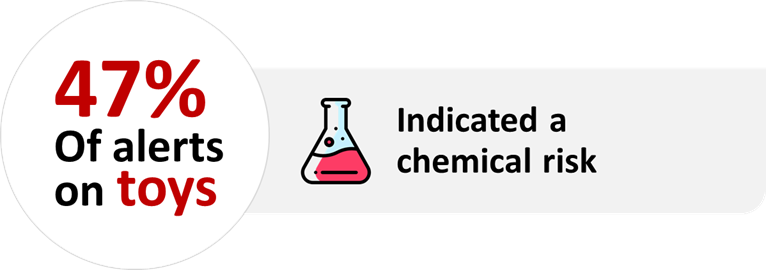
Chemical risk alerts on toys continue to be prominent each year, with the identification of many banned chemicals that pose serious risks to children’s health. Similar to previous years, in 2019, 47% of alerts about toys in Europe (RAPEX) indicated a chemical risk. One of the more common risks observed for the past few years has been the presence of phthalates in the plastics used to make dolls.

image-png-Mar-30-2021-04-11-17-08-AM

Source: RAPEX 2019

In this challenging context, where compliance challenges meet time to market pressures, anticipating and preventing these risks is crucial.

How can we ensure compliance while improving time to market?
Travel restrictions and numerous logistical and production uncertainties are adding additional pressure to supply chains and slowing down some of their processes. Validating samples has become a lengthier process in many cases. With many brands’ in-house teams unable to be onsite due to travel restrictions, a great deal of time is being spent in back-and-forth exchanges between factories and brands.

One of the most feared – and too-common – moments is being surprised with a ‘FAIL’ result in a pre-shipment test at the last minute, when timelines are tight.

Continuing the plastic dolls example, how can a brand anticipate risks and avoid this significant issue right before the shipment? The answer is simple: to anticipate risks as early as possible.

Instead of testing the PVC doll, brands and retailers can move upstream to, for example, track and test the PVC input and ensure it’s coming from an approved source. Where do the pellets originate? Who is the plastic supplier? This means taking a step back to evaluate the supplier’s performance based on the finished product and their processes and materials.

At API, we can help brands and retailers shorten their time to market with our onsite support and remote solutions, acting on behalf of brands onsite and guiding in-house teams remotely with our technical expertise. Our experts in Asia and Europe act as bridges between brand teams and factories, connecting your unique requirements with technical teams in the local language.

Some of our expert solutions for toys along the entire supply chain include:

Interested in learning more about our toy solutions?

Catégories
Actualités

L'API a partagé les meilleures pratiques sur le terrain à l'ICPHSO

API IPCHSO COLOR

API participated as a speaker at the ICPHSO (International Consumer Product Health and Safety Organization) 2021 Annual Virtual Meeting and Symposium last month. We had the opportunity to share some of the best practices by household goods and toy brands to mitigate risks during COVID-19.

Adjusting to the new normal and mitigating safety and quality risks has seen an evolvement in best practices among leading household goods and toy brands and retailers. Although contingency plans and strategies differ across companies, some have been repeatedly put into practice by many. We have identified the top 10 practices seen on the ground to ensure business continuity and ongoing safety and quality in the new normal, including:

  1. Tackling issues upstream: Sharpen your focus on the earlier stages of development and get support from third-party technical teams onsite when your own teams can’t travel.
  2. Relying on local experts: Bringing partners on board who can act and adapt onsite to minimize risk is pivotal when your own teams can’t be there.
  3. Using tech tools to increase your supply chain visibility: Capture and leverage the right data to follow your operations remotely and capitalize on similar advantages. Maximize your data through dedicated platforms that help capture, connect and analyze the intelligence, enabling faster, easier, and more informed decisions.

Interested in learning more about these and some of the other examples seen on the ground?

Catégories
Actualités

La nouvelle plateforme d'intégrité et de conformité des produits d'API : I-TCF

Brands and retailers globally are obligated to ensure their products are compliant with market destination standards and regulations. However, many factors make ensuring compliance a tricky task, including stricter regulations and increasing picking stores by the local authorities, the need for improved traceability and records, and the large number of references requiring time and technical staff.

Defining the applicable scope across different product categories requires expertise, while gathering all the necessary documentation from various supply chain stakeholders is a time-consuming task. This administrative burden also brings risk and the need for technical review, as nearly one document in every three reviewed by our experts is found to be not compliant. In many instances, it isn’t easy to handle this internally due to issues such as:

  • Complexity with keeping records up to date
  • Multiplicity of suppliers with different maturity and contact persons (to stay competitive and ensure good pricing, brands tend to diversify).
  • Multiple documents and files requiring the right expertise to collect the right documents, need to know the regulation covering the product in order to ask for the right docs
  • No dedicated team for the task: Dull task for brand’s engineers, very administrative. But cannot be done by someone without technical knowledge.
  • Process too slow vs. rotation of collections too fast
  • Significant time required
  • No proper interface to coordinate document collection and review


Introducing API’s I-TCF platform

To alleviate this challenge, API has launched its new I-TCF platform. Leveraging our 15 years’ experience in this service and the valuable feedback from our clients we have designed a new user-friendly platform that supports our I-TCF solutions, enabling you to easily keep your eyes on what matters: the completed files, the ones under completion, and those that will expire soon.

The I-TCF, or Integrity and Technical Compliance File, is a digital ID of your product and its proven compliance with the latest applicable standards and regulations, including:

  • Protocoles applicables
  • Document validation/rejection
  • Validity over time

The platform introduces a new way to manage documentation, proving compliance with increased visibility on products and status, such as:

  • Quality overview of your products
  • Document status and tracking
  • Alerts management
  • Regulatory watch

Suppliers can now benefit from the easy-to-use system by uploading the documents required to complete your I-TCF, receiving regular updates about your I-TCF status, as well as guidance from our experts on the next steps needed for any rejected documentation.

How API’s I-TCF platform can benefit your brand

  • Confidence in a correctly completed I-TCF
  • Fast reply to authorities – documents available in one click
  • Reduced time and costs, allowing internal teams to focus on core added-value missions:
    API’s team of experts complementing your teams on specific product categories
  • Executing document collection and verification

Interested in learning more about API’s I-TCF platform?

Catégories
Blogs

Safer toys: Managing risks from the early stages

2020 was a challenging year for most industries, driving companies to adapt and disrupt their habits and ways of doing business. Despite this, the global toy industry maintained stronger-than-expected performance, with parents and grandparents looking for new ways to keep children entertained at home.

This extraordinary context, however, brought unexpected pressures to supply chains – including shortages of qualified workers, limited access to materials, difficulties in performing quality checks, and more – adding to the existing challenge of meeting stringent regulations while ensuring the timely delivery of finished goods that meet consumer expectations. Regardless of changing circumstances, the responsibilities of toy- and children-related industries remain the same: guaranteeing the safety of products to ensure that little ones always ‘play safe’.

Despite global authorities and consumer associations putting vulnerable young consumers’ safety first, many risks and non-compliances are being uncovered. In Europe alone, toys were again the most notified product in 2019, representing 29% of RAPEX alerts.
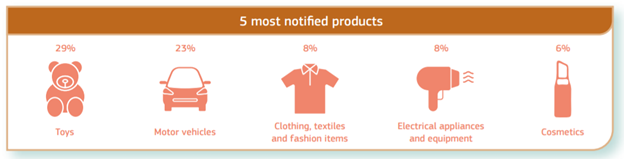
Source: RAPEX 2019 Annual Report

Today, the importance of adopting measures at the earliest stages of production is more crucial than ever, enabling brands to anticipate risks before production even begins to avoid ‘fail’ results in pre-production tests – or even worse – in pre-shipment tests. This can not only help brands save time and money but also prevent the feared product recall and consequent negative impacts.

Many precautions can be taken to secure the supply chain and reduce risks throughout the production process, such as factory audits, in-line inspections, and in-production assessments. However, some measures that can be adopted before production even starts, allowing brands to anticipate risks at the earliest stages.

Leveraging product and manufacturing expertise

At API, our product and manufacturing expertise – acquired daily, on the ground – allows us to identify and anticipate risks before they reach the production line. Our toy experts can guide and assess your teams from the design and prototype stages, helping you manage risks and make your products safer. We work closely with toy committees, keeping up to date with changes in standards and regulations and receiving the latest news on current areas of concern and hot industry topics.

Example
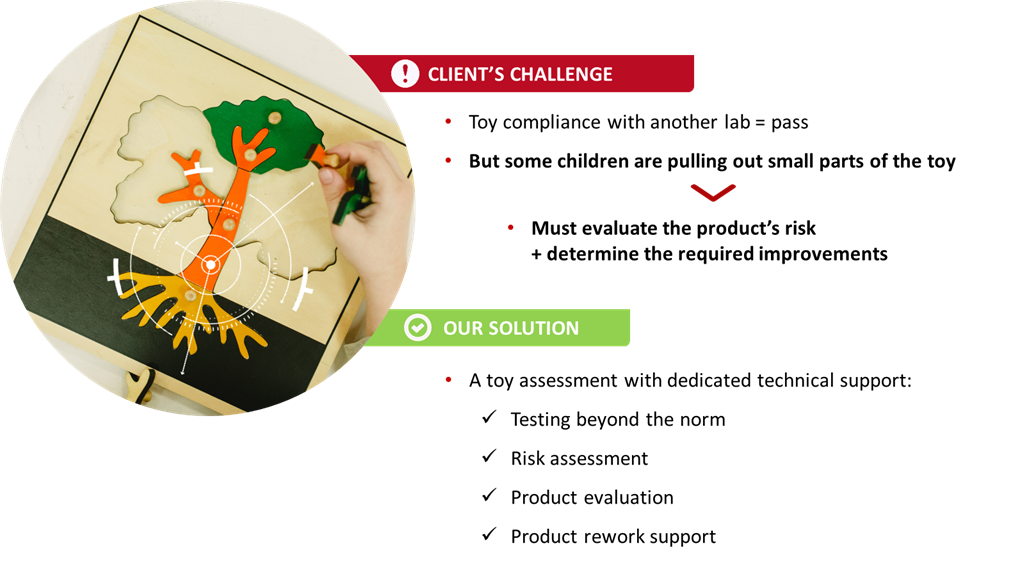

Some of our preventive solutions for toys in our laboratories in Asia and Europe include:

  • Product Validation Report: An exhaustive report highlighting golden sample specifications and flagging critical points that could represent a safety or quality risk. Also assesses the functionality and performance from an end-user’s perspective and provides in-depth evaluation of the toy marking.
  • Collection Review: A product review in the showroom that includes identifying risks and non-conformity of mechanical issues and advice from our experts and recommendations on product amelioration.
  • Risk Assessment on design or prototype: A risk evaluation at the initial stages of development, which identifies any critical areas for improvement and provides expert recommendations for increased product safety.
  • Marking verification: A review of regulatory markings and instruction manuals adapted to the appropriate age grade.
  • Recommendations on performance and fit-for-play: Adapted, tailor-made protocols that simulate the child’s use of and interest in the toy.
  • Pre-production test

Our experts can help you find the right solution for your needs in anticipating toy production risks.

Catégories
Actualités

L'API partage l'expertise de l'industrie à l'occasion de l'ICPHSO 2021

API will address the ‘new normal’ and share technical insights and expertise at the ICPHSO (International Consumer Product Health and Safety Organization) 2021 Annual Virtual Meeting and Symposium.

During a plenary session on ‘Practical Strategies for Business Continuity, Ongoing Product Safety, and Increased Visibility,’ Jennifer Miller, the senior director of business development, North America, for SgT (API’s sister company), will discuss the impacts of COVID-19 on supply chains and how companies should adapt to ensure business continuity and ongoing safety and quality through a ‘boots on the ground’, preventative approach.

About the Session

Plenary 3: “Practical Strategies for Business Continuity, Ongoing Product Safety, and Increased Visibility”

Thursday February 25, from 8:15AM to 9:00AM ET

Ensuring supply chain continuity while managing risk and disruption has become a key priority globally. Practices that ran smoothly before COVID-19 must now be reassessed, with the need to evaluate vendors and suppliers more carefully and develop processes that protect resilience. Traditional onsite product controls have been challenged by ongoing travel restrictions, budget constraints, lack of transparency, and more, compelling businesses to adapt and find new ways to safeguard continuity.

Securing product safety and quality in this ‘new normal’ requires visibility over the entire supply chain to better understand its composition and processes for greater traceability. With the help of advanced technologies and adaptable tools, teams can also remotely monitor this improved transparency to ensure product safety and quality in an unprecedented era.

Interested in learning more about this or other topics?

Catégories
Blogs

Collect the right data for product compliance with our I-TCF

Data has undoubtedly been one of this year’s most repeated words when discussing how to make supply chains more resilient. Collecting, sharing and analyzing the right data can enable the entire supply chain to run more efficiently thanks to more informed decisions. In the context of quality control, data remains one of the basics.

COVID-19 has brought unprecedented challenges to supply chains and highlighted the importance of increased visibility and agility to maintain product safety and quality. Ensuring product compliance with each market’s standards and regulations remains a key obligation of brands and retailers, but guaranteeing every document’s validity and accuracy is a tedious task.

Collecting the right information about a product to prove compliance with the latest applicable standards and regulations is time-consuming at best. On top of this already arduous task, brands and retailers must remain aware of changes in standards and regulations for numerous product references in their portfolio, which can be labor-intensive and prone to errors.

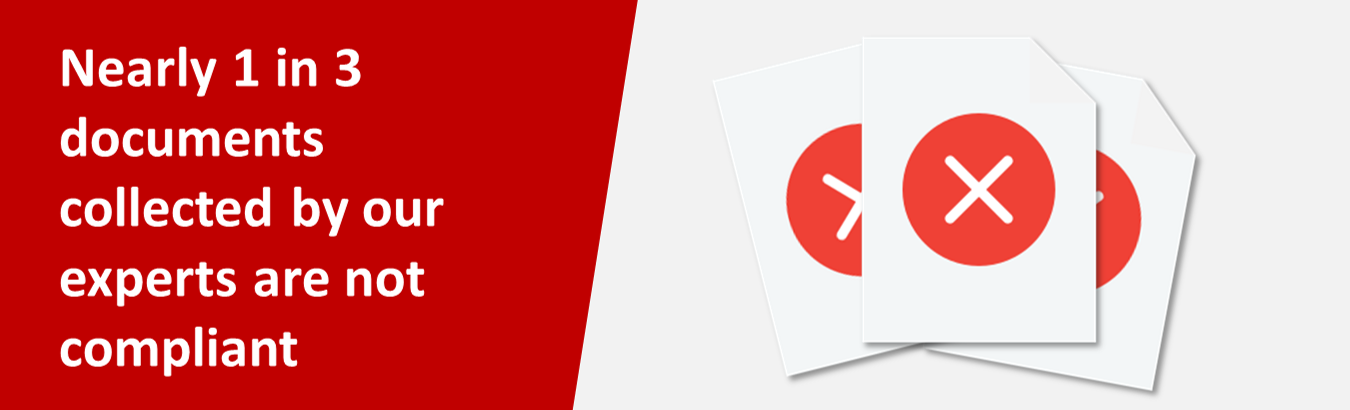
The I-TCF teams at API experienced that nearly one in three documents collected are not compliant and need additional follow-up steps to complete the TCF file according to requirements and establish the product’s conformity.

Documents_TCF_W

API’s team of experts can support companies in preparing a ‘digital ID’ of each product with our I-TCF solutions (Product Integrity and Technical Compliance File). This digital ID helps verify product compliance and includes key information such as applicable protocols, document validation or rejection, and validity over time. In addition to our experts’ regulatory guidance, brands appreciate the minimal investment required, enjoy a higher degree of control with our clear digital platform, and are ultimately ready to provide the valid required documentation in cases of custom verification. 

With more than 15 years’ experience developing I-TCF solutions, we can help brands and retailers save time and money on this task. We offer support with:

  • Définir le périmètre de conformité pertinent
  • Collecting and quickly validating a high volume of documents

Interested in finding out more about how our I-TCF solutions can help your brand?

Catégories
Actualités

Base de données SCIP pour les déclarations SVHC - à partir du 5 janvier

From January 5, 2021, the new SCIP database – the Substances of Concern In articles as such or in complex objects (Products) – will come into force. Established under the Waste Framework Directive (WFD), the database requires companies that supply articles containing substances of very high concern (SVHCs) on the Candidate List in a concentration above 0.1% weight by weight (w/w) in the EU market to submit information on these articles to the European Chemicals Agency (ECHA).

Companies in the household goods and toys segments also need to respond to this new directive when their articles or packaging contain a higher concentration than is allowed. Products at lower risk of such concentration levels will most likely be those made from inorganic materials such as metal or glass. On the other hand, consumer goods made of plastic, rubber, or with high levels of ink, paint or glue have higher chances of being at risk. The spectrum of products that can be affected is broad, ranging from such items as toys or inflatable articles, to luggage, outdoor furniture and other household goods. 

This database collects information about substances of concern, aiming to decrease the generation of waste containing hazardous substances and promote substitution. It will also contribute to a safer circular economy, providing waste operators with more information on the hazardous substances in the waste they process, making sorting waste easier and improving the quality of recycled materials due to greater visibility over chemicals. It will also allow consumers to make more informed purchasing decisions and choose safer products.


What needs to be submitted?

  • Information relevant to the identification of the article;
  • Name, concentration range, and location of the SVHC; and
  • Other information on the safe use of the article, particularly if the above information is not sufficient to ensure the proper management of the article as waste.

Who needs to submit information?

Companies supplying articles containing substances of very high concern (SVHC) on the Candidate List must be present in an article in a concentration above 0.1 % weight by weight, including:

  • EU producers and assemblers;
  • EU importers; and
  • EU distributors of articles and other actors who place articles on the market.

Retailers and other actors supplying articles directly to consumers are not obliged to submit information to ECHA.


Do you have questions about how the new SCIP database requirements may affect your business?

Catégories
Actualités

Amendement : Règlement européen relatif au contact des matières plastiques avec les denrées alimentaires

As per the updates on the Regulation (EU) 2020/1245 in September 2020, the European Union introduced amendments in Regulation (EU) No. 10.2011 on plastic materials and articles intended to come into contact with food. The new regulation came into force on September 23, 2020.

The most significant changes are:

Union list of authorized substances (Annex I)

  1. Some amendments on the following substances:
  • 1-3-phenylenediamine (CAS 108-45-2)
  • Antimony trioxide (1309-64-4).
  1. Three entries are newly added.

Specific migration (Annex II)

  1. Heavy metals – Newly added 9 heavy metals on top of the existing 9 heavy metals (total 18 heavy metals) are required:
  • Arsenic, Cadmium, Chromium, Europium, Gadolinium, Lanthanum, Lead, Mercury & Terbium. 
  1. Primary aromatic amines (PAA) – the detection limits for PAA are amended:
    • ≤ 0.002 mg/kg for each PAA listed in entry 43 Annex XVII to REACH Regulation No 1907/2006, and no migration limit is specified in Table 1 of Annex 1.
    • ≤ 0.01 mg/kg for the sum of PAAs not listed in entry 43 of Annex XVII to REACH Regulation, and no migration limit is specified in Annex I.


Declaration of Compliance (Annex IV)

  • Identification and quantity of substances in the intermediate materials are included.


Compliance Testing (Annex V)

  1. For repeated use materials and articles:
    1. The specific migration between subsequent tests does not increase (i.e. SM1 > SM2 > SM3). 
    2. Stability of the material and articles also need to be verified. In cases of insufficient stability, compliance of the material shall NOT be established, even in cases where the specific limit is not exceeded in any of the three tests.

  2. For overall migration testing conditions:
    • OM0 (new) – 30 minutes at 40°C for materials used only at cold or ambient temperatures for 30 minutes or less.
    • OM4 – reflux condition is available as one of the options.


Transitional Arrangements

  • Plastic materials and articles complying with Regulation 10/2011 as applicable before September 23, 2020, and which were first placed on the market before March 23, 2021, may continue to be placed on the market until September 23, 2022, and remain on the market until all stock has been sold
  • New materials and articles that were manufactured after September 23, 2020, need to comply with the new regulation starting March 23, 2021.

Do you have questions about this or other regulatory changes?

Catégories
Actualités

API au SYMPOSIUM VIRTUEL INTERNATIONAL DE L'ICPHSO 2020

API is glad to be participating as a sponsor at the 2020 ICPHSO International Virtual Symposium. The event will take place on October 27–28, 2020, in conjunction with the European Commission’s International Product Safety Week.

The focus of this year’s international symposium is ‘Safely sustainable: exploring how the concept of sustainability is impacting and shaping consumer product safety.’