Kostenlose Online-Schulung Higg FEM 4.0

Kategorien
Aktuelles

Kostenlose Online-Schulung Higg FEM 4.0

API Kostenloses Higg FEM 4.0 Schulungs-Webinar

Das Higg Facility Environmental Module (Higg FEM) ist ein Instrument zur Nachhaltigkeitsbewertung, das Hersteller, Marken und Einzelhändler über die Umweltleistung ihrer einzelnen Anlagen informiert und sie in die Lage versetzt, Verbesserungen im Bereich der Nachhaltigkeit zu erzielen.

Die nächste Version von Higg FEM (Higg FEM 4.0) wird in den kommenden Monaten offiziell veröffentlicht. Um sich auf die Aktualisierungen vorzubereiten, besuchen Sie unser kostenloses Schulungsseminar am 25. September 2023! Diese Schulung wird von unserem zugelassenen Ausbilder für SAC durchgeführt und bietet Ihnen die Möglichkeit, die Änderungen, die beim Übergang von Higg FEM 3.0 zu Higg FEM 4.0 vorgenommen werden, besser zu verstehen.

Sitzung 1

Datum: 25. September 2023 (Montag)

Zeit: 9:30 Uhr - 11:30 Uhr (Dhaka-Zeit UTC +06:00)

Klicken Sie hier, um sich jetzt anzumelden.

Sitzung 2

Datum: 6. Oktober 2023 (Freitag)

Zeit: 9:30 - 11:30 Uhr (Neu Delhi Zeit UTC+5:30)

Klicken Sie hier, um sich jetzt anzumelden.

Behandelte Themen

  • Kadenzzeitplan für Version 4.0
  • Higg FEM 4.0 Rahmen und Methodik
  • Die wichtigsten Änderungen in Higg FEM 4.0
  • Higg FEM 4.0 Inhalt der einzelnen Abschnitte
  • Wie man sich als Hersteller auf Higg FEM 2023 vorbereitet

Über API

API ist der Qualitätsspezialist für Haushaltswaren und Spielzeug der WORMS SAFETY Alliancedie erste globale Allianz von Spezialisten für Sicherheits- und Qualitätsmanagement. API wurde 1994 gegründet und ist ein führendes Qualitätsmanagement-Unternehmen, das sich auf Haushaltswaren von der frühen Entwicklungsphase bis zum Ende der Produktion spezialisiert hat. API zielt darauf ab, die Sicherheit und Qualität der Produkte seiner Kunden zu gewährleisten durch Inspektion, Laboruntersuchungen (Konformität und Leistung), I-TCF (Product Integrity and Technical Compliance File), Audits und Nachhaltigkeitslösungen.

API ist ein von der Sustainable Apparel Coalition (SAC) zugelassener Ausbilder und Prüfer für das Higg Facility Environmental Module (FEM).


Wir freuen uns darauf, Sie in den kostenlosen Webinaren kennenzulernen! Wenn Sie Fragen zu den Higg FEM-Dienstleistungen von API haben, kontaktieren Sie uns bitte!

Kategorien
uncategorized

Acceptable Quality Limit (AQL) For Product Inspections

API führt aus. Dienstleistungen im Bereich Produktkontrolle according to recognized international quality standard for product inspections: ISO 2859-1 (ANSI/ASQC Z1.4-2003), also known as the AQL Tables. Clients may request us to use an alternative standard if they have special requirements.

Inspektionsverfahren
What do we inspect during an inspection?
  • die produzierte Menge (halbfertig, fertig und verpackt)
  • Das optische Erscheinungsbild (kosmetische Kontrolle der Massenproduktion)
  • The product specifications (size, dimensions, colors)
  • Die Etikettierung und Kennzeichnung
  • Die Verpackung und die Verpackung
  • Alle möglichen Funktionen und Tests (Sicherheit, Missbrauch, Drucken, usw.)
What quality standards do we use for product inspections?

Based on the acceptable quality limit sampling size chosen from the AQL tables, we carefully ensure to select random production samples. We inspect each sample and classify the defects into critical, major and minor defects. We use detailed product checklists for these definitions. Your are invited to make amendments if there are any product-specific issues we need to take into account.

According to the number of defects found for each type, we will advise you to accept or to reject your shipment. You can then make your own decision based on the detailed report we have provided, discuss the findings with your vendor, ask him to rework, re-produce or sort out the defective products.

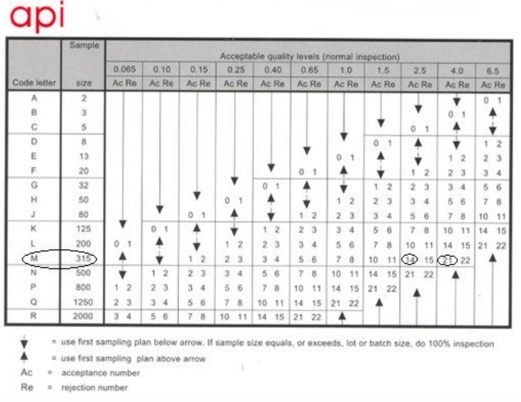
AQL-Tabelle für die API-Endkontrolle nach dem Zufallsprinzip
How to use the AQL tables?

Die AQL-Tabellen sind in die internationalen Qualitätsstandards integriert, um sicherzustellen, dass die Produktqualität Ihren Erwartungen entspricht.

The tables will determine the sampling size we inspect according to your order quantity and your Acceptable Quality Tolerance level (I, II or III). The standard AQL sampling plan used by 98% of the people is the level II for a normal product inspections.

If your order has multiple references, we should ideally perform a level II inspection on each reference, at the minimum.

For a standard order, the standard level II from the AQL gives the minimum sampling size we should check per reference if you do not want to take additional risks. If we inspect a general level II sampling size on multiple references orders, then the sampling size is diluted and divided by the number of references, increasing the risks as the sampling size must not be representative enough. More information about:

  • How to use the AQL table
  • Choosing the right AQL inspection level
How to find your sampling size on the AQL table?

To find the AQL sampling size for inspection, we look at the first chart and locate the range of total items produced on the left side. You have the choice of levels I, II and III, with Level III being the most stringent testing and level I being the least. Level II is the standard and is most commonly used. For example, if you are producing 8,000 items, at level II that results in the letter L which in turn corresponds to the inspection of 200 items in the second table.

On the top of the second AQL chart, you can find the defect levels, ranging from 0 to 6.5. Choose which level to apply to each type of defect: critical, major, and minor. Most importers usually choose standard defect levels which are 0/2.5/4, but you can pick 1/1/1 or 0/1.5/2.5 for high-risk products such as those in the automotive industry. Using the standard 0/2.5/4 defect levels and a sample size of 200, we see that if you have more than 0 critical defects, 10 major defects, or 14 minor defects, you should reject your shipment. Of course, the decision about what to do after your received the inspection results belongs to you. Most importers discuss all inspection findings with their vendor/manufacturer to improve wherever possible.

In case the inspection results are very close to AQL limits, it is important that you double check if the level of found defects is acceptable to you or not.

You can also use our AQL Calculator to define the sample size you need.

Kategorien
Aktuelles

API auf der ICPHSO-Jahrestagung 2023 und dem Schulungssymposium

API freut sich, an der ICPHSO-Jahrestagung und dem Ausbildungssymposium 2023 teilnehmen zu können. Das Symposium wird vom 20. bis 23. Februar 2023 in Orlando stattfinden. Das viertägige Symposium bietet Fachleuten für Produktsicherheit weltweit die Möglichkeit, sich über relevante Fragen der Produktsicherheit zu informieren und diese zu diskutieren und die Sicherheit von Konsumgütern auf der ganzen Welt weiter zu verbessern.

Auf der Website des ICPHSO finden Sie weitere Informationen zu der Veranstaltung: https://icphso.org/

Für weitere Informationen wenden Sie sich bitte an Ihren zuständigen Kundenbetreuer.

Kategorien
Blog

Toys go green, but are they safe?

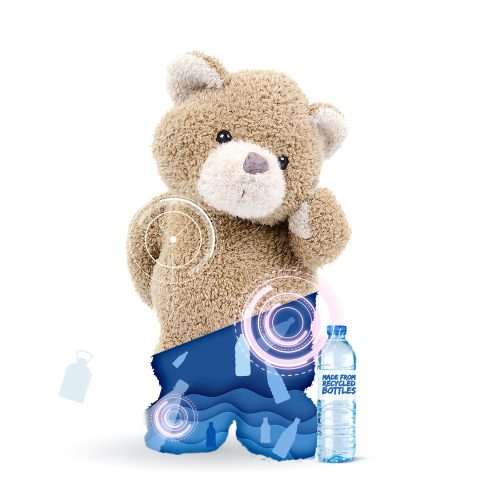
The sustainability mega-trend hasn’t missed the toy market. Today’s eco-conscious consumers have put toy makers under pressure to produce products that are sustainable, but the reality is that very few toys can be recycled. Most are made from a combination of plastics, metals, and other components that most recycling companies don’t accept. To put a number to it, experts suggest that the toy industry alone is on track to produce more than one million tons of plastic waste annually from 2023. In the face of this staggering plastics problem, the sustainable toy market is growing, valued at US$19 million in 2020 and forecast to reach US$60 million by 2030.

Environmental responsibility isn’t the only driving force behind the rise of green toys. Consumers have become more aware of the health effects of toxic chemicals and materials found in products intended for children and are demanding alternatives. Technological and material innovations have also advanced the sustainability quest, but obstacles remain in sourcing and testing. Furthermore, a combination of kids being stuck at home and eco-anxiety caused by the pandemic has accelerated consumer appetite for made-to-last, planet-friendly toys.

Many of the major players in the toy industry are leading the way to reduce the environmental impact of toys. The Lego Group is on a challenging mission to make all its core products out of sustainable materials by 2030, and by 2025, all its packaging will be made from renewable or recycled materials. The brand has also introduced an initiative (Lego Replay) that invites children to donate their pre-loved Lego bricks to children in need. Mattel Inc. has expanded its Mattel Playback program, which allows consumers to send back a broad range of Mattel toys for recycling and reuse. The brand has also introduced certified carbon-neutral toys and aims to use entirely recycled, recyclable, or bio-based plastics in all its toys and packaging by 2030.

It may be recycled, but is it safe?

Consumers naturally expect safe products from the brands they trust—especially those targeting children. When implementing sustainable materials and processes, toy brands must ensure that they’re not introducing products that may be dangerous for children. Toxic chemicals in toys are of particular concern, especially those made for kids under 3 because of their mouthing and rapid metabolic rate, high surface area to body weight ratio, and rapid physical development. The product safety risks of toys made with sustainability in mind include:

  • Recycled materials, such as plastic, may contain toxic chemicals due to exposure during the recycling process.
  • Toys made from recycled plastic may contain toxic chemicals such as flame-retardants (PBDEs, HBCDs) or POPs (persistent organic pollutants).
  • Sustainable toys may also contain toxic materials like lead paint on wooden toys.
  • Different mechanical properties may introduce risks: for example, a sustainable product may be more brittle and not pass all tests.
  • It’s difficult to be sure where old materials came from, and they may contain unknown chemical sources.

Most toy safety testing relates to chemicals, and any substances found to be potentially damaging to human health are immediately banned from the industry. Regulation in this area is increasing and becoming more expensive and challenging to navigate. A third-party expert can help you determine which tests are required based on your BOM and materials and work with you to streamline the testing process. This will not only enable you to stay ahead of regulations and avoid costly risks but will, most importantly, put your customers’ health and wellbeing first. It will also give you visibility over your supply chain so you can anticipate and manage risks throughout the product life cycle.


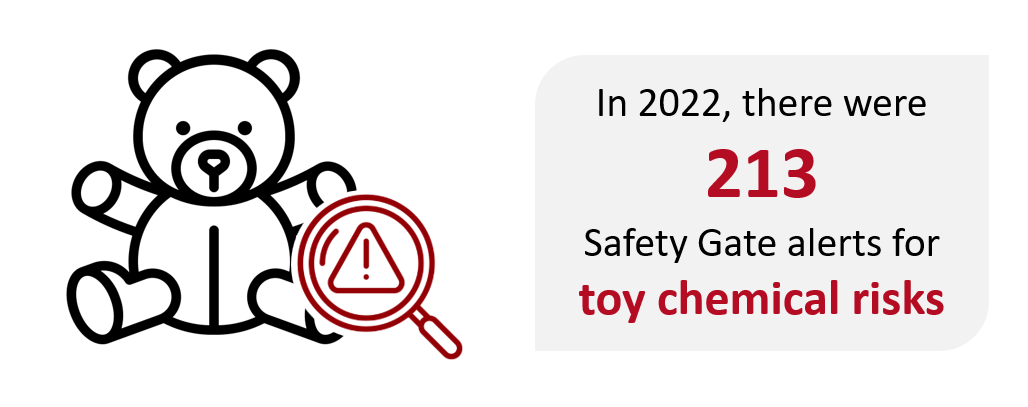
Missteps can be costly, and they do happen. In 2022, 213 toy products were recalled in Europe because of chemical risks.

By not actively managing your chemical risks, you risk a lot more: your brand reputation. After consumer trust satisfaction plummets, it can be a tall and expensive mountain to climb to win that trust back—especially for toy companies that are perceived to not care about the wellbeing of children. Mattel Inc., the largest brand in the US, recalled millions of toys in 2007 due to hazards from small, powerful magnets and lead paint. The recall costs and lawsuits have cost the brand over US$100 million, but the damage to brand reputation may cost them for many years to come.

How can toy brands align their sustainability efforts with the importance of product safety? Compliance is essential, but it’s only the starting block. Supply chain visibility, improved traceability, and scientific methods that help verify the origin of new materials and the potential presence of harmful substances can help you anticipate risks early on and focus on the areas where risks are highest, ultimately saving you time and money.

Chemical Risk Assessment is the identification and mapping of product risks based on:

  • Materials
  • Product group: e.g., toys for under 3 years
  • Factory performance: an audit be performed within the last 12 months
  • Industry insights: e.g., product recalls or newly banned substances

This risk-based approach allows you to maximize safety while managing costs.

API’s specialized solutions for sustainable toys

At API, we combine our on-the-ground experience with our scientific expertise in an end-to-end approach, allowing you to create more sustainable products that are still safe to use. Some of our specialized solutions include:

  • Chemische Risikobewertung
  • Rückverfolgbarkeit und verbesserte Transparenz in Ihrer gesamten Lieferkette
  • rPET testing, advanced testing that verifies and quantifies rPET in products to ensure your recycled polyester claims are genuine.  
  • Chem Scan Check™, a new testing approach that detects more than 250 chemical substances in one test.

Interested in finding out more about how our safety solutions can benefit your brand?

Kategorien
uncategorized

API’s Quality Solutions – ICPHSO 2023

Ihr Partner für Sicherheit und Konformität

API are the household goods and toys quality experts of the WORMS SAFETY Alliance. Established in 1994, API is trusted by some of the biggest retailers in Europe. We understand compliance comes first, but also that new challenges require a new approach. We can help you to stay ahead of the game, so you can create better products that are safe to use. We secure the safety and quality of our customers products via laboratory testing (compliance and performance), TCF (Product Technical Compliance File), audits, inspections and sustainability solutions made for this industry.

We understand that the current environment is very challenging. We can help you bring new thinking to transform increasing risks into opportunities

5 Reasons Why We Are Different

The expertise of a specialist

Return on investment oriented

Our DNA: ‘boots on the ground’

Not a one-size-fits-all provider

We make it simple

We Focus In 5 Strategic Areas

Technical expertise

Data Leverage

Innovation & Technologies

Tailor-made solutions

Sustainability, Traceability

We Put The Environment At The Heart Of What We Do

Umwelt-Audits

Sustainable Processes

- Environmental assessments
- Chemical assessments
- Verification of low impact processes
- Coaching of factories

Sustainable Products

- Life Cycle Assessments
- Product carbon footprint
- Green claims validation
- Hot-spots identification

We bring A DIFFERENT APPROACH TO SUPPORT YOUR BUSINESS GOALS

Risk Management: Optimizing Your Quality Budget

Allocate resources to the products and suppliers that need the most technical support – the higher the risk in one dimension, the higher the control and monitoring required.

Recycled Polyester Testing – Verification & Quantification

Ensure your recycled polyester claims are genuine.

Following years of research, Worms Safety Laboratories have pioneered an innovative solution to detect and quantify rPET in textiles. Increasing regulation and consumer expectations has increased the need for substantiation of claims.

Even if you know your supply chain, relying solely on someone else’s information and declarations is risky. Accurate scientific testing is the only way to verify the genuineness and amount of rPET within raw materials.

Chem Scan Check™(CSC)

To support our partners in chemical risk management, we developed Chem Scan Check™ (CSC), which scans for more than 285 hazardous chemical substances in one go. Instead of waiting and paying for multiple tests on expected chemicals with a traditional testing approach, we offer our partners wider visibility, in 72 hours so they can anticipate and mitigate risk.

A chemical scan that gives you visibility on almost all hazardous substances to help prevent ‘unexpected’ non-compliance risks in only 72h.

Kategorien
Aktuelles

API auf der Spielwarenmesse® 2023, Spielwarenmesse Nürnberg

Wir freuen uns, unsere Teilnahme an der Spielwarenmesse® 2023 in Nürnberg vom 1. bis 5. Februar 2023.

Sind Sie auch auf der Spielwarenmesse® 2023? Besuchen Sie uns an unserem Stand B-76 in Halle 7 und entdecken Sie APIs innovative Lösungen und bewährte Verfahren für das Qualitätsmanagement von Spielzeug. Buchen Sie Ihren Termin für ein Gespräch mit unserem Team! 

APIs Lösungen für Spielzeug: Dem Spiel immer einen Schritt voraus

API sind die Spielzeugqualitätsexperten der WORMS SAFETY Alliance. API wurde 1994 gegründet und genießt das Vertrauen einiger der größten Einzelhändler in Europa. Wir wissen, dass die Einhaltung von Vorschriften an erster Stelle steht, aber auch, dass neue Herausforderungen einen neuen Ansatz erfordern. Wir können Ihnen helfen, der Zeit voraus zu sein, so dass Sie bessere Produkte herstellen können, die sicher in der Anwendung sind. Wir gewährleisten die Sicherheit und Qualität der Produkte unserer Kunden durch Laboruntersuchungen (Einhaltung und Leistung), TCF (Technische Produktkonformitätsdatei), Audits, Inspektionen und Nachhaltigkeitslösungen für diese Branche gemacht.

Kategorien
uncategorized

API’s Toy Quality Solutions – Spielwarenmesse

STAY AHEAD OF THE GAME

Ihr Partner für Sicherheit und Konformität

API are the toy quality experts of the WORMS SAFETY Alliance. Established in 1994, API is trusted by some of the biggest retailers in Europe. We understand compliance comes first, but also that new challenges require a new approach. We can help you to stay ahead of the game, so you can create better products that are safe to use. We secure the safety and quality of our customers products via laboratory testing (compliance and performance), TCF (Product Technical Compliance File), audits, inspections and sustainability solutions made for this industry.

As your partner, API’s toy quality control specialists work with you on-site in your factory, or that of your suppliers, to offer QC solutions which assure your toys and children’s products adhere to the strictest international standards. These solutions include supplier audits and quality inspections throughout production. Our toy quality management service assures your toys' safety and compliance from raw materials, to production line, and pre-shipment inspections; finally progressing onto continuous random inspections for subsequent shipments too. In addition, our fully accredited Asian and European laboratories conduct a full spectrum of mechanical, material, and chemical tests on toys, ensuring their safety and compliance with your local regulations.
Spielzeug-Labortests

API offer comprehensive laboratory testing for all international toys tests at our labs in Asia and Europe. We are accredited (COFRAC, EN 71-1/2/3).

  • Rohmaterialprüfung: Analyse der eingesetzten Werkstoffe auf Reinheit und Sicherheit. 
  • Elektrische Sicherheit: Überprüfung von elektronischen Komponenten und batteriebetriebenen Spielzeugen.
  • Entflammbarkeitstests: Prüfung des Brennverhaltens gemäß geltenden Sicherheitsnormen.
  • Physical and Mechanical
  • Fit for Use and Performance

We understand the new risks (sustainable materials, chemical management), and we can go further to make your products safer.

Lösungen zur Sicherung der Spielzeugqualität

Vom ersten Produktdesign über die Entwicklung bis hin zum fertigen Versand – API bewertet und sichert die Konformität Ihrer Lieferanten und Produkte mit folgenden Lösungen: 

  • Auditierung von Zulieferbetrieben: Umfassende Vor-Ort-Prüfung Ihrer Partner zur Sicherstellung von Qualitäts- und Sozialstandards.
  • Rohmaterialprüfung & Design-Check: Strategische Analyse und Entwurfsbewertung zur Vermeidung von Fehlern vor Produktionsbeginn.
  • Fertigungsbegleitende Qualitätskontrollen: Überwachung der laufenden Produktion, um Abweichungen sofort zu korrigieren.
  • Endkontrollen vor dem Versand (Pre-Shipment Inspections): Finale Stichprobenprüfungen, bevor die Ware das Werk verlässt.
rPET_lr
Recycled Polyester Testing – Verification & Quantification

Ensure your recycled polyester claims are genuine.
Following years of research, Worms Safety Laboratories have pioneered an innovative solution to detect and quantify rPET in textiles. Increasing regulation and consumer expectations has increased the need for substantiation of claims. Even if you know your supply chain, relying solely on someone else’s information and declarations is risky. Accurate scientific testing is the only way to verify the genuineness and amount of rPET within raw materials.

Chem Scan Check™(CSC)

To support our partners in chemical risk management, we developed Chem Scan Check™ (CSC), which scans for more than 285 hazardous chemical substances in one go. Instead of waiting and paying for multiple tests on expected chemicals with a traditional testing approach, we offer our partners wider visibility, in 72 hours so they can anticipate and mitigate risk.

A chemical scan that gives you visibility on almost all hazardous substances to help prevent ‘unexpected’ non-compliance risks in only 72h.

Kategorien
Aktuelles

API auf dem internationalen Symposium 2022 der ICPHSO

API freut sich, als Sponsor am internationalen ICPHSO-Symposium 2022 "Redefining Key Concepts of Product Safety" teilzunehmen. Das Symposium wird am 14. und 15. November 2022 in Brüssel stattfinden. Das eineinhalbtägige Symposium bietet Fachleuten für Produktsicherheit die Möglichkeit, an Diskussionen teilzunehmen, die die Sicherheit von Konsumgütern auf der ganzen Welt weiter verbessern.

Auf der Website des ICPHSO finden Sie weitere Informationen zu der Veranstaltung: https://icphso.org/

Für weitere Informationen wenden Sie sich bitte an Ihren zuständigen Kundenbetreuer.

Kategorien
Blog

Alles dreht sich um die Sicherheit: Verringerung der Risiken nachhaltiger Küchengeräte

Blog - It all boils down to safety: Reducing the risks of sustainable kitchenware

Die globale Nachhaltigkeitsbewegung hat auch dazu geführt, dass die Verbraucher sichere und zuverlässige Küchenprodukte suchen, die sich positiv auf den Planeten auswirken. Während die Verbraucher früher Bedenken wegen der mit Antihaft- oder Aluminiummaterialien verbundenen Risiken hatten, konzentrieren sich die Marken jetzt auf recycelte Materialien und nachhaltige Prozesse und darauf, ob sie neue Risiken für die Sicherheit von Küchengeräten mit sich bringen.

Die Nachfrage nach Kochgeschirr für den Hausgebrauch steigt sprunghaft an, sei es durch den Anstieg der Hausmannskost während der Pandemie oder durch die wachsende Popularität von Kochsendungen und Modulküchen. Überall sind die Verbraucher damit beschäftigt, neue Rezepte auszuprobieren, ihre Fähigkeiten zu verbessern und ihr altes Kochgeschirr durch neue Produkte zu ersetzen.

Lebensmittelkontakt / Küchengeräte - eine stark regulierte Branche

Der Bereich Küchenutensilien und Kochgeschirr ist seit langem stark reguliert, und es gelten strenge Normen, um sicherzustellen, dass die Produkte die Gesundheit und Sicherheit der Verbraucher nicht gefährden. Da Küchenutensilien häufig direkt mit Lebensmitteln in Berührung kommen, besteht eines der Hauptrisiken darin, dass diese Materialien möglicherweise Chemikalien enthalten, die auf die Lebensmittel übergehen könnten, die sie berühren. Die Verbraucher neigen dazu, darauf zu vertrauen, dass die Produkte, die sie kaufen, sicher sind, aber wie können sie sich dessen sicher sein - vor allem angesichts der ständigen Veränderungen von Materialien und Prozessen, die durch den Nachhaltigkeitsgedanken vorangetrieben werden?

In den meisten Ländern der Welt gelten strenge Vorschriften für Produkte und Materialien, die mit Lebensmitteln in Berührung kommen, wobei die Regeln je nach Land und Material variieren. So müssen Produkte, die in der EU und den USA verkauft werden, Vorschriften wie die EG Nr. 1935/2004 (EU) und die FDA 21 CFR (USA) einhalten. Verschiedene Länder in der EU haben zusätzliche Vorschriften, wie z. B. das LFGB-Gesetz in Deutschland und die Empfehlungen der DGCCRF in Frankreich.

Diese Verordnungen beziehen sich in der Regel auf die gebräuchlichsten Materialien für Küchengeräte wie Kunststoffe, Silikone und Gummi, Metalle und Legierungen, Keramik, Holz, Papier und Pappe sowie Lacke und Endbeschichtungen. Die spezifischen Kriterien hängen nicht nur von der Art des Materials, sondern auch von seinem Verwendungszweck ab. So kann eine Verordnung beispielsweise berücksichtigen, ob ein Behälter aus Kunststoff oder Keramik besteht und ob er für wässrige Lebensmittel wie Wasser oder Kaffee, für säurehaltige Lebensmittel wie Saft oder für alkoholische Getränke wie Bier oder Wein verwendet werden soll und ob er für heiße oder kalte Speisen bestimmt ist.

Es mag überraschen, aber auch heute noch werden auf den Zielmärkten Risiken festgestellt, selbst für bekannte Marken. Solche Ereignisse können nicht nur dem Image der Marke schaden, sondern auch zusätzliche Risiken mit sich bringen, wenn die Marke mit einer Geldstrafe oder einem Produktrückruf belegt wird. Nicht einmal große Marken sind gegen Produktrückrufe gefeit, wie beispielsweise die globale Möbel- und Dekormarke, die eine Tasse vom Markt nehmen musste, bei der festgestellt wurde, dass sie möglicherweise übermäßige Mengen an Dibutylphthalat (DBP) enthält.

Nachhaltige Materialien und Schadstoffe

Der weltweite Wandel hin zu nachhaltigen Produkten und einer Kreislaufwirtschaft ist zwar eine gute Nachricht für unseren Planeten, bringt aber auch neue Risiken mit sich, die die Produktsicherheit gefährden können. Eines von vielen Beispielen ist die Verwendung von recycelten Materialien, die aufgrund der mangelnden Transparenz über die Herkunft der Materialien und der potenziellen Verwendung schädlicher Chemikalien bei der Umwandlung von Rohstoffen in fertige Produkte mit Risiken verbunden sind.

Wie können Marken also ihr Streben nach mehr Nachhaltigkeit mit der Bedeutung der Produktsicherheit in Einklang bringen? Klare Sichtbarkeit in der Lieferkette, verbesserte Rückverfolgbarkeit und wissenschaftliche Methoden, mit denen die Herkunft neuer Materialien und das mögliche Vorhandensein von Schadstoffen überprüft werden können, sind einige der Trends, die sich durchsetzen, um eine nachhaltige und sichere Zukunft zu gewährleisten.

Andere Risiken, über die man nachdenken sollte

Während man bei Materialien, die mit Lebensmitteln in Berührung kommen, oft zuerst an chemische Risiken denkt, gibt es bei Küchenzubehör auch einige physikalische Risiken in Bezug auf Ermüdung, Korrosion und Hitzebeständigkeit sowie thermische Gefahren. Das heißt, wenn sie als mikrowellengeeignet oder spülmaschinenfest vermarktet werden, müssen sie die Hitze oder das Wasser aushalten können, ohne zu zerbrechen oder Schaden zu nehmen. Physikalische Risiken werden auf dem Markt für Küchengeräte ebenfalls häufig festgestellt. Die häufigsten Rückrufe betreffen die Gefahr von Verletzungen und Verbrennungen, weil die Produkte unter Hitzeeinwirkung brechen, oder die Gefahr von Verletzungen durch Risse im Produkt.

Über die Einhaltung der Vorschriften hinausgehen

Die Branche für Küchenutensilien und -zubehör ist sehr wettbewerbsintensiv. Zahlreiche Marken konkurrieren um die Aufmerksamkeit der Verbraucher inmitten ständiger Produktneuentwicklungen und Preiskämpfe. Dies erhöht die Komplexität für Marken und Einzelhändler und macht deutlich, wie wichtig Innovation und Gebrauchstauglichkeit sind, um Produkte auf den Markt zu bringen, die den Erwartungen der Verbraucher entsprechen.

In diesem anspruchsvollen Umfeld, in dem die Lieferketten unter ständigem Druck stehen und Lieferverzögerungen die Lieferzeiten gefährden, ist die Gewährleistung von Produktqualität und -sicherheit vor Das Ende der Produktion ist entscheidend, damit Sie es beim ersten Mal richtig machen.

API's spezialisierte Lösungen für Küchengeräte

API hilft Marken und Einzelhändlern, die Sicherheit, Qualität und Leistung ihrer Küchengeräte mit maßgeschneiderten Lösungen zu gewährleisten. Einige unserer wichtigsten Bereiche der Unterstützung umfassen:

  • Laboruntersuchungen: Prüfung nach EU-/US- oder länderspezifischen Richtlinien zur Aufrechterhaltung der chemischen und physikalischen Sicherheit sowie Prüfung nach spezifischen Protokollen zur Gewährleistung von Leistung und Gebrauchstauglichkeit.

    Zwei unserer jüngsten Innovationen zur Unterstützung von Marken und Einzelhändlern auf ihrem Weg zur Nachhaltigkeit sind:
    - Prüfung von recyceltem Polyester zur Überprüfung und Quantifizierung des Anteils von recyceltem Polyester in Ihren Produkten.
    - Chem Scan Check - eine wissenschaftliche Screening-Methode, die in einem einzigen Test mehr als 285 Substanzen nachweisen kann, um sicherzustellen, dass keine unerwarteten Schadstoffe enthalten sind.

  • Unterstützung der Produktentwicklung: Identifizierung kritischer Bereiche und Empfehlungen für Anpassungen in der Entwurfs- oder Kaufphase.
  • Datei zur technischen Übereinstimmung: Überprüfung der Dokumentation, die die Übereinstimmung des Produkts mit den Protokolldefinitionen bescheinigt, von der Erfassung und Überprüfung der Dokumente bis zur Ausstellung des Berichts.
  • Fabrik-Audits: Fabrikbewertungen, bei denen die Fähigkeiten der Fabrik bewertet werden, die Produktionsstandards zu erfüllen und sichere Produkte rechtzeitig zu liefern.
  • Engagierte Programme: Maßgeschneiderte Programme, die auf die Bedürfnisse jedes Kunden abgestimmt sind und Unterstützung in jeder Phase der Lieferkette bieten.

Möchten Sie mehr erfahren über API's Lösungen für Küchengeräte?

Kategorien
Blog

How your brands can become more socially responsible

Today’s socially conscious consumers want more than just a product, and here’s why brands must adapt

In the last few years, we have seen companies and brands increasingly change the way they operate. The views of the customer are evolving and companies and brands need to adapt quickly. The coronavirus pandemic catalyzed a debate about the broader impact of human actions, with people concerned about the way we live, issues of social justice, and our destruction of the environment.

Increasingly, customers value companies and brands they can trust. Today’s consumer wants to purchase from companies and brands that are transparent in their work, create an impact, offer sustainable alternatives to regular products, and are vocal about causes that matter. Consumers have rising concerns about climate change, pollution, biodiversity loss, resource scarcity and the wider well-being of society. These changing behaviors and values regarding environmental friendliness, social responsibility, and economic inclusiveness translate into a demand for corporate change.

In the last few years, we have seen companies and brands increasingly change the way they operate. The views of the customer are evolving and companies and brands need to adapt quickly. The coronavirus pandemic catalyzed a debate about the broader impact of human actions, with people concerned about the way we live, issues of social justice, and our destruction of the environment. Increasingly, customers value companies and brands they can trust. Today’s consumer wants to purchase from companies and brands that are transparent in their work, create an impact, offer sustainable alternatives to regular products, and are vocal about causes that matter. Consumers have rising concerns about climate change, pollution, biodiversity loss, resource scarcity and the wider well-being of society. These changing behaviors and values regarding environmental friendliness, social responsibility, and economic inclusiveness translate into a demand for corporate change

Source: How sustainability is fundamentally changing consumer preferences – Capgemini

The global consumer goods industry is increasingly implicated in the debate because it faces significant challenges of its own and because many of its consumers are leading the movement for change. According to the Capgemini Research Institute, 79% of consumers are changing purchase preference based on the social responsibility, inclusiveness or environmental impact of their purchases.

Most companies, regardless of their size, are realizing the importance of creating products that show their brand positioning as a company that cares for the causes close to their heart. From environmental issues to social justice, it comes down to simply making a difference.

Additionally, there is increasing pressure from countries and NGOs, with continuous initiatives to reinforce control and ensure more responsible practices. The European Commission, for instance, recently proposed an import ban on products manufactured using forced labor, a proposal that still requires discussion and agreement by the European Parliament and the Council of the European Union before it is legislated, but that demonstrates the mechanisms under consideration to stop forced labor and modern slavery.

Frequent industry issues and the growing initiatives against

While there has been great improvement in recent years, the industry still struggles with ethical issues. Some of the most frequent issues found in the fashion industry include low wages, child labor, animal cruelty, health and safety risks, and environmental issues. The list, unfortunately, goes on.

Some initiatives for change could include:

  • Checking the material and product sources.
  • Repurposing old items and using pieces of them to create other products.
  • Supporting Community Fair Trade (different programs).
  • Supporting Ethical Trade (Ethical Trade Program, Supplier Code of Conduct).
  • Creating inclusive pieces that can be available for everyone. 
  • Changing packing in favor of more sustainable solutions. 
  • Taking a stand in helping the planet and being overall more environmentally conscious: generating less waste, reduction of CO2 emissions, electricity consumption, increasing the amount of recyclable material, decreasing unnecessary packaging materials. 
  • Being open about values, mission, and what they stand for while also taking action in these areas.
  • Taking a stand against animal cruelty.
  • Better treatment of workers.

The industry-wide initiatives around sustainability and CSR are endless, and these examples can be considered as good starting points.

There are many industry initiatives and reference tools that set the guidelines and requirements brands must follow to be more socially and environmentally responsible. Some of the most well-known ones include:

  • Sedex: Supplier Ethical Data Exchange
  • ICS: Initiative for Compliance and Sustainability
  • SLCP: The Social and Labor Convergence Program
  • ILO Conventions: International Labour Organization Conventions

How Our Expert Support Can Help You

At API, we provide expert solutions to support our customers in their CSR journey. Some of our programs include:

  •  Social audit assessment:
    – As per the defined code of conduct (ICS, Sedex, SCLP, ILO Conventions)
    – Tailor-made based on industry / your code of conduct / API’s standards and local labor laws
  • Supplier capacity building
    – Different programs for different suppliers (new, strategic, low performing, those with zero tolerance, however willing to improve, etc.)
  • Stake holders coaching
    – Awareness and pre-assessment set-up program for internal teams (audit, sourcing…)
  • Code of conduct, manual, audit guidelines creation & review
    – Creation from ground zero and based on your requirements, or review of existing materials – all with the support of our team of experts
  • Program benchmarking services for strategic suppliers
    – Assessment and program recommendation, report, monitoring

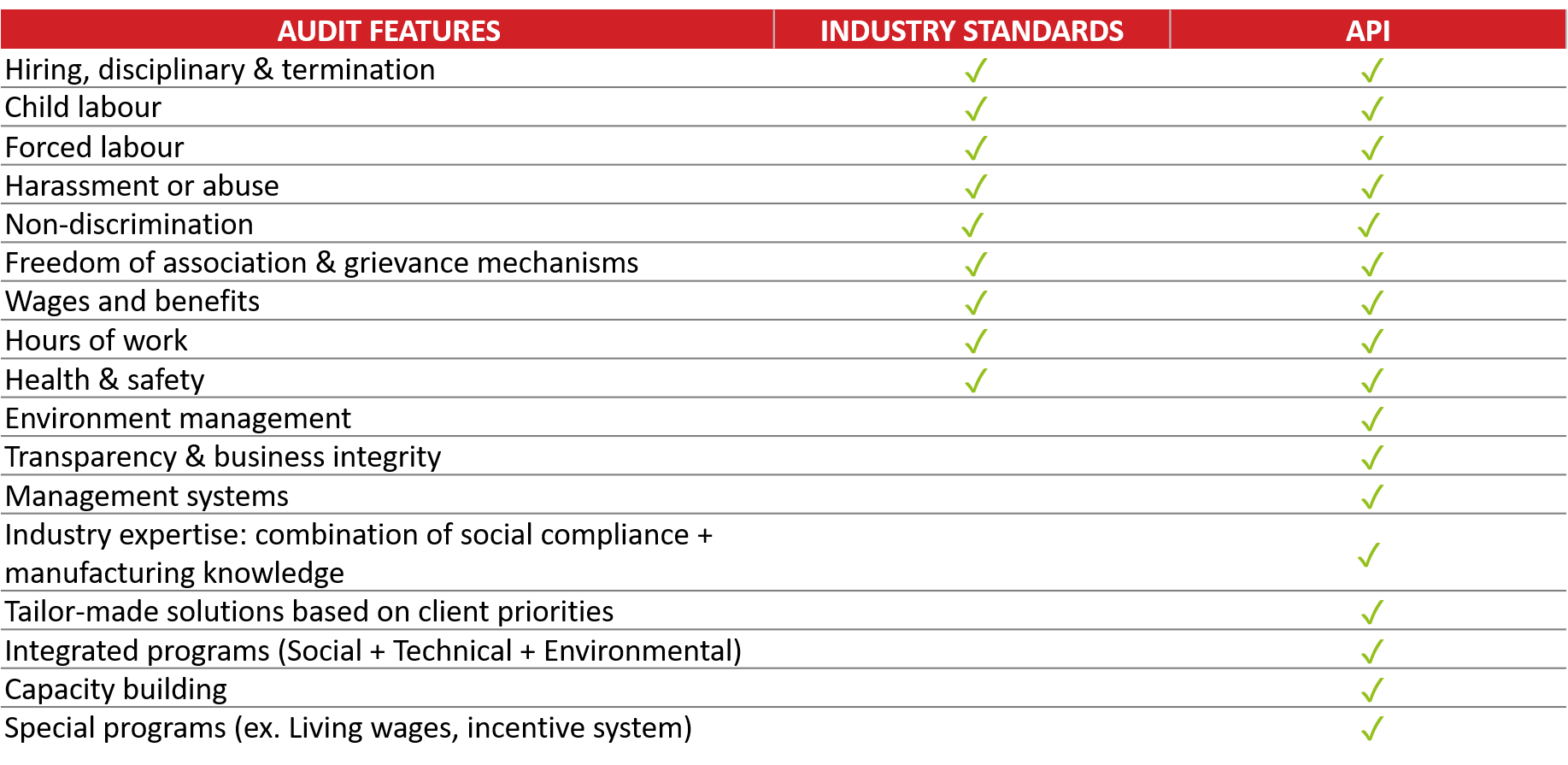
    Thanks to our boots-on-the-ground approach, we offer adapted solutions to our customers that go beyond the traditional industry standards. We put our expertise at the service of our customers with concrete solutions that leverage our daily presence in factories, such as follow-up on sustainability. 

Interested in finding out more about our CSR solutions?