It all boils down to safety: Reducing the risks of sustainable kitchenware

Categorías
Blogs

It all boils down to safety: Reducing the risks of sustainable kitchenware

Blog - It all boils down to safety: Reducing the risks of sustainable kitchenware

The global sustainability movement has also led consumers to pursue safe and reliable kitchen products that positively impact the planet. While consumers once shared a concern about risks associated with non-stick or aluminum materials, brands are now focusing on recycled materials and sustainable processes and whether they’re introducing new risks to kitchenware safety.

Demand for home cookware products is skyrocketing due to everything from the rise of home cooking during the pandemic to the growing popularity of cooking shows and modular kitchens. Consumers everywhere have been busy trying new recipes, improving their skills, and looking to replace their old cookware with new items.

Food Contact / Kitchenware - A highly regulated industry

The kitchen utensils and cookware segment has long been highly regulated, with strict standards in place to ensure products don’t jeopardize the health and safety of consumers. Since kitchenware often comes into direct contact with food, one of the key risks centers on the potential presence of chemicals in these materials that could potentially migrate to the foods they touch. Consumers tend to trust that the products they purchase are safe, but how can they be certain – especially amid constant changes to materials and processes driven by the sustainability push?

Most countries around the world have strict regulations for products and materials that come into contact with food, and the rules vary based on the country and material. For instance, products sold in the EU and the US need to follow regulations such as the EC No. 1935/2004 (the EU) and the FDA 21 CFR (the US). Different countries in the EU have additional regulations, such as the LFGB Law in Germany and the DGCCRF recommendations in France.

These regulations typically cover the most common kitchenware materials, such as plastics, silicone and rubbers, metals and alloys, ceramics, wood, paper and board, and varnishing and end coating. The specific criteria depends not only on the type of material but its intended use. For example, a regulation may consider whether a container is plastic or ceramic and if it’s intended to be used for aqueous food such as water or coffee, acidic foods like juice, or alcoholic beverages like beer or wine, and if it’s designed for hot or cold.

It might seem surprising, but risks are still identified today in destination markets, even for well-known brands. Such events can not only damage the brand’s image but can also generate additional risks if the brand is subject to a fine or a product recall. Not even major brands are immune to product recalls, such as the global furniture and décor brand that had a mug recalled from the market that was found to be potentially migrating excessive levels of dibutyl phthalate (DBP).

Sustainable materials and harmful substances

While the global shift toward sustainable products and a circular economy is great news for the planet, it’s bringing with it new risks that may put product safety in danger. As one of many examples, the use of recycled materials is subject to risks due to the lack of visibility over the materials’ origin and the potential use of harmful chemicals in the transformation of raw materials to finished goods.

So, how can brands align their quest for increased sustainability with the importance of product safety? Clear visibility over the supply chain, improved traceability, and scientific methods that help verify the origin of new materials and the potential presence of harmful substances are some of the trends gaining traction to ensure a future that’s both sustainable and safe.

Other risks to think about

While chemical risks often come to mind first when discussing food contact materials, kitchen accessories have some associated physical risks related to fatigue, corrosion, and heat resistance as well as thermal hazards. Simply put, they need to fit their expected use, meaning if they’re marketed as microwave-safe or dishwasher-resistant, they must be able to handle the heat or water without breaking or suffering damage. Physical risks are also frequently identified in the kitchenware market, with the most common recalls including the risk of injury and burns due to products breaking under heat exposure, or laceration hazards resulting from product cracks.

Going beyond compliance

The kitchen utensils and accessories industry is highly competitive, with numerous brands competing for consumer attention amid constant product redevelopments and price battles. This adds additional complexity for brands and retailers, highlighting the importance of innovation and fit-for-use to bring products to the market that meet consumer expectations.

In this challenging environment in which supply chains are under constant pressure and shipping delays put delivery times at risk, ensuring product quality and safety before the end of production is key, so you ‘get it right the first time.’

API’s specialized solutions for kitchenware

API helps brands and retailers ensure their kitchenware’s safety, quality, and performance with tailor-made solutions. Some of our key areas of support include:

  • Laboratory testing: Testing according to EU/US or country-based directives to maintain chemical and physical safety, as well as testing with specific protocols to ensure performance and fit-for-use.

    Two of our latest innovations to support brands and retailers in their sustainability journeys include:
    – Recycled polyester testing to verify and quantify the amount of recycled polyester in your products.
    – Chem Scan Check – a scientific screening method that can detect 285+ substances in a single test to ensure there are no unexpected harmful substances.

  • Product development support: Identification of critical areas and recommendations for adjustment at the design or purchase stage.
  • Technical Compliance File: Documentation review that attests product compliance according to protocol definitions, from document collection and verification to report issuance.
  • Factory audits: Factory evaluations that assess factory capabilities to meet production standards and deliver safe products on time.
  • Dedicated programs: Bespoke programs based on each client’s needs that provide support at every stage of the supply chain.

Interested in learning more about API’s kitchenware solutions?

Categorías
Blogs

How your brands can become more socially responsible

Today’s socially conscious consumers want more than just a product, and here’s why brands must adapt

In the last few years, we have seen companies and brands increasingly change the way they operate. The views of the customer are evolving and companies and brands need to adapt quickly. The coronavirus pandemic catalyzed a debate about the broader impact of human actions, with people concerned about the way we live, issues of social justice, and our destruction of the environment.

Increasingly, customers value companies and brands they can trust. Today’s consumer wants to purchase from companies and brands that are transparent in their work, create an impact, offer sustainable alternatives to regular products, and are vocal about causes that matter. Consumers have rising concerns about climate change, pollution, biodiversity loss, resource scarcity and the wider well-being of society. These changing behaviors and values regarding environmental friendliness, social responsibility, and economic inclusiveness translate into a demand for corporate change.

In the last few years, we have seen companies and brands increasingly change the way they operate. The views of the customer are evolving and companies and brands need to adapt quickly. The coronavirus pandemic catalyzed a debate about the broader impact of human actions, with people concerned about the way we live, issues of social justice, and our destruction of the environment. Increasingly, customers value companies and brands they can trust. Today’s consumer wants to purchase from companies and brands that are transparent in their work, create an impact, offer sustainable alternatives to regular products, and are vocal about causes that matter. Consumers have rising concerns about climate change, pollution, biodiversity loss, resource scarcity and the wider well-being of society. These changing behaviors and values regarding environmental friendliness, social responsibility, and economic inclusiveness translate into a demand for corporate change

Source: How sustainability is fundamentally changing consumer preferences – Capgemini

The global consumer goods industry is increasingly implicated in the debate because it faces significant challenges of its own and because many of its consumers are leading the movement for change. According to the Capgemini Research Institute, 79% of consumers are changing purchase preference based on the social responsibility, inclusiveness or environmental impact of their purchases.

Most companies, regardless of their size, are realizing the importance of creating products that show their brand positioning as a company that cares for the causes close to their heart. From environmental issues to social justice, it comes down to simply making a difference.

Additionally, there is increasing pressure from countries and NGOs, with continuous initiatives to reinforce control and ensure more responsible practices. The European Commission, for instance, recently proposed an import ban on products manufactured using forced labor, a proposal that still requires discussion and agreement by the European Parliament and the Council of the European Union before it is legislated, but that demonstrates the mechanisms under consideration to stop forced labor and modern slavery.

Frequent industry issues and the growing initiatives against

While there has been great improvement in recent years, the industry still struggles with ethical issues. Some of the most frequent issues found in the fashion industry include low wages, child labor, animal cruelty, health and safety risks, and environmental issues. The list, unfortunately, goes on.

Some initiatives for change could include:

  • Checking the material and product sources.
  • Repurposing old items and using pieces of them to create other products.
  • Supporting Community Fair Trade (different programs).
  • Supporting Ethical Trade (Ethical Trade Program, Supplier Code of Conduct).
  • Creating inclusive pieces that can be available for everyone. 
  • Changing packing in favor of more sustainable solutions. 
  • Taking a stand in helping the planet and being overall more environmentally conscious: generating less waste, reduction of CO2 emissions, electricity consumption, increasing the amount of recyclable material, decreasing unnecessary packaging materials. 
  • Being open about values, mission, and what they stand for while also taking action in these areas.
  • Taking a stand against animal cruelty.
  • Better treatment of workers.

The industry-wide initiatives around sustainability and CSR are endless, and these examples can be considered as good starting points.

There are many industry initiatives and reference tools that set the guidelines and requirements brands must follow to be more socially and environmentally responsible. Some of the most well-known ones include:

  • Sedex: Supplier Ethical Data Exchange
  • ICS: Initiative for Compliance and Sustainability
  • SLCP: The Social and Labor Convergence Program
  • ILO Conventions: International Labour Organization Conventions

How Our Expert Support Can Help You

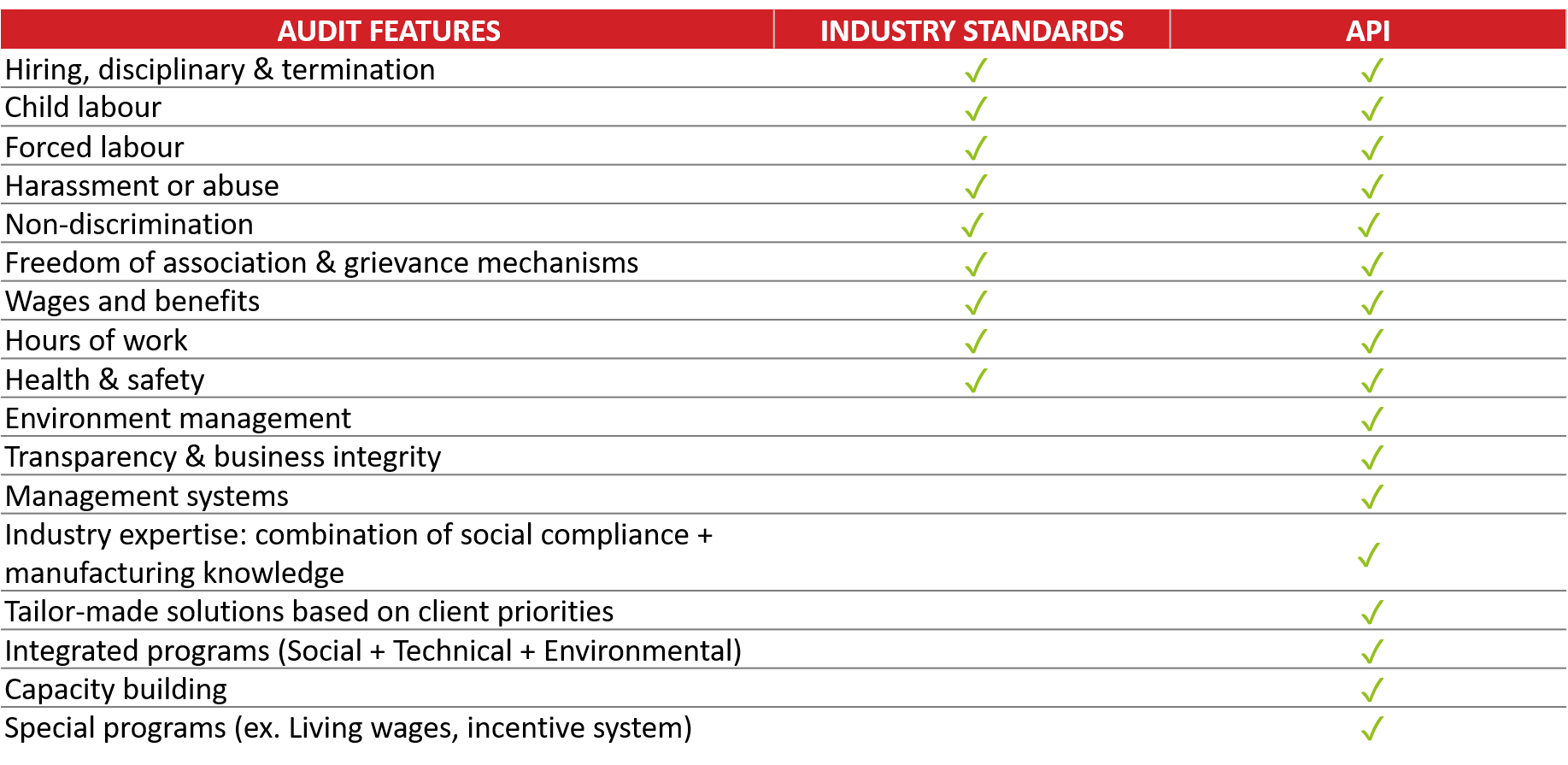
At API, we provide expert solutions to support our customers in their CSR journey. Some of our programs include:

  •  Social audit assessment:
    – As per the defined code of conduct (ICS, Sedex, SCLP, ILO Conventions)
    – Tailor-made based on industry / your code of conduct / API’s standards and local labor laws
  • Supplier capacity building
    – Different programs for different suppliers (new, strategic, low performing, those with zero tolerance, however willing to improve, etc.)
  • Stake holders coaching
    – Awareness and pre-assessment set-up program for internal teams (audit, sourcing…)
  • Code of conduct, manual, audit guidelines creation & review
    – Creation from ground zero and based on your requirements, or review of existing materials – all with the support of our team of experts
  • Program benchmarking services for strategic suppliers
    – Assessment and program recommendation, report, monitoring

    Thanks to our boots-on-the-ground approach, we offer adapted solutions to our customers that go beyond the traditional industry standards. We put our expertise at the service of our customers with concrete solutions that leverage our daily presence in factories, such as follow-up on sustainability. 

Interested in finding out more about our CSR solutions?

Categorías
Recursos Visual Guide & Infographic

Infografía: Cómo simplificar el cumplimiento de la normativa y aumentar la satisfacción del consumidor

Infografía: Cómo simplificar el cumplimiento de la normativa y aumentar la satisfacción del consumidor

Learn more about the challenges faced by brands and how they can reduce the risks of non-compliance and bring products to the market that meet consumer expectations.

Our new infographic covers:

  • Current situation of risks and non-compliances in Europe
  • What is needed to prove compliance?
  • How brands can achieve the smoothest possible in-house process
  • What is a product Technical Compliance File?

Ensuring product’s compliance with market destination standards and regulations is a challenging task.  

Learn more about how brands and retailers can reduce the risks of non-compliance by filling out the form and clicking ‘Download eBook’ to download your own copy.

API’s Product Technical Compliance File (TCF) Solution

At API, we offer a new way to help brands manage product compliance and beyond. Read more about our TCF solutions aquí. 

Categorías
Recursos webinar

Repetición del seminario web: Una solución sostenible - Chem Scan Check™

In this video, you will learn more about our new sustainability solution – Chem Scan Check™.

Watch the video on YouTube:

API experts talk about one of the latest solutions developed by Worms Safety Laboratories to bring a sustainable way for 0% unexpected chemical risks: Chem Scan Check™. Join us to find out how this new solution is already helping some of our partners in their chemical management strategies.

API’s Innovative Chem Scan Check™ Solution

To support our partners in optimizing their testing strategies, we developed Chem Scan Check™ (CSC), which scans for more than 285 hazardous chemical substances in one go. Instead of waiting for a pass/fail outcome for expected chemicals with a traditional testing approach, we offer our partners insight into the potentiality of 285 chemicals that may be present—including those you wouldn’t usually look for in a regular test.

For the first time, a check-through chemical scan gives you visibility on almost all hazardous substances to help prevent ‘unexpected’ non-compliance risks in only 72h.

Read more about this innovative solution aquí. 

Categorías
Recursos webinar

Vídeo - Solución al expediente de conformidad técnica

In this video, you will learn more about our Technical Compliance File Solutions.

Watch the video on YouTube:

Brands and retailers are obligated to ensure their products are compliant with market destination standards and regulations, but this is easier said than done.

At API, our TCF solutions help our customers create a digital ID of each product that confirms its compliance to the latest applicable standards and regulations. Find out more about our TCF solutions in this video.

API’s SOLUTIONS FOR COMPLIANCE

Los expertos de API pueden ayudarte a cumplir con los estrictos requisitos normativos y más allá, aprovechando nuestra experiencia en artículos del hogar y juguetes.

  • Establecimiento de los procedimientos adecuados
  • Definición del alcance relevante de cumplimiento
  • Ayuda para definir criterios adicionales de calidad y seguridad para ir más allá del cumplimiento normativo
  • Recopilar y validar un gran volumen de documentos rápidamente.
  • Reunir todos los documentos en un único lugar (disponibles durante 10 años).

Read more about our comprehensive product compliance solutions aquí. 

Categorías
Recursos webinar

Soluciones API para juguetes

In this video, you will know more about our comprehensive quality management solutions for toys.

Watch the video on YouTube:

At API, we offer tailor-made solutions to manage quality and safety right from the early stages of development thanks to our strong toy expertise.

API SOLUTIONS FOR TOYS

At API we support toy brands across their entire supply chain. Read more about our tailor-made solutions for toys aquí. 

Categorías
Blogs

Updated standard EN 14749+A1:2022


An update of the European Standard EN 14749: 2016 was released in May, introducing the EN 14749+A1:2022 : Furniture – Domestic and kitchen storage units and kitchen-worktops – Safety requirements and test methods. This is one of the primary reference standards for the certification of furniture used in the home. It establishes some changes to the safety requirements and test methods for household and kitchen storage furniture and kitchen workshops.

Some of the key changes include:

  • Completion of the definition part.
  • Some additional tests and markings in the new amendment for TV furniture.
  • New markings for all types of storage units: Any unit intended to be attached to the building shall be supplied with installation instructions.

This standard will replace the previous version from November 30, 2022. If a storage unit is imported to Europe after the date of withdrawal, a EN 14749+A1:2022 test report shall be provided when it’s controlled by market surveillance.

Our experts at API can help support your transition to this or any other regulatory changes.

Do you need more information about this or any other standards?

Categorías
Blogs

Leveraging the power of customer reviews

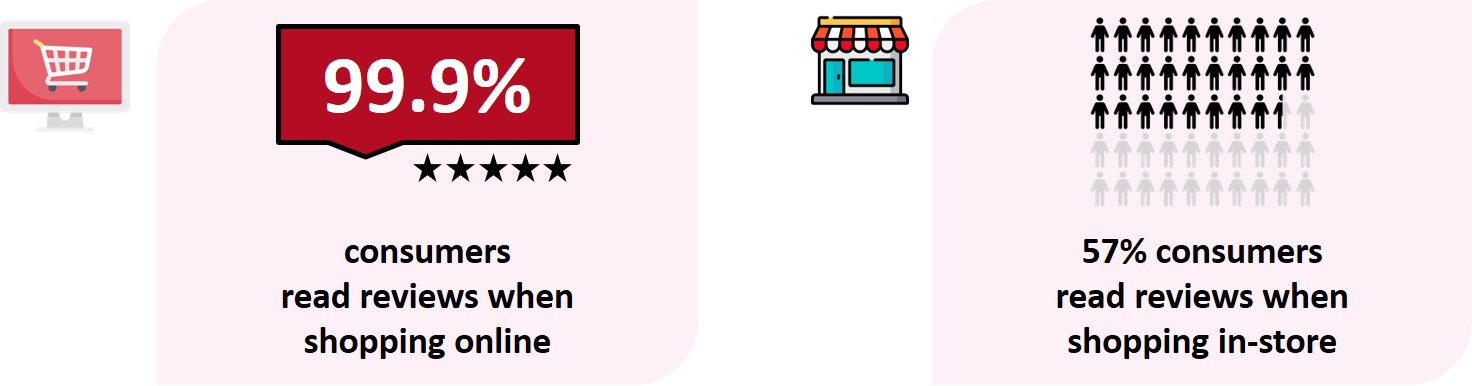
Consumers have always had the power to vote with their wallets and decide what they do and don’t buy. But in today’s online world, they have the power to not only influence what they buy but what others buy.

Empowered by the connectivity of social networks and the democratization of information, consumers are taking control of where, when, and how they engage with brands. This has effectively given consumers a role in the supply chain as they demand more personalized products and expect brands to adapt to their needs.

Now they have been given a voice, consumers are increasingly willing to share their opinions publicly and seek out what others have to say. In some categories, consumers are reluctant to make purchases without independent recommendations. This has not only disrupted the traditional purchasing process but puts additional pressure on brands, who need to ensure they bring to the market products that live up to their promises.

According to a report from the technology company PowerReviews, customer reviews have become the single most important factor when making purchasing decisions, ranking above other elements such as price and recommendations from family and friends. 

How to make customer reviews work for your brand

One of the key benefits of reviews is that this feedback lets brands know whether a product is relevant to its audience and whether it’s better than its competitors’.

Although positive reviews can naturally benefit brands in enormous ways, negative product reviews can have drastic impacts. They can not only affect the sales of the product but can escalate to the point of harming the brand image as a whole.

That said, bad reviews also provide an opportunity to improve and show customers that the brand is actively listening and willing to bring improved products to the market that aligns with customers’ quality and safety expectations. Customer reviews can also help find niches in the market yet to be explored, based on what customers feel is missing in a product or would be nice to have.

Navigating the masses of online reviews and identifying real issues and their root causes to make valuable improvements is not always easy. It might require support from a third party who can assess and identify issues and establish the appropriate recommendations. 

Turning negative reviews into positive outcomes

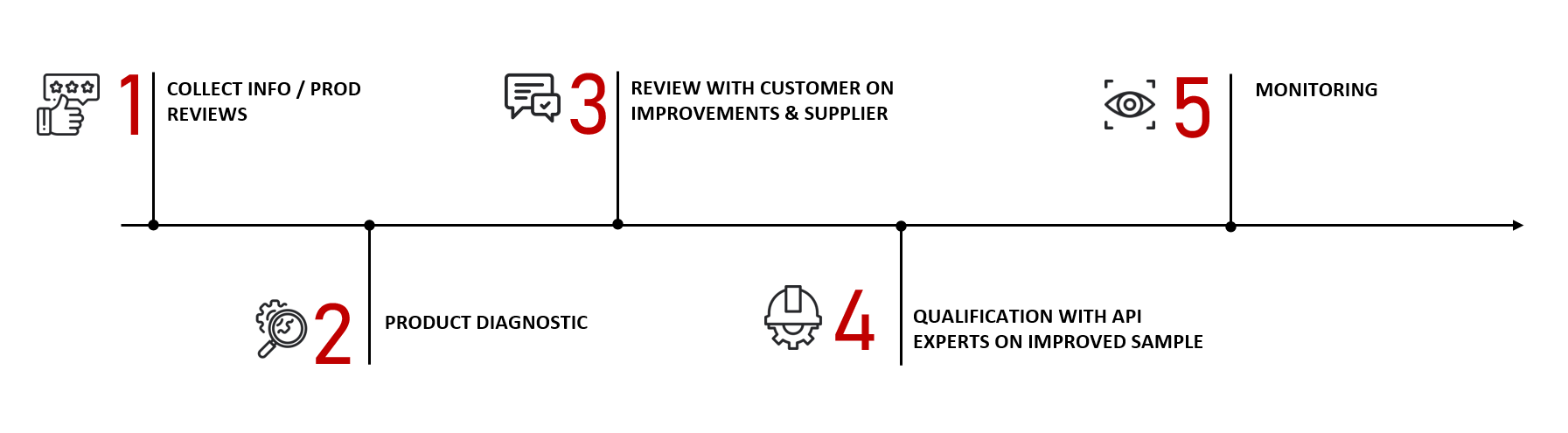
At API, we help our customers improve quality and safety at the product development stage to meet consumer expectations through a dedicated program that uses five steps to:

  • help brands and retailers listen to and understand consumer feedback
  • identify the causes of bad ratings
  • establish recommendations for product improvements

What are the benefits for brands?
  • Better and differentiated products
  • Increased quality and safety
  • Increased customer satisfaction
  • Supplier empowerment
  • Better budget allocation

Interested in finding out how API can help you bring better products to the market? 

Categorías
ebook Recursos

Estudio de caso: 2 soluciones de control de calidad para reducir las retiradas de productos

Case Study: 2 QA Solutions API Used to Help Retailers Optimize Their Processes

Learn how API helped one retailer reduce product recalls by 60% in a year and more!

Reduce Product Recalls - Ebook: 2 Quality Assurance Solutions API Used to Help Retailers Optimize Their Processes

As a retailer, you understand that your quality assurance systems are essential to every aspect of your supply chain and the ultimate growth of your business.

But, what happens when you decide to undergo process changes to facilitate growth and things take an unexpected turn for the worst?

Our new case study covers:

THE CHALLENGES:
  • Retailer A decided to take procurement procedures into their own hands and didn’t have an adequate enfoque del control de calidad. and inspection system in place, resulting in over 50% of their shipment being held due to basic procedural non-compliances rendering them “pending”
  • Retailer B experienced many product recalls due to incomplete/unavailable technical compliance files, and found themselves in a place where there was a lack of resources to begin properly monitoring and reviewing all the technical requirements for all the products that needed to get to market
WHAT THESE RETAILERS WERE LOOKING FOR IN A PROVIDER:
  • Help in improving their decision process on product quality assessment to deal with issues immediately before they became problems
  • Greater insights into the efficiency of their suppliers and their operational systems and structures, to help them to identify risk early on and provide long-term cost savings
THE QUALITY ASSURANCE SOLUTIONS AND THEIR RESULTS:
  • With actionable, real time data and information, retailer A was able to streamline their processes and decrease their “pending” release shipment percentage from 65% to less than 15%
  • By implementing customized TCF software, retailer B reduced the amount of product recalls they experienced by 60% in a year

Ensuring that you are equipped to deal with supply chain issues as they arise is essential for your business. 

Learn more about how our customized quality assurance solutions helped retailers just like you by filling out the form and clicking ‘Download eBook’ to download your own copy.

Categorías
ebook Recursos

eBook: Guía de optimización de la garantía de calidad para marcas regionales

Free Download: A Quality Assurance Optimization Guide For Regional Brands

This guide will help you to optimize your quality assurance procedures and empower you to improve your current quality systems through best practice.

A Quality Assurance Optimization Guide For Regional Brands

Striving for optimized quality assurance procedures should be seen as an opportunity for continued strategic and competitive advantage that can put your brand in a position for growth. 

In this eBook, “A Quality Assurance Optimization Guide For Regional Brands” we explore the challenges of QA and what strategies you can use to implement into your quality systems to maintain your competitive advantage. These procedures will not only enhance your brands quality, but also strengthen your credibility. 

Here’s a quick look at what’s inside the guide:

  • Quality challenges faced by regional retailers
  • Solutions that can be applied to your context 
  • Key take aways from global strategies. 

We wrote this eBook for any manager who understands that quality is the litmus test for how effectively a retailer is at implementing its QA strategy across its supply chain.

Are you ready to read this FREE eBook to begin optimizing your quality systems? Just fill in the form and click “Download eBook” to request your FREE copy.