Data has undoubtedly been one of this year’s most repeated words when discussing how to make supply chains more resilient. Collecting, sharing and analyzing the right data can enable the entire supply chain to run more efficiently thanks to more informed decisions. In the context of quality control, data remains one of the basics.
COVID-19 has brought unprecedented challenges to supply chains and highlighted the importance of increased visibility and agility to maintain product safety and quality. Ensuring product compliance with each market’s standards and regulations remains a key obligation of brands and retailers, but guaranteeing every document’s validity and accuracy is a tedious task.
Collecting the right information about a product to prove compliance with the latest applicable standards and regulations is time-consuming at best. On top of this already arduous task, brands and retailers must remain aware of changes in standards and regulations for numerous product references in their portfolio, which can be labor-intensive and prone to errors.
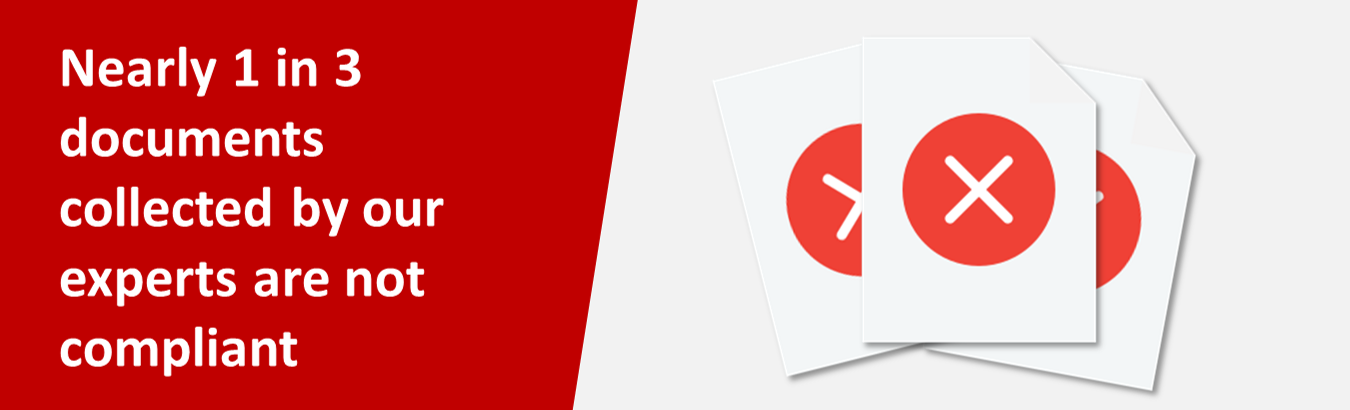
The I-TCF teams at API experienced that nearly one in three documents collected are not compliant and need additional follow-up steps to complete the TCF file according to requirements and establish the product’s conformity.
API’s team of experts can support companies in preparing a ‘digital ID’ of each product with our I-TCF solutions (Product Integrity and Technical Compliance File). This digital ID helps verify product compliance and includes key information such as applicable protocols, document validation or rejection, and validity over time. In addition to our experts’ regulatory guidance, brands appreciate the minimal investment required, enjoy a higher degree of control with our clear digital platform, and are ultimately ready to provide the valid required documentation in cases of custom verification.
With more than 15 years’ experience developing I-TCF solutions, we can help brands and retailers save time and money on this task. We offer support with:
Festlegung des relevanten Geltungsbereichs (Scope Definition)
Collecting and quickly validating a high volume of documents
Interested in finding out more about how our I-TCF solutions can help your brand?
Did you know that around 80% of chemicals in Asia are either produced locally or come from unknown sources? There are no guarantees that some of these chemicals don’t contain traces of hazardous substances, making your products and supply chains vulnerable. In 2020, one in four imported products were found to be non-compliant with REACH and CLP*, with most cases focused on the presence of the restricted substances cadmium, lead, and nickel.
While uncertainty around chemical composition can be toxic for consumer confidence in general, brands and retailers have different setups, needs, and levels of awareness regarding compliance, risk, and sustainability:
Some have mature testing programs in place and are responsive to existing pressures in their market. These companies would still benefit from a single test that can detect hundreds of substances with fast results, attractive pricing, strong service support, and the advantage of monitoring low-performing vendors and empowering high-performing vendors.
Other companies focus on finished products only, meaning that when they detect a risky substance, it’s often too late to cancel the order. Testing articles when they’re finished or late in the process may lead to reproducing the entire line of articles and retesting, which can blow out budgets.
Some companies have no system in place and no chemical or regulatory expertise but still want to offer the end-user a secure product. Generally speaking, all companies want to be more compliant and transparent.
As the use of recycled materials in products increases, the possibility of these materials containing unknown substances follows suit. Overall, better fashion begins with a bigger commitment to detect and address issues from the beginning, leading to less impact on the environment and society, empowering the best-performing suppliers, and focusing time and money on where the risks are high.
Our new solution: Chem Scan Check™(CSC)
To support our partners in optimizing their testing strategies, we developed Chem Scan Check™ (CSC), which scans for more than 332+ hazardous chemical substances in one go. Instead of waiting for a pass/fail outcome for expected chemicals with a traditional testing approach, we offer our partners insight into the potentiality of 332+ chemicals that may be present—including those you wouldn’t usually look for in a regular test.
What does Chem Scan Check™ offer that’s different?
While our Worms Safety network proudly offers 15 laboratories globally for traditional testing methods, our broader goal is to enable our customers to anticipate risks, identify root causes, and instill a more innovative, proactive approach.
One test, 332+ substances: Chem Scan Check™ brings to the market one test run instead of the full substance list test. With only 5g of material, you can receive a screening result in accordance with the AFIRM restricted substance list for your textiles or plastics within 72 hours—and at a cost level that makes sense. The innovative technology is applicable to all products containing plastics and textiles; however, our current scope focuses on textiles, apparel, footwear, and home textiles, including sensitive products such as baby wear.
Increased visibility for better business: As Chem Scan Check™ offers greater visibility over product lines, it is an excellent opportunity to achieve company strategies that are not restricted by common test parameters.
End-to-end solution: A key advantage of Chem Scan Check™ is that it’s applicable across the entire life cycle—from raw materials to semi-finished products to finished products—monitoring recycled materials and certified materials.
Customizable and adaptable: While it’s highly beneficial across the entire supply chain, CSC is a customizable concept that can address specific focus points, such as monitoring within a vendor empowerment program or complementing sustainability strategies with a scientific method.
Chem Scan Check™ in action
We have already experienced cases in which sensitive products such as baby wear passed a risk-based RSL test, but our Chem Scan Check (CSC) detected a non-compliance. In another case, CSC found prohibited chemicals—including phthalates and PAH—in rubber pet toys, which were possibly used to give the toys a flexible, plastic feel. In another instance, CSC detected exotic fertilizer (diammonium phosphate) within a teddy bear. The brand then uncovered that the new supplier they were working with was using local chemicals that contained the fertilizer.
Why 332+ chemicals?
Chem Scan Check™ can actually check for more than 332+ substances. Currently, over 500 substances are calibrated with external standards. However, while Chem Scan Check uses powerful solvents and equipment, there is a limitation to organic substances. Each substance in the screening process also needs to be validated with extensive research to ensure repeatability and accuracy, so we have initially focused on supporting the textile industry in relation to the AFIRM RSL. At the moment, Chem Scan Check™ in combination with additional tests for heavy metals and formaldehyde can cover 100% of substances listed under AFIRM.
Which chemicals are covered by Chem Scan Check™?
Phthalates
PAHs
Azo dyes
Disperse dyes
Short/middle-chained chlorinated paraffins
PCP
VOCs
Alkylphenol ethoxylates (APEOs, NPEOs, OPEO)
Dimethylfumarate (DMFu)
PFOA
And more
To cover completed RSL lists, other tests like heavy metals and formaldehyde will be tested separately.
How can Chem Scan Check™ (CSC) integrate with your chemical strategy?
Superior sustainability: CSC will complement your existing recycled materials testing, facilitating broader claims with the assurance that your products contain 0% of unexpected non-compliant substances.
Tighter risk control: CSC allows you to test more substances that you wouldn’t usually look for, generating greater visibility and reducing risk.
Test new areas: CSC can cover the entire life cycle of your products and will invite you to consider new testing areas of focus, such as raw materials.
Customizable for vendor empowerment: CSC enables you to award greater autonomy to your best-performing suppliers by allowing for random, limited checks instead of one-size-fits-all testing.
Preparedness for new regulations: CSC will ensure you are ready for new regulations that require increased visibility and control over substances that may be present in your products.
What are the product applications?
Substanzen unbekannter Herkunft: Identifizierung kritischer Inhaltsstoffe in der vorgelagerten Lieferkette.
Chemical cocktails
Rezyklate: Validierung von recycelten Materialien auf Schadstofffreiheit.
Sensitive Warengruppen: Fokus auf Produkte mit erhöhtem Gefährdungspotenzial.
In December 2021, two new European standards for outdoor candles were published to help ensure a reasonable degree of safety during their use: “EN 17616:2021 Outdoor candles – Specification for fire safety” and “EN 17617:2021 Outdoor candles – Product safety labels.”
These documents specify requirements, testing methods, and labeling requirements for the fire safety of candles intended to be burned outdoors. The European standards will be given the status of a national standard, either by the publication of an identical text or by endorsement, by latest June 2022, and conflicting national standards will be withdrawn by latest June 2022.
The major new requirements for outdoor candles include:
Container candles
The candle shall not tip over when tested on a slope of 10°
The wind resistance shall have a value > 1
The temperature at the surface below the container shall not exceed 350°C
No secondary ignition shall occur for more than 10 seconds
The container shall not ignite or break during testing
The container shall not burn for longer than 15 seconds on average and 30 seconds in any individual test during the testing
The container shall not be completely burned away during testing
The candle shall not spontaneously relight after extinguishing
Freestanding candles
The candle shall not tip over when tested on a slope of 10°
No secondary ignition shall occur for more than 10 seconds
The candle shall not spontaneously relight after extinguishing
Garden torches
Shall be designed to be set up and stay in a stable manner
No secondary ignition shall occur for more than 10 seconds
No burning or smoldering material shall fall off during testing
Candles placed on a stick shall also meet the requirements relevant for the respective candle type, except stability
Floating candles
No secondary ignition shall occur for more than 10 seconds
The candle shall not spontaneously relight after extinguishing
Mandatory supplementary safety information (symbols or text)
For outdoor use only.
Never leave a burning candle unattended.
Keep a distance of min. x m beside and y m above to things that can catch fire.
Keep away from children and pets.
Use a heat-resistant base. (Not mandatory if the container itself has a heat-resistant base)
Candle gets lighter during burning, protect from strong wind by using a suitable holder.” (For container candles that didn’t comply with the wind resistance requirement as specified in EN 17616)
Only use at cemeteries outdoors. (For grave lights only)
Use in a suitable bowl filled with water. (For Floating candles only)
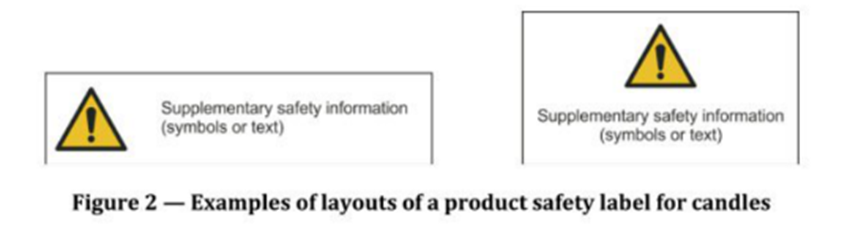
Layout of the product safety label:
At API, we can support our customers to comply with these or other requirements for candles to further secure the safety and quality of your products.
With unprecedented quality issues facing the importing of furniture, how can we avoid lengthy delays, product recalls, and brand reputation damage before it’s too late?
Southeast Asia remains a hub for furniture imports, despite logistics, compliance, and communication barriers posing continuous challenges. Pressures stemming from COVID-19 haven’t helped, leading to brands being unable to visit their factories, shipment delays requiring more flexible and agile manufacturing, and last-minute surprises like raw materials and component shortages.
All these can put product safety and quality at risk, but following a few key steps can ensure your furniture reaches you at its optimum quality to protect your competitive advantage and meet the standards of your market destination:
1. Determine your defect classification list
This step is often an afterthought, but classifying your defects at the outset will help clarify the meaning of your furniture inspection reports.
This is the most widely used defect classification list (DCL):
Kritischer Fehler – A defect that judgment and experience indicate is likely to:
Result in unsafe conditions for individuals using, maintaining, or depending upon the products; or
Verhinderung der Erfüllung der taktischen Funktion eines wichtigen Endprodukts. Ein kritischer Fehler ist eine Produkteinheit, die einen oder mehrere kritische Fehler aufweist.
Erheblicher Mangel – A defect that is likely to result in failure or reduce the usability of the product for its intended purpose.
Geringfügiger Mangel – A defect that is not likely to reduce the usability of the product for its intended purpose or is a departure from established standards having little bearing on the effectiveness or operation of the product.
If there is no established DCL, API offers a detailed inspection checklist to proceed with the inspection.
2. Conduct an inspection during production or place a dedicated technician onsite
This is a critical stage in ensuring that your final piece of furniture reaches its expected level of quality. It allows you to identify problems before the end of production and to adopt the required corrective measures to improve results along the production line.
3. Update your furniture specifications based on in-production feedback
Consider critical areas for improvement and the points that need to be addressed, and put a strategy in place to correct them. At this stage, you will need to re-communicate your product specifications to the factory, which may bring language challenges when sourcing in Asia. You can overcome these barriers by using a neutral third-party quality provider with expertise in your sourcing area. This ‘boots on the ground’ approach will ensure that your product specifications are communicated correctly and clearly.
4. Do a root cause analysis as a preventative measure
It is important to have a root cause analysis (RCA) strategy that determines how you will handle any defective products with your supplier. This need not be a time-consuming strategy; it should simply highlight potential problem areas and make room for process optimizations.
Don’t have an RCA strategy? Follow these steps:
Recognize and define the problem –Acknowledge and define your furniture’s production issue.
Identifizieren Sie die Ursachen –Go through the process of cause identification. The trick here is not to spend too much time brainstorming or mind mapping. This needn’t be a time-consuming part of the root cause analysis.
Identify the solutions –Based on your cause identification, you will need to determine the best possible solutions for addressing the problem to avoid it happening again.
Umsetzung der Lösungen –If your furniture quality was compromised during the production line, you would need to begin implementing the solutions you identified to prevent future occurrences. The solution should optimize and improve your operational processes. If it doesn’t, you may need to repeat the above steps.
5. Conduct a final check with a random inspection
A final random inspection is an inspection of a small sample of your furniture prior to shipment. This is used to determine any quality defects that may have come from the production process. Questions to consider include:
Does the furniture sample meet all of your product specifications?
Wie viele Sehfehler gibt es?
Welche Tests müssen vor Ort durchgeführt werden?
Wichtigste Erkenntnisse
A clear strategy to identify risks upstream is key in producing high-quality furniture that meets customer expectations. Some of the benefits of a well-planned sourcing strategy include:
Improved products
Faster time-to-market
Quality budget optimization
Increased customer satisfaction.
The above steps should be planned and strategized for each product category that you source. At API, we support our customers with solutions all along their supply chains. Contact us now to learn more about how our furniture expertise can give your brand the competitive edge it deserves.
API is glad to be participating as a sponsor at the 2022 ICPHSO Annual Meeting and Training Symposium. The event will take place on February 14–17, 2022 in Washington, D.C. The four-day Annual Meeting and Training Symposium provides an opportunity for global health and safety professionals to participate in discussions that further enhance the safety of consumer products throughout the world.
Will you also attend the event? Book an appointment to talk to our team!
Visit ICPHSO’s website for more details about the event: https://icphso.org/
Das Vereinigte Königreich hat eine neue Steuer auf Kunststoffverpackungen eingeführt, die am 1. April 2022 in Kraft treten wird. Die als "UK Plastic Packaging Tax" (PPT) bekannte Steuer wird Unternehmen betreffen, die Kunststoffverpackungen herstellen oder importieren, einschließlich Verpackungen, die bereits Waren enthalten (z. B. Plastikflaschen mit Getränken). Ziel der Steuer ist es, die Verwendung von recyceltem statt neuem Kunststoff in Verpackungen zu fördern (sofern dies zulässig ist) und das Recycling und die Sammlung von Kunststoffabfällen voranzutreiben.
Wie wird die Steuer funktionieren?
Die PPT-Steuer gilt für Kunststoffverpackungen, die im Vereinigten Königreich hergestellt oder in das Vereinigte Königreich eingeführt werden und deren Kunststoff zu weniger als 30% recycelt wird.
Alle Kunststoffverpackungen werden übernommen nicht um die Anforderungen an den Recyclinganteil zu erfüllen, sofern die Unternehmen nicht das Gegenteil beweisen können.
Der Steuersatz beträgt 200 £ pro Tonne Kunststoffverpackungen für die betroffenen Unternehmen. Wenn ein Unternehmen beispielsweise 10 Tonnen Kunststoffverpackungen herstellt und 1 Tonne weniger als 30% recycelten Kunststoff enthält, muss das Unternehmen 200 GBP zahlen.
Wer muss sich für die Steuer registrieren lassen?
Jedes Unternehmen, das innerhalb eines Zwölfmonatszeitraums 10 oder mehr Tonnen Kunststoffverpackungen herstellt oder einführt, muss sich für die PPT-Steuer registrieren lassen, auch wenn die Verpackungen mehr als 30% recycelten Kunststoff enthalten. In einem solchen Fall muss die Steuer jedoch nicht gezahlt werden.
Dies gilt auch für Importeure von Verpackungen, die bereits Waren enthalten, wie z. B. Plastikflaschen mit Getränken. Wenn die von Ihnen eingeführte Verpackung bereits andere Waren enthält, gilt die Steuer nur für die Kunststoffverpackung selbst.
Aufzeichnungen müssen auch dann geführt werden, wenn alle hergestellten oder eingeführten Verpackungen mehr als 30% recycelten Kunststoff enthalten.
Die Online-Plattform für die Registrierung und Zahlung wird verfügbar sein, wenn die PPT-Steuer am 1. April 2022 in Kraft tritt. Lesen Sie mehr Informationen über Registrierung für die Kunststoffverpackungssteuer.
Bitte wenden Sie sich an unsere Experten, um zu erfahren, wie API Sie bei der Umstellung auf diese neue Verpackungssteuer unterstützen kann.
Household goods manufacturing and supply chain operations remain under significant pressure, forcing the speeding up of processes in some cases to meet tight deadlines. An increasing need for agility and flexibility has introduced new risks as well as shortcuts and vulnerabilities that can lead to compliance and regulations violations.
With the pace at which the many complex parts of a supply chain must move to keep up with changes and disruptions, brands and retailers should be working with suppliers that can guarantee reliable outcomes without compromising the integrity of their processes and products. Strong visibility and understanding of the supply chain and adequate supplier mapping are essential steps for avoiding quality and compliance situations that don’t go according to plan.
The most effective way to address these challenges is to map your suppliers by performing factory audits, identifying areas of risk ahead of time and ensuring you work only with the most reliable partners. A factory audit will make certain that your supplier can produce your product to your expected levels of quality without jeopardizing supply chain integrity or compliance in destination markets.
Factory audits also help assess the risks that may be present with a particular supplier and provide direction on how to manage those risks.
The decision to work with a particular supplier will ultimately be up to you, but a factory audit will mean your decision is based on a trusted risk assessment with a presented improvement strategy.
The criteria for selecting the right supplier will naturally vary and depend not only on international requirements and regulations but also on industry best practices and brand values and guidelines. For example, you may request that a supplier apply stricter environmental measures to ensure eco-friendlier processes and reduce their impact on the planet.
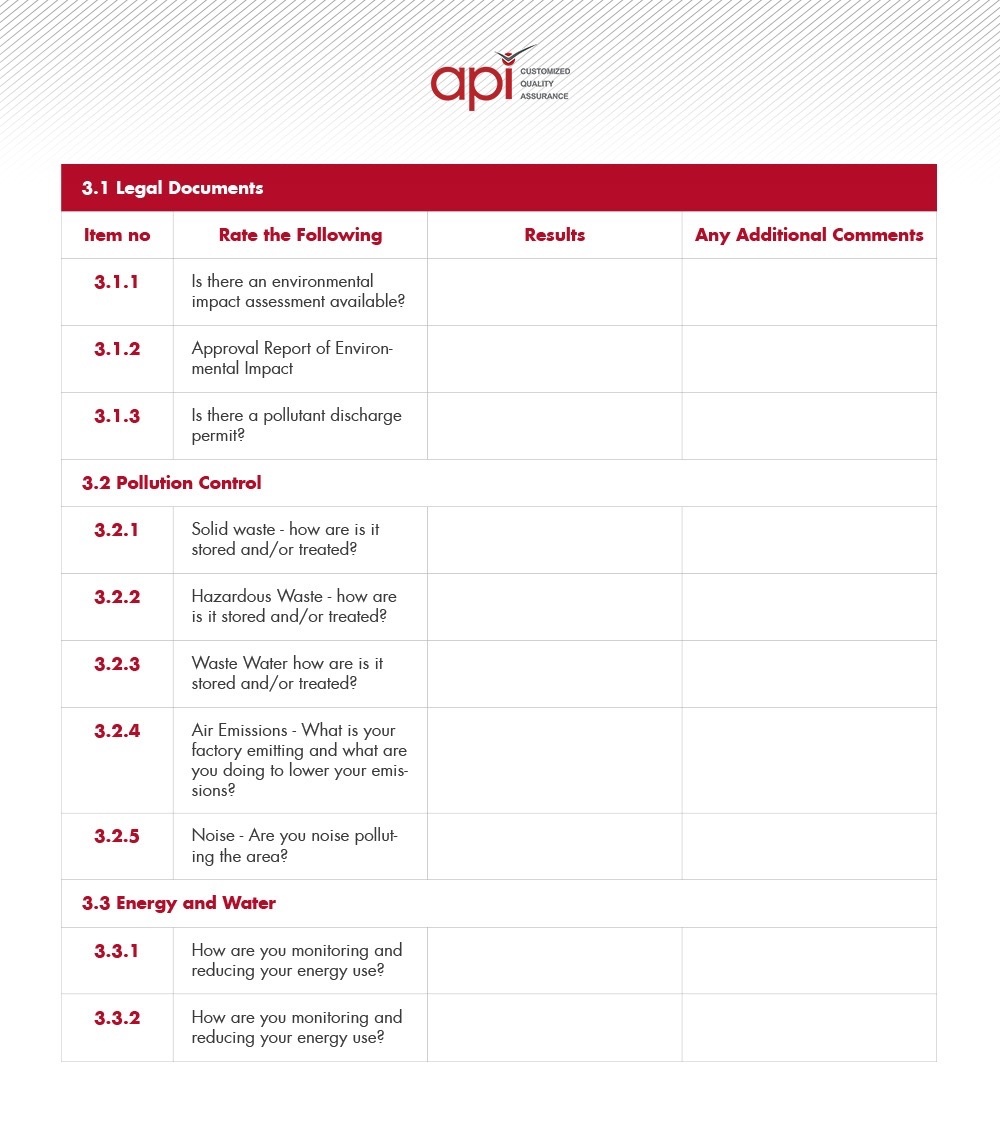
Our checklist sample takes you through what a brief assessment of your supplier’s quality systems might look like, and touch on quality management, social, and environmental compliance.
The checklist example covers three main sections and includes some of the more common points when evaluating supplier performance in these areas:
The following guidelines can be followed for each process:
N/A: Process not available or not evaluated.
0 – Major non-conformity: Absence of procedure or proof of significant discrepancies in implementation. Corrective action will be designed for this process.
1 – Minor non-conformity: Incomplete procedure or proof of discrepancies in implementation. Corrective action will be designed for this process.
2 – Acceptable: Procedures are available and implementation is acceptable; however, opportunities for improvement exist. An opportunity for improvement can be designed for this process.
3 – Good: Procedure and implementation are acceptable; no opportunity for improvement identified.
4 – Best practice: Factory has designed and implemented the industry best practice.
Quality Assurance & Technical Assessment
Technical assessments will obtain an objective picture of your supplier’s organization and evaluate their capabilities in the following areas, among others:
Adequate quality management system and framework to achieve acceptable quality levels.
Relevant product knowledge and the ability to produce the products in compliance with international regulations and customer expectations.
Capability to mass-produce on time while maintaining the required levels of quality and safety.
When evaluating a supplier’s capacity, some of the most frequently considered points include:
Quality manual and procedures demonstrate revision control (sign-offs and dates), history of changes.
Product quality yield data, problems and corresponding improvement actions, the status of preventive/corrective/audit results.
Strategische und taktische Ziele, Vorgaben, Aktionspläne usw.
Analyses of field failures, inspection yields, resource needs, internal audit results, corrective action statuses, etc.
Corrective actions, trend charts, meeting minutes, non-conformance frequency and cost analysis.
Management review meetings and corrective actions.
Investigating training aids and instructions at workstations.
Qualification records, certification history.
Testing records, production quality records, audit records, interview workers to validate training records.
Job descriptions, job skills assessment, training records, training manuals.
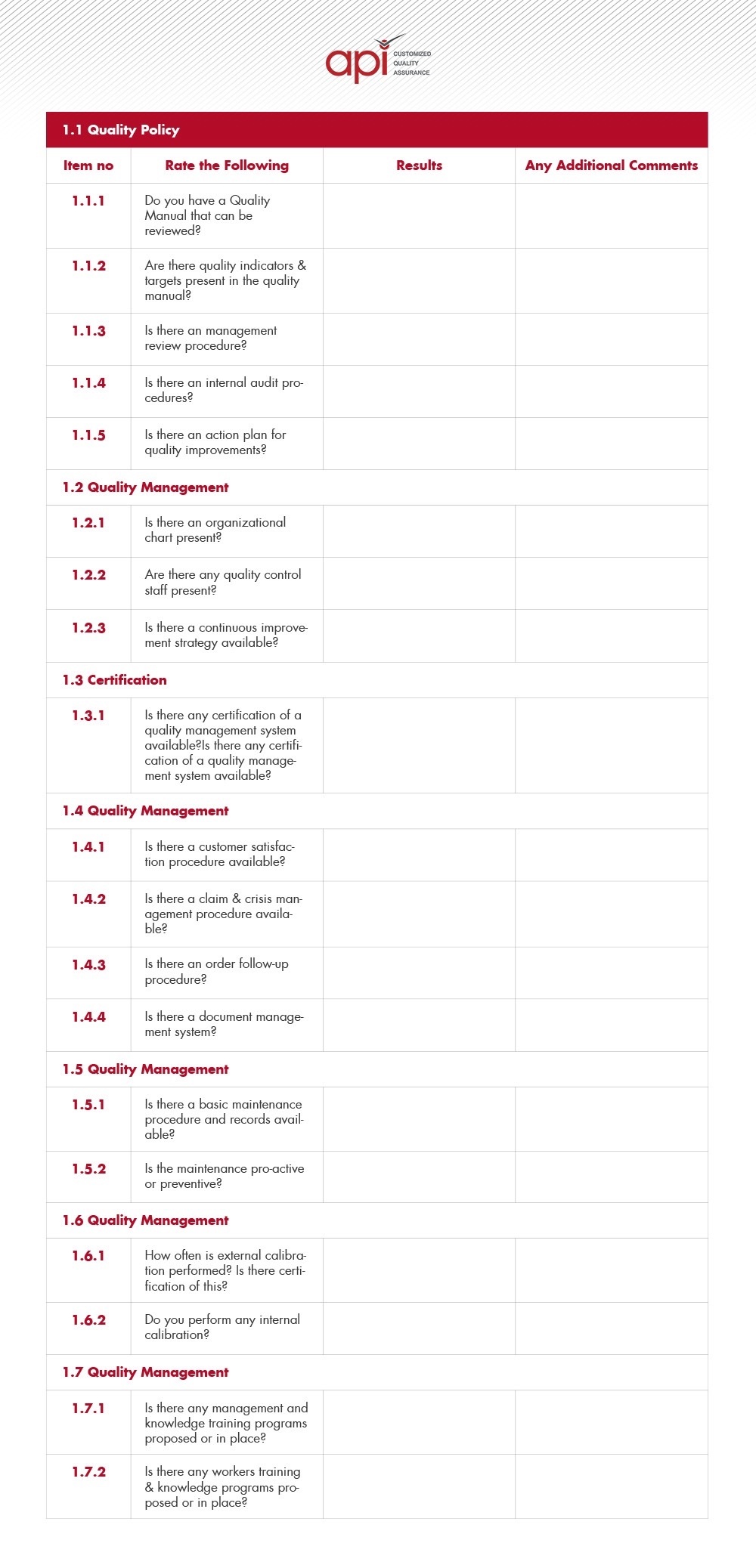
Example of a quality audit checklist:
API factory quality audit checklist
What If My Quality Assurance Score Is Below Standard?
Thanks to its manufacturing and product knowledge and experience on the field, API is able to customize its QA solutions based on your specific needs and requirements. API will provide the supplier information on how they can go about improving various things within a factory. This information will be relayed back you, the retailer, where you will gain insight into your potential supplier and their factory operations to ensure compliance across the board.
Social / Health & Safety Assessment
The objective of a social audit is to provide an unbiased image of a supplier organization and practices according to local laws and international standard as well as your internal code of conduct.
Thanks to an adequate assessment of your pool of suppliers, your company can protect its brand image and improve its competitiveness. Managing your social risk should bring associated costs saving and should also foster long-term cooperation with a selected pool of suppliers.
To evaluate your supplier’s ability to meet the expected social, health & safety requirements, some of the more critical areas typically covered by a social audit include:
Checking whether factories operate in compliance with laws specifically related to wages and compensation, working hours, child labor, forced labor, harassment, and abuse.
Examining conditions in production and residential facilities and their consistency with applicable laws and regulations
Reviewing emergency preparedness and response plans as well as monitoring and performance measurements
Evaluating whether all possible precautions are in place to reduce labor and safety risks
The social audit assesses the social systems and structures that your supplier has in place and is normally based on the standards as laid out by the SA8000 and ETI Based Code. As a professional third-party auditing company, API is able to provide their industry expertise and longtime experience to aid you in achieving your social compliance certification. In addition to this analysis, our team will also define a corrective action plan and can also help you in the implementation and follow-up of this list of actions.
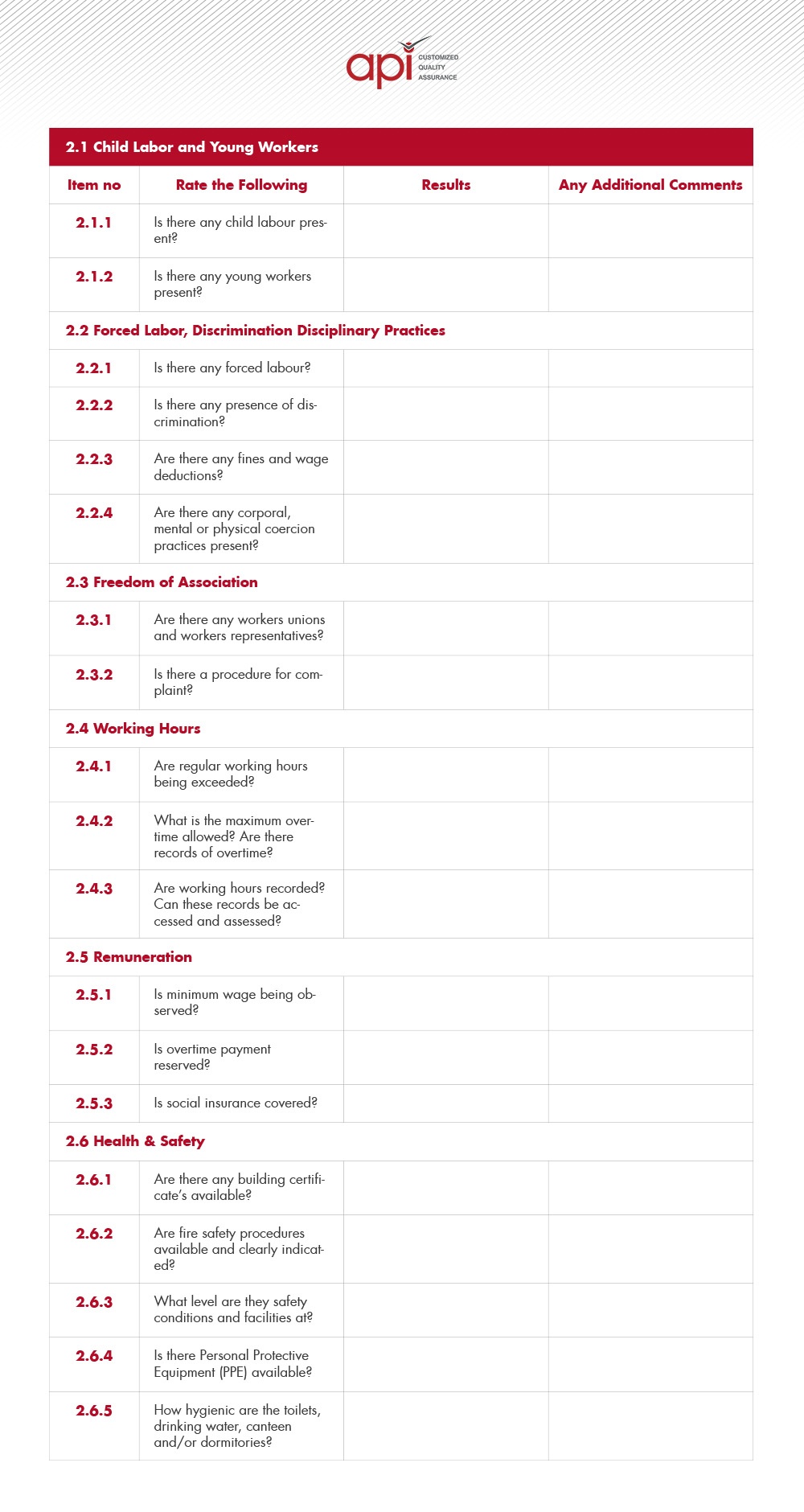
Example of social audit checklist:
API factory social audit checklist
Environmental Audit Assessment
It’s not new that supply chains are under increasing scrutiny to ensure environmentally friendly processes. In the context that we are currently living it’s important to verify that your suppliers are aligned with the relevant requirements and regulations to ensure a sustainable supply chain, and that they comply as well with your brand requirements and expectations. The best way to obtain a good level of visibility is by performing and environmental audits assessment to evaluate all relevant criteria and improve the environmental and chemical performance of your suppliers.
In order to evaluate your supplier’s ability to respect the environmental requirements some of the most critical areas usually covered during an environmental audit will cover the below:
Umweltpolitik-Erklärung Dokument
Aufzeichnungen über behördliche/staatliche Inspektionen, Verfahren zur Messung und Überwachung umweltsensibler Tätigkeiten
Aufzeichnungen über Einkäufe, Abfallströme und Verbrauch; Bestandsverwaltungsprozeduren
Materialien, die keine Gefahrstoffe enthalten (RoHS/WEEE-konform) in der Produktion, biologisch abbaubare Materialien, Mehrwegbehälter oder -verpackungen, Recyclingprogramm, Verpackungsmaterialien aus recycelten Materialien
API sustainability team can help you assess the environmental and chemical performance of your suppliers with an accurate evaluation and adequate action plan to reduce the impact of your supplier’s processes and ensure that you are in the right path to achieve your sustainability goals and meet your customer’s demands.
Our on-the-ground expertise and our strong presence on the field allow us to have a deep knowledge of the factories processes, challenges and the applicable regulations. We understand your processes, factories and products, and are able to provide bespoke sustainability services that will result in higher levels of efficiency.
Example of environmental audit checklist:
API factory environmental audit checklist
KEY TAKEAWAYS
An adequate factory audit allows you to have a better visibility of your supply chain, starting with the relevant insights of your suppliers’ quality control processes and manufacturing capabilities, social and environmental practices to identify the best performing suppliers and those with the higher risk. This allows you to select your pool of suppliers accordingly and empowers you to strengthen those weaker processes where needed.
An adequate audit checklist will help ensure:
Ihre Qualitätssysteme sind auf dem neuesten Stand, organisiert und gut dokumentiert.
Vertrauen in die Auswahl Ihres Lieferanten auf Basis von Checklisten-Erkenntnissen.
Vertrauen in die Qualität des hergestellten Produkts.
confidence that your supplier is actively meeting compliance standards, social and environmental practices.
This approach allows you to build a more collaborative relationship with your supplier, where you supplier has a more invested approach to your brand and its product. It helps to ensure top-class quality systems and a mutually beneficial relationship between supplier and retailer and a better budget allocation to focus where risks are high.
Interested in learning more about how API can help you with our audit solutions?
On September 14, 2021, the new SCIP Dissemination Portal by the European Chemicals Agency (ECHA) went live, giving the public access to information about substances of concern (SVHC) in articles as such or in complex objects (Products). The portal’s launch increases the transparency over chemicals of concern in products and will help track products containing substances of very high concern until they reach the waste stage. It also allows consumers to make more informed purchasing decisions and to choose safer products.
Since January 2021, companies that supply articles containing substances of very high concern (SVHC) on the Candidate List in a concentration above 0.1% weight by weight (w/w) in the EU market have been required to submit information on these articles to the ECHA. The notifications are stored in the SCIP (Substances of Concern in Products) database, and will be publicly available via the portal throughout the entire lifecycle of the products and materials – including the waste stage – contributing to a safer circular economy.
In a recent announcement, the ECHA said that around 6,000 companies across the European Union have already complied with this new obligation, with more than four million relevant article notifications registered in the SCIP database.
Based on the information gathered so far, the most notified product categories include:
Machinery and their parts
Measuring instruments and their parts
Electronic equipment and their parts
Vehicles and their parts
Articles made of rubber
Furniture.
Wer muss die Informationen einreichen?
Companies that supply articles containing substances of very high concern (SVHC) on the Candidate List in a concentration above 0.1% weight by weight (w/w) in the EU market are required to submit, including:
EU producers and assemblers
EU importers
EU-Händler von Erzeugnissen und andere Akteure, die Erzeugnisse in Verkehr bringen.
Retailers and other actors that supply articles directly to consumers are not obligated to submit this information to ECHA.
What information needs to be submitted?
Informationen, die für die Identifizierung des Artikels relevant sind;
Name, Konzentrationsbereich und Ort des SVHC; und
Sonstige Informationen über die sichere Verwendung des Erzeugnisses, insbesondere wenn die oben genannten Informationen nicht ausreichen, um die ordnungsgemäße Entsorgung des Erzeugnisses als Abfall zu gewährleisten.
Do you have any questions about how the new SCIP database requirements affect your business?
Many governments around the world are using legislation to drive responsible business practices and positive impacts on people’s working conditions. These laws require companies to manage their operational impacts on people and the environment and report on their efforts. It’s important to know which of these laws apply to your business and how to comply.
One of the most recent changes in this area is the new Human Rights Due Diligence Law adopted by the German parliament on June 11, 2021.
From 2023, this law will require large companies to conduct supply chain due diligence activities. Companies will need to identify, prevent, and address human rights and environmental abuses within their own and their direct suppliers’ operations, and take actions if they find violations.
The law aims to ensure that social and environmental standards are maintained in large companies’ operations and supply chains to address the following risks:
Zwangsarbeit
Child labor
Diskriminierung
Violations to freedom of association
Unethical employment
Unsafe working conditions
Environmental degradation.
Who does this new law affect?
From 2023: Companies based in Germany with more than 3,000 employees, or German-registered branches of foreign companies with more than 3,000 employees.
From 2024: Companies based in Germany with more than 1,000 employees, or German-registered branches of foreign companies with more than 1,000 employees.
What do the affected companies need to do?
Set up a process to identify, assess, prevent, and remedy human rights and environmental risks and impacts in:
1. Your supply chain 2. Your own operation.
Ensure you provide ways for employees of indirect suppliers to file a complaint alerting the company to any human rights or environmental violations.
Publish an annual report outlining the steps you have taken to identify and address these risks.
How can affected companies prepare for this change?
If this – or any similar law – applies to your business, it’s most important to have a clear internal process to understand and assess your supply chain:
Step 1: Define your scope
Map your suppliers and put in place a preliminary risk analysis to better understand your supply chain and current CSR capabilities.
Step 2: Pre-assess your suppliers’ CSR conditions
Conduct a deeper evaluation to identify your most reliable suppliers, the ones requiring action, and those with zero tolerance issues. You can then prioritize your program and create an action plan.
Step 3: Apply relevant actions based on identified risks and priorities
Deploy an adequate action plan based on the identified issues and their risk levels and implement remediation programs to improve the suppliers’ performance.
Many other countries have enhanced their regulations on human rights, such as:
Australia: Modern Slavery Act 2018
France: Corporate Duty of Vigilance Law
Germany: CSR Directive Implementation Act
India: Business Responsibility and Sustainability Reporting
Italy: Legislative Decree no. 254
United Kingdom: Modern Slavery Act 2015
United States: Transparency in Supply Chains Act 2012 (State of California).
How API can help you prepare for these legislative requirements:
Documentary review
Preliminary risk assessment to help you prioritize issues
Factory audit
Ausbildung
COC/manual/audit guidelines creation and review
Program benchmarking services for strategic suppliers.
Die Industrie für Küchenutensilien und Kochgeschirr ist stark reguliert und unterliegt strengen Sicherheitsstandards, um die Gesundheit und Sicherheit der Verbraucher zu gewährleisten. Es ist bekannt, dass Chemikalien, die in so genannten "Lebensmittelkontaktmaterialien" enthalten sind, in die Lebensmittel, mit denen sie in Berührung kommen, übergehen und diese verunreinigen können, was eine Gefahr für die Gesundheit der Verbraucher darstellt.
Wie können die Verbraucher also sicher sein, dass der Behälter, in dem sie ihre Lebensmittel aufbewahren, sicher ist? Oder dass die Tasse, aus der sie ihren Kaffee trinken, keine schädlichen Chemikalien freisetzt? In den meisten Ländern weltweit müssen alle Produkte, die mit Lebensmitteln in Berührung kommen, den geltenden Vorschriften für die am häufigsten verwendeten Materialien und den Verwendungszweck des Produkts entsprechen.
Welche Vorschriften zu beachten sind, hängt vom Material und vom Land ab. So müssen in der EU und den USA verkaufte Artikel Vorschriften wie die EG-Verordnung Nr. 1935/2004 in der EU oder die FDA-Verordnung 21 CFR in den USA erfüllen, die die gängigsten Materialien wie Kunststoffe, Silikone und Kautschuk, Metalle und Legierungen, Keramik, Holz, Papier und Pappe, Lacke und Endbeschichtungen und mehr abdecken. Es gelten unterschiedliche Kriterien, wenn der Behälter z. B. aus Kunststoff oder Keramik besteht, aber auch, wenn er für wässrige Lebensmittel wie Wasser oder Kaffee, säurehaltige Lebensmittel wie Saft oder alkoholische Getränke wie Bier oder Wein verwendet werden soll, und wenn der Behälter für eine einmalige oder wiederholte Verwendung bestimmt ist.
Selbst bei großen Marken können noch Risiken festgestellt werden, nachdem die Produkte auf den Markt gekommen sind, die nicht nur das Image der Marke gefährden, sondern auch zusätzliche Kosten verursachen können, wenn es zu Produktrückrufen oder Geldstrafen kommt. Einige große Marken waren im vergangenen Jahr Gegenstand von Produktrückrufen, wie z. B. eine große internationale Möbel- und Dekormarke, die einen Becher vom Markt zurückrief, der möglicherweise übermäßige Mengen an Dibutylphthalat (DBP) enthielt.
Neben den chemischen Risiken birgt das Küchenzubehör auch einige physikalische Risiken in Bezug auf Ermüdung, Korrosion und Hitzebeständigkeit sowie thermische Gefahren. Wenn sie beispielsweise mikrowellen- oder spülmaschinenfest sein sollen, müssen sie Hitze oder Wasser aushalten, ohne zu zerbrechen oder Schaden zu nehmen. Dies mag zwar einfach erscheinen, doch werden auf dem Markt für Küchenartikel auch häufig physische Risiken festgestellt. Zu den häufigeren Rückrufaktionen gehören ein erhöhtes Verletzungs- und Verbrennungsrisiko, weil ein Behälter unter Hitzeeinwirkung bricht, oder die Gefahr von Schnittverletzungen aufgrund von Rissen im Produkt.
Sorgfältige Qualitätskontrollen und fundierte Kenntnisse der Rechtsvorschriften sind von entscheidender Bedeutung. Außerdem müssen Sie sicherstellen, dass Sie mit den richtigen Lieferanten zusammenarbeiten und während der gesamten Produktentwicklung und -herstellung strenge Kontrollen durchführen. Es ist von entscheidender Bedeutung, die Kapazitäten der einzelnen Fabriken und die Herkunft der verwendeten Materialien zu kennen und sicherzustellen, dass das Design genau eingehalten wird. Um die Produktqualität insgesamt zu verbessern, kann ein Fabrik-Audit Ihnen helfen, die Fähigkeiten einer Fabrik zu verstehen und zu optimieren, einschließlich:
Qualitätsmanagement
Produktentwicklung
Wareneingangsprüfung (IQC)
In-Prozess-Kontrolle (IPQC)
Endkontrolle der Fertigwaren (FQC)
Ressourcenmanagement
Lager- und Bestandsführung
Prüfmittelüberwachung & Kalibrierung
Auch die Branche der Küchenutensilien und -zubehör ist hart umkämpft. Zahlreiche Marken konkurrieren um die Aufmerksamkeit der Verbraucher mit ständigen Überarbeitungen ihres Angebots und in vielen Fällen mit einem Preiskampf. Dies führt zu weiteren Überlegungen, wie etwa der Bedeutung von Innovation und Gebrauchstauglichkeit, um Produkte auf den Markt zu bringen, die den Erwartungen der Verbraucher entsprechen.
In diesem schwierigen Umfeld, in dem die Lieferketten unter Druck stehen und Lieferverzögerungen die Lieferzeiten gefährden, ist es wichtig, die Produktqualität und -sicherheit zu gewährleisten. vor Das Ende der Produktion ist entscheidend, damit Sie es beim ersten Mal richtig machen".
API'S SPEZIALISIERTE LÖSUNGEN FÜR KÜCHENGERÄTE
API hilft Marken und Einzelhändlern, die Sicherheit, Qualität und Leistung ihrer Küchengeräte mit unserem maßgeschneiderte Lösungen. Zu den wichtigsten Bereichen unserer Unterstützung gehören:
Laboruntersuchungen: Prüfung nach EU-/US- oder länderspezifischen Richtlinien zur Aufrechterhaltung der chemischen und physikalischen Sicherheit sowie Prüfung nach spezifischen Protokollen zur Gewährleistung der Leistung und Gebrauchstauglichkeit.
Unterstützung der Produktentwicklung: Identifizierung kritischer Bereiche und Empfehlungen für Anpassungen in der Entwurfs- oder Kaufphase.
Datei zur technischen Übereinstimmung: Dokumentationsprüfung, die die Übereinstimmung des Produkts mit den Protokolldefinitionen bescheinigt, von der Dokumentenerfassung und -überprüfung bis zur Ausstellung des Berichts.
Fabrik-Audits: Fabrikbewertungen, bei denen die Fähigkeiten der Fabrik bewertet werden, die Produktionsstandards zu erfüllen und sichere Produkte rechtzeitig zu liefern.
Engagierte Programme: Maßgeschneiderte Programme, die auf die Bedürfnisse jedes Kunden abgestimmt sind und Unterstützung in jeder Phase der Lieferkette bieten.
Sind Sie daran interessiert, mehr über die Küchenlösungen von API zu erfahren?