


This crisis may be the catalyst to revisit the global supply chain strategy and accelerate the adoption of new models and capabilities, but in the meantime short-term actions are needed to respond to the challenge.
Here are some tips from a manufacturing perspective to help with the continuity of your supply chain while maintaining quality products:
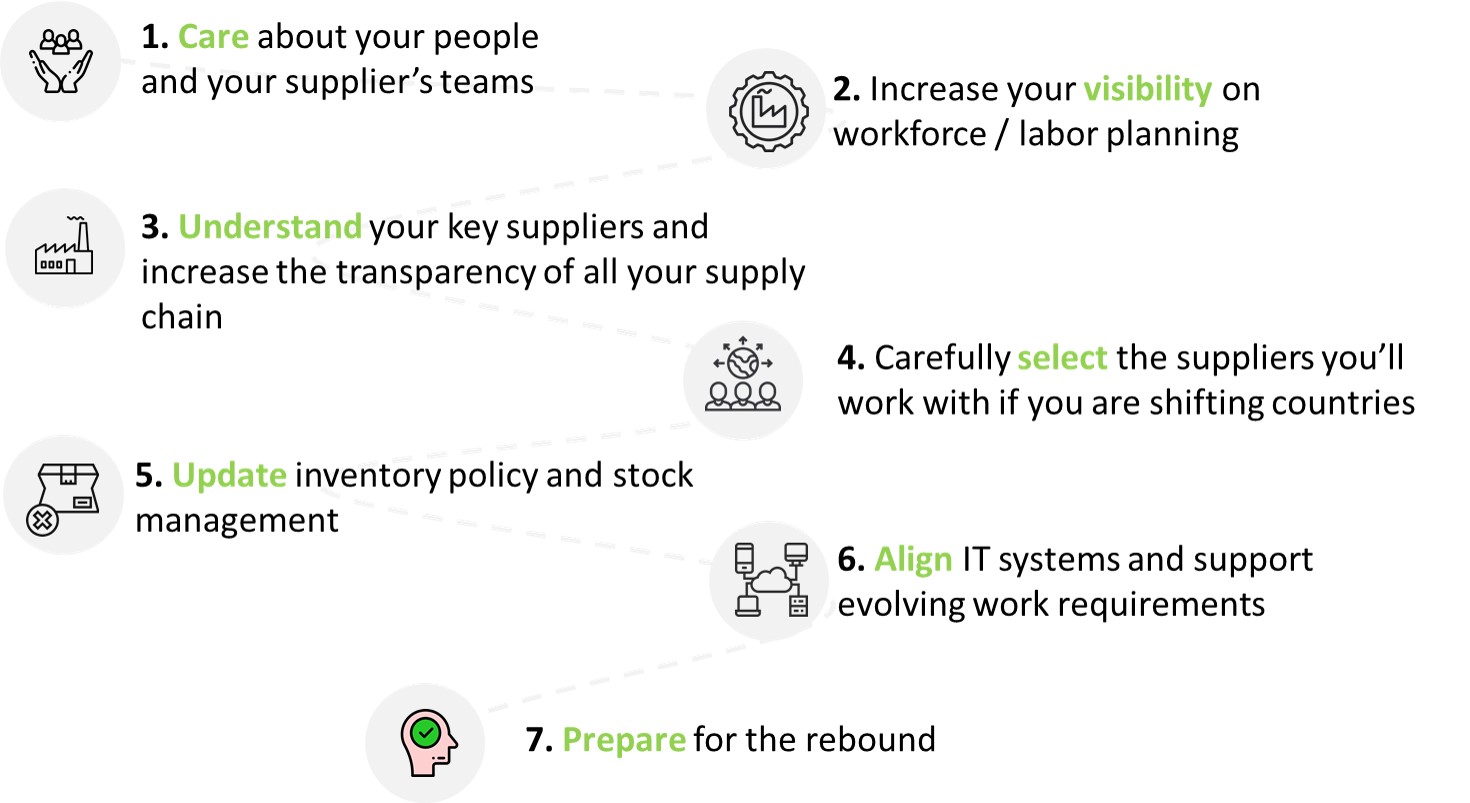
- Care about your people and your supplier’s teams
- Educate employees on COVID-19 symptoms and prevention
- Ensure your factory has screening protocols
Training and specific audits that focus on the measures to be adopted during this crisis are a good tool to ensure the health and safety of the teams.
- Increase your visibility over workforce/labor planning
- Check actual capacity of your factories
- Assess impact on production times
- Pay additional attention to product quality as plants run with fewer workers and some might hire temporary/new staff who might be unqualified
Data collection here is key: from gathering the records of the factories for a quick screening, to implementing more in-depth measures such as technical audits, in-line inspections or in-production assessment, having greater visibility of the real situation of your factories is vital at this stage to not only ensure the completion of your production on time but also the quality of the goods delivered.
- Understand your key suppliers and increase the transparency of all your supply chain
- Understand the impact your orders have on one’s factory production lines
- Understand the flexibility one factory has in regard to production / purchase shifts
Whether your orders only represent a small portion of one factory’s production lines or you are flooding these same production lines with your goods makes a huge difference as to how to interact with this factory.
If you are not a key customer, you need to make sure you understand how the factory will be dealing with your order when/if they face a shortage of staff or inventory. What flexibility do they have to shift production and purchase order fulfilment to other locations if their supplier of raw materials / components is out of stock?
- Carefully select the suppliers you’ll work with if you are shifting countries
- Ensure you’re working with the right suppliers for your productions
The concept of shifting production to other areas was already on the table before the virus appeared, with a trend among many companies toward considering moving ‘out of China’. Diversifying areas of production and looking for alternative locations can help secure additional inventory and capacity. However, launching production in a new area can be challenging if you don’t have the experience or the right teams in that specific area. A third-party company can support you with adapted solutions to facilitate the transition and ensure the quality of your production through a dedicated technician program.
- Update inventory policy and stock management
- Before = as little stock as possible
- Now = need to anticipate and increase safety stock
This might lead to associated risks such as product deterioration or mold development which can be identified via a final inspection and tackled with a warehouse condition audit or a more elaborate mold prevention program.
- Align IT systems and support evolving work requirements
- Manage quality remotely
- Use new IT tools and solutions
We are being forced to shift from a culture of ‘on-site’ work to ‘remote work’. Be ready to embrace change and to consider possibilities that were not even contemplated a few months ago, such as video-monitored inspections.
For brands, retailers and importers’ quality management teams, online quality management solutions can help manage your goods’ quality even when working from home. With a simple click of the mouse, it is now possible to keep track of your quality actions, read reports and make decisions on whether or not the goods should be shipped. Expert technicians can also be one video/phone call away, offering their support in these difficult times and finding the best possible solutions to cope with the crisis.
- Prepare for the rebound
- Be ready to move quickly
We are, without doubt, facing exceptional times and although it is impossible to anticipate when and how this epidemic will pass, we need to remain confident, align our efforts and prepare for a brighter future. Stay alert and ready for change: those that are able to adjust quickly will have a higher chance of rebounding and adapting to the times ahead.
we are in this together, and at API we are putting our manufacturing experience and product expertise at the disposal of our clients to help them adjust during this difficult time. Thanks to the agility and flexibility of our teams and our local infrastructure, we are able to quickly implement on-site and remote solutions to respond to our clients’ needs.
Do not hesitate to get in touch with us to discuss your supply chain challenges.
 purchase price of $69.38 each, resulting in revenues totaling
  A: One of greatest challenges is ensuring that each branch is able to comply with the
  international regulation?
 Let’s take a look at what Walmart did; They created what they call the Sustainability Index, which is essentially a scorecard for suppliers to be reported on from various social and environmental production factors.
Walmart has said that by the end of 2017 that 70% of its products will come from suppliers who participate through this Index, and as a benefits they will be endorsed as a sustainable partner and proud Walmart supplier.
Soluciones
Supply chain compliance is an important issue to address, with many local retail brands realising that compliance needs to be a top priority to be achieved in order to achieve a globally competitive advantage in the market.
So how do we go about achieving just that?
Let’s take a look at what Walmart did; They created what they call the Sustainability Index, which is essentially a scorecard for suppliers to be reported on from various social and environmental production factors.
Walmart has said that by the end of 2017 that 70% of its products will come from suppliers who participate through this Index, and as a benefits they will be endorsed as a sustainable partner and proud Walmart supplier.
Soluciones
Supply chain compliance is an important issue to address, with many local retail brands realising that compliance needs to be a top priority to be achieved in order to achieve a globally competitive advantage in the market.
So how do we go about achieving just that?
 1. Supply chain visibility – This refers to the data visibility made available within your supply chain; from where your raw materials come from, to your factory’s technical operations right through to your
  con procedimientos de calidad eficaces. También están al día de los últimos avances del sector y de las mejores prácticas a seguir. Como resultado, dispondrá de toda la experiencia y
 El departamento de compras de cualquier organización tiene muchas funciones, desde la adquisición de materias primas hasta las pruebas de carga de diversos artículos domésticos, pasando por el cumplimiento de las políticas. Cada uno de estos componentes requiere el liderazgo y los conocimientos técnicos de un gestor de calidad para garantizar que todo el procedimiento se lleva a cabo con eficacia y de acuerdo con las normas establecidas.
  – Todas las marcas se esfuerzan por aumentar su credibilidad en el mercado mundial; esta norma puede ayudarle a mantener esa ventaja competitiva, ya que los proveedores que la tienen suelen ser seleccionados por encima de los que no la tienen.
2. Mejora de la satisfacción del cliente - En esencia, esta norma trata de la mejora de la satisfacción del cliente, mediante una planificación minuciosa y una aplicación eficaz en la que el usuario final quede satisfecho con la funcionalidad, la calidad del producto y la forma en que se le ha entregado.
3. Mejor integración de los procesos - Comprendiendo y analizando sus procesos podrá encontrar claramente las mejoras necesarias. Éstas se basan en los datos recopilados para introducir mejoras en los procedimientos.
4. Mejore sus pruebas para la toma de decisiones - La toma de decisiones basada en pruebas se fundamenta en datos concretos. Las decisiones pueden tomarse a partir de datos que permitan una asignación adecuada de los recursos y, a su vez, supongan un ahorro para su marca.
5. Crear una cultura de mejora continua - Al inculcar un ciclo de mejora continua en su oficina de compras, no sólo aumentará sus resultados, sino también la calidad y el nivel de sus procedimientos y del producto final, además de crear esa satisfacción del cliente.
Un sistema de gestión de la calidad es esencial para garantizar
– Todas las marcas se esfuerzan por aumentar su credibilidad en el mercado mundial; esta norma puede ayudarle a mantener esa ventaja competitiva, ya que los proveedores que la tienen suelen ser seleccionados por encima de los que no la tienen.
2. Mejora de la satisfacción del cliente - En esencia, esta norma trata de la mejora de la satisfacción del cliente, mediante una planificación minuciosa y una aplicación eficaz en la que el usuario final quede satisfecho con la funcionalidad, la calidad del producto y la forma en que se le ha entregado.
3. Mejor integración de los procesos - Comprendiendo y analizando sus procesos podrá encontrar claramente las mejoras necesarias. Éstas se basan en los datos recopilados para introducir mejoras en los procedimientos.
4. Mejore sus pruebas para la toma de decisiones - La toma de decisiones basada en pruebas se fundamenta en datos concretos. Las decisiones pueden tomarse a partir de datos que permitan una asignación adecuada de los recursos y, a su vez, supongan un ahorro para su marca.
5. Crear una cultura de mejora continua - Al inculcar un ciclo de mejora continua en su oficina de compras, no sólo aumentará sus resultados, sino también la calidad y el nivel de sus procedimientos y del producto final, además de crear esa satisfacción del cliente.
Un sistema de gestión de la calidad es esencial para garantizar  2. Strategic partnerships
 3. Inventory management tactics
Managing inventory is all about balance. Making sure that you don’t have too much inventory thus face the risk of increased storage costs and a longer time to market having an effect on your return. You also need to make sure you don’t have too little inventory forcing people to shop elsewhere for a similar product. Both sides of the equation can have detrimental effects for your brand. Here we look at two inventory management tactics that are applied by two of the biggest global retailers:
3. Inventory management tactics
Managing inventory is all about balance. Making sure that you don’t have too much inventory thus face the risk of increased storage costs and a longer time to market having an effect on your return. You also need to make sure you don’t have too little inventory forcing people to shop elsewhere for a similar product. Both sides of the equation can have detrimental effects for your brand. Here we look at two inventory management tactics that are applied by two of the biggest global retailers:
 4. Quality Control
 they need products. You may find yourself at a loss with a delivery delay. Contingency plans are essential to ensuring your product gets to market. A
  1.Risk Management – Global brands take every procedure into account when understanding possible areas of risk. From sourcing to logistics to inventory management, each of these areas affects one another. If there is a problem with sourcing, it inadvertently affects the logistics of the entire operation. Therefore a brand such as Amazon needs to have a Risk Mitigation strategy that spans the entire operation.
 Miller is seen as instrumental in paving the way with greening the supply chain from using a green design for their products, to ensuring they use less harmful chemicals within the products. The only way they were able to do this was through gaining supplier buy-in. They asked their suppliers to begin complying with the zero-waste policies within their procedures.
 effectively manage their supply chains. Regionally there is the thought that this may be too expensive to apply. When it comes to technology, it is too easy to jump to the first software you find. It is essential to understand what you need technology to do for you, so that you may select the type of technology that is best suited to your needs. By doing this, you are ensuring that this is not overly costly for you and maximizes its efficiency for you.

